Monthly Archives: May 2025

Mauritius/UK: Chagos Archipelago Agreement Signed

On 22 May 2025 the UK and Mauritius signed the Agreement between the Government of the United Kingdom of Great Britain and Northern Ireland and the Government of the Republic of Mauritius concerning the Chagos Archipelago including Diego Garcia (Chagos Archipelago Agreement), which will enter into force following completion of the respective domestic procedures and notification of the other Party (Art 18). The UK requires amended primary and secondary legislation, while it is estimated the required Mauritian Ministerial decisions will take less than 6 months (Explanatory Memorandum, pp. 11-12).
From a UK perspective, “The purpose of the treaty is to secure the long-term, secure and effective operation of the UK-United States of America (US) military base on Diego Garcia, which is critical for the UK’s national security; to ensure legal certainty over the operation of the Base while respecting partners’ interests; and to uphold the international rule of law” (Explanatory Memorandum, p.2; US State Department). The UK believed the sustainability of the UK operation of the Base was at significant risk, including most notably as a result of the decisions of international courts and tribunals, including the International Court of Justice, relating to the Chagos Archipelago (Chagos Archipelago Agreement, Preamble) and the foreseeability of a future binding decision upon the UK. “Sovereignty was also routinely challenged in the Indian Ocean Tuna Commission, which carried risk of legal challenge leading to an ICJ judgment” (Explanatory Memorandum, p. 3; see further IOTC Agreement, Art 23, which might e.g. be raised in disputes on ‘coastal State’ membership, Art 4). Tellingly, this matter is addressed in Article 8 and the Exchange of Letter on the Interpretation of Article 8 of the Chagos Archipelago Agreement (22 May 2025), which provides that upon entry into force, among others, the UK confirms its membership of the Indian Ocean Tuna Commission (IOTC) in respect of Chagos Archipelago transfers to Mauritius and the UK will not claim ‘Coastal State’ but ‘Distant Water Fishing Nation’ membership status at IOTC. The Explanatory Memorandum also made it clear that Mauritius made “frequent public commitments to continue pursuing its legal campaign to secure a binding judgment. The UK government of the day (and all subsequent governments) recognised that there were multiple pathways by which Mauritius could achieve this”.

From a Mauritius perspective, the Chagos Archipelago Agreement “recognises the sovereignty of Mauritius over the entirety of the Chagos Archipelago, including Diego Garcia […] [and] marked a significant step in the completion of the decolonisation process of Mauritius” (Prime Minister Navinchandra Ramgoolam’s Remarks;  Chagos Archipelago Agreement, Preamble). Recognising the “wrongs of the past”, the Chagos Archipelago Agreement shall address the past treatment of Chagossians and their continuing welfare.

The Chagos Archipelago Agreement is designed as a comprehensive agreement in ‘full and final resolution of the differences’ related to the Chagos Archipelago and therefore addressed an array of ocean governance issues. A unique compulsory dispute settlement procedure by arbitration, which can only be triggered by the UK, is provided in Article 15(4)-(5) and Annex 4 concerning disputes on if a ground for termination exists and the dispute cannot be resolved by other means. A non-exhaustive selection of key provisions for ocean governance is provided below:

Article 1 Sovereignty
Mauritius is sovereign over the Chagos Archipelago in its entirety, including Diego Garcia.

Article 2 Authorisation in respect of Diego Garcia
1. As sovereign, Mauritius authorises the United Kingdom to exercise the rights and authorities of Mauritius with respect to Diego Garcia in accordance with the terms of this Agreement.
2. The authorisation under paragraph 1 shall comprise all rights and authorities that the United Kingdom requires for the long-term, secure and effective operation of the Base, including for the Defence and Security Requirements, Conditions and Procedures in Annex 1 and the Jurisdiction and Control Arrangements in Annex 2.
3. Mauritius retains title over the land and the territorial sea of Diego Garcia, including the seabed and subsoil, as well as all rights and authorities not authorised under paragraphs 1 and 2, including:[…]
f. sovereignty over natural resources, including fisheries;
g. conservation and protection of the environment, including the marine environment;

Article 3 Defence and Security
1. The Parties agree to the Defence and Security Requirements, Conditions and Procedures in Annex 1 […]
3. The Parties shall cooperate on matters relating to maritime security, including trafficking in narcotics, arms and persons, people smuggling and piracy.

Article 5 Environment
1. The United Kingdom shall exercise the rights and authorities under Article 2 in accordance with applicable international law on environmental protection, and with due regard to applicable Mauritian environmental laws.
2. The United Kingdom agrees to provide support and assistance to Mauritius in the establishment and management of its Marine Protected Area in the Chagos Archipelago, in accordance with terms to be agreed between the Parties by a separate written instrument.
3. The Parties shall cooperate on other matters relating to the protection of the environment, including in relation to oil and other spills, and illegal, unreported and unregulated fishing.

Article 8 International Organisations
1. The United Kingdom agrees to ensure its membership in international organisations is consistent with Article 1.

Article 12 Joint Commission
A Joint Commission to facilitate the implementation of this Agreement shall be established. The composition, functions and procedures of the Joint Commission are set out in Annex 3 [which provides for a composition of UK and Mauritius representatives, with the USA having observer status].

Article 19 Definitions
For the purposes of this Agreement: […]
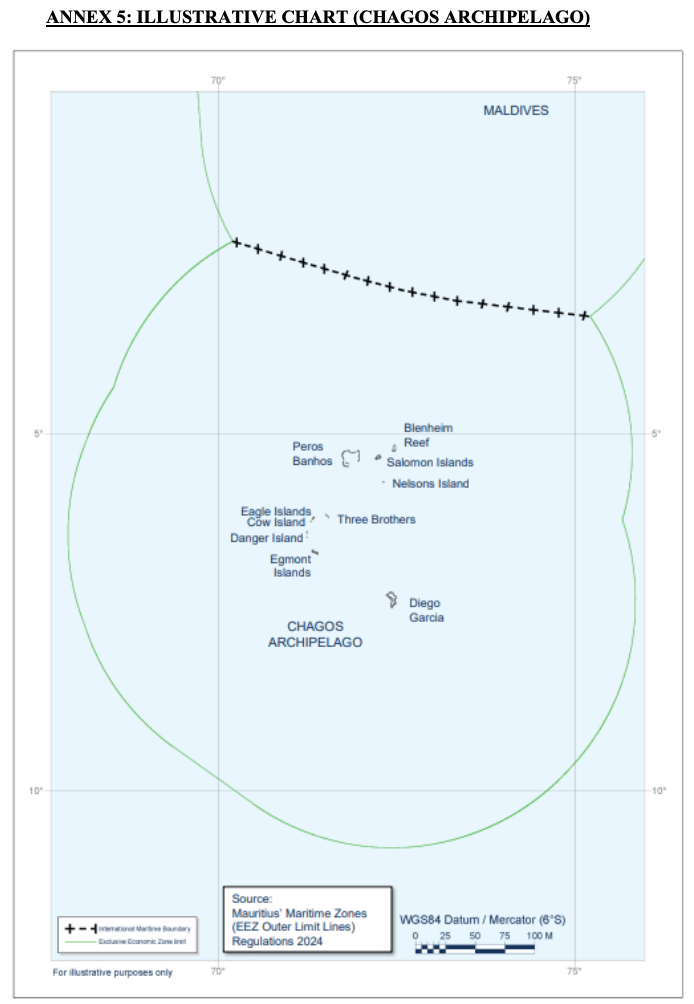
Chagos Archipelago” means the islands, including Diego Garcia, and maritime zones of the Chagos Archipelago, including the internal waters, territorial sea, archipelagic waters and the exclusive economic zone, and the airspace above and seabed and subsoil below [without prejudice to Mauritius’ claims in respect of the continental shelf].
“Diego Garcia” means the island of Diego Garcia and a twelve (12) nautical mile zone surrounding the island of Diego Garcia, and includes the airspace above and seabed and subsoil below.

Annex 1: Defence And Security Requirements, Conditions And Procedures
Diego Garcia
1. In accordance with this Agreement and with reference to Article 2(5) and Annex 2, in respect of Diego Garcia, Mauritius agrees the United Kingdom shall have:
a. unrestricted access, basing and overflight for United Kingdom and United States of America aircraft and vessels to enter into the sea and airspace of Diego Garcia;
b. unrestricted ability to: […]
v. authorise the installation, operation and repair of new and existing communication systems and electronic systems and associated cables; […]
viii. permit access, basing and overflight for non-United Kingdom and non-United States of America aircraft and vessels, upon notification to Mauritius; and
ix. manage, use and develop the land and surrounding waters and seabed for defence purposes. This excludes the construction of any artificial islands.

Chagos Archipelago beyond Diego Garcia
3. In accordance with this Agreement, in respect of the Chagos Archipelago beyond Diego Garcia, Mauritius agrees:
a. vessels and aircraft of the United Kingdom and the United States of America shall have unrestricted rights of overflight, navigation and undersea access. States operating with the United Kingdom or the United States of America shall also have such unrestricted rights, save in respect of overflight or undersea access, which require notification;
b. the United Kingdom shall have rights of access for maintenance and upgrades of equipment, following notification to Mauritius, after having advised Mauritius of the location of all such equipment; […]
f. between twelve (12) and twenty-four (24) nautical miles surrounding the island of Diego Garcia, Mauritius and the United Kingdom shall jointly decide on the construction or emplacement of any maritime installation, sensor, structure or artificial island.

Mauritian Security Review
4. Before approving or proceeding with a proposal for:
a. the construction or emplacement of any maritime installation, sensor, structure or artificial island in an area beyond the twenty-four (24) nautical miles surrounding the island of Diego Garcia; or
b. any proposal for development in the land territory of the Chagos Archipelago beyond Diego Garcia, Mauritius shall conduct a Security Review in accordance with paragraph 6 [which provides for information exchanges with the UK, as well as possible decision making by the Joint Commission. An emerging risks procedure is also found in para 7].

11. For the purposes of this Annex:
a. “access” refers to the grant of rights or permissions which would not otherwise exist in international law. Nothing in this Agreement modifies or affects any rights, including rights of overflight or navigation, which exist as a matter of international law;
b. “Chagos Archipelago beyond Diego Garcia” means any area within the Chagos Archipelago that is beyond Diego Garcia;
c. “unrestricted” means not requiring permission or notification, subject to the standing authorisations and notifications separately agreed between the Parties to meet the requirements of international or domestic Mauritian law or current practice.

Annex 2: Jurisdiction And Control Arrangements
Mauritian criminal jurisdiction
3. On Diego Garcia, Mauritius shall exercise all prescriptive, enforcement and adjudicative criminal jurisdiction conferred on it by its laws in relation to allegations against […]
b. all persons not connected to the operation of the Base, including persons involved in offences relating to unlicensed commercial fishing and the trafficking in arms or narcotics.

Cooperation in the exercise of criminal jurisdiction
8. In order to support the exercise of jurisdiction by Mauritius on Diego Garcia, the United Kingdom agrees to provide assistance to Mauritius in: […]
e. the prevention of unlicensed commercial fishing, and trafficking of arms, persons and narcotics and illegal migration.

Miscellaneous
15. Mauritius shall exercise criminal and civil jurisdiction in respect of activities such as irregular migration and unlicensed commercial fishing, provided such exercise of jurisdiction is in conformity with the requirements of this Agreement.

Chagos Archipelago Agreement (2025)

Finally, the signing of the Chagos Archipelago Agreement was accompanied by the signing of a new Strategic Partnership Framework. Among other items, it will address:

  • Deepening cooperation on maritime security and irregular migration in areas such as “irregular migration, drugs trafficking, piracy, and illegal, unregulated and unreported fishing”. This will include “Cooperation agreements and capacity building to secure Mauritius’s Exclusive Economic Zone; Consideration of patrolling capability across the Chagos Archipelago to support a secure maritime domain; Cooperation to counter and manage irregular migration; and Provision of training and institutional partnerships to boost Mauritian maritime security capability and strengthen fisheries protection”.
  • Cooperation in addressing climate change. This will include “Mitigation and adaptation projects to tackle the immediate effects of climate change including coral restoration, coastal erosion and indigenous species conservation; and Technical expertise to develop and manage the Chagos Archipelago Marine Protected Area, pursuant to the agreement on the exercise of sovereignty over the Chagos Archipelago”.

For further information, see previous reporting.

Leave a comment

Filed under Jurisprudence, State Practice, Treaties

CoE: Adoption of Convention on the Protection of the Environment through Criminal Law

On 14 May 2025 the Committee of Ministers of the Council of Europe (CoE) adopted the Council of Europe Convention on the Protection of the Environment through Criminal Law. The date of opening for signature will be decided later (anticipated to be in 2025) and the Convention will enter into force following 10 Signatories expressing their consent to be bound, including at least eight Member States of the Council of Europe (Art 53).

The Convention builds upon numerous international treaties with extraterritorial application to the oceans, including –but not limited– to MARPOL, SOLAS, UNCLOS and the Hong Kong Convention. Indeed, the Convention provides:

Recognising that environmental crime has a negative impact on economies, public health, human safety, food security, livelihoods and habitats;
[…]
Recognising that environmental crime increasingly has extraterritorial effects and takes the form of international trafficking, which, along with the acceleration of degradation phenomena (climate change, erosion of biodiversity, depletion of natural resources, destruction of habitats, etc.), prompts the need for general minimum standards in criminal law as part of a common and collaborative international framework;

Council of Europe Convention on the Protection of the Environment through Criminal Law, Premable

The Convention seeks to effectively prevent and combat environmental crime, promote and enhance national and international co-operation against environmental crime and establish minimum rules to guide States in their national legislation (Art 1(1)). Reflecting the period in which the Committee of Experts was drafting the Convention, the Convention explicitly remains applicable in times of peace and in situations of armed conflict, wartime or occupation (Art 2(2)). The application of human rights at sea are evident in its provisions, including non-discrimination (Arts 4, 49, 51(1); see further ECHR, Art 14).

26 Articles address substantive crimes for which Parties shall take the necessary legislative or other measures for their prevention (Art 10). Parties shall also take effective, proportionate and dissuasive sanctions against offenders (Art 35). Substantive crimes shall include inciting or aiding said offences, as well as attempting to commit certain offences (Art 32). Offences with application in an ocean context include: unlawful pollution (Art 12); import or export of regulated chemical substances (Art 14); transport, import, export or disposal of radioactive material or substances (Art 15); import or export of mercury, mercury compounds and mixtures of mercury and mercury-added product (Art 16); import, export, use or release of ozone-depleting substances, or the import or export of products and equipment containing or relying on such substances (Art 17); import, export, use or release of fluorinated greenhouse gases, or the import of products and equipment containing or relying on such gases (Art 18); transport, shipment or disposal of waste (Art 19); operation or closure of an installation in which a dangerous activity is carried out (Art 20; including floating installations – Explanatory Report (paras 123-124); recycling of ships (Art 22); ship-source discharges (Art 23); mining (Art 26); killing, destruction, taking, possession and transboundary trade of protected wild fauna or flora (Arts 27 and 28(2)); deterioration of habitats within a protected site (Art 29) transporting, releasing or spreading invasive alien species (Art 30); and a ‘particularly serious offence’ (Art 31; Explanatory Report (para 172 including ‘ecocide’).

Parties must establish jurisdiction over the defined offences in an ocean context in a number of explicit cases:

  • The coastal State for offences committed in its territory, including the internal waters and territorial sea and, for archipelagic States, the archipelagic waters (Art 33(1)(a)) (‘historic waters’ claims are on a case-by-case basis, but would usually fall within the ‘territory’ and thus obligations of the coastal State under this Convention);
  • The flag State for offences committed on board a ship flying their flag (Art 33(1)(b));
  • The State of registry for offences on board an aircraft registered under its laws (Art 33(1)(c));
  • The State of nationality for offences committed by one of its nationals (regardless of the flag State or maritime zone in which the offence occured (Art 33(1)(d));
  • Application of the ‘extradite or prosecute‘ principle (Art 33(3)).

Parties may consider to establish jurisdiction over offences committed against one of their nationals (passive personality principle; Art 33(2)). For more information see here.

Leave a comment

Filed under State Practice, Treaties

2025 London International Boundary Conference

King’s College London and Volterra Fietta will co-host the 7th London International Boundary Conference12-13 June 2025, in a hybrid format (King’s College London/Online). For more information see here and here.

Leave a comment

Filed under Events

PCA: Ruling in UK-Sandeel Fisheries Dispute

On 28 April 2025 an Arbitral Tribunal  (Trade and Cooperation Agreement (TCA), Article 740) established in UK-Sandeel (The European Union v. the United Kingdom of Great Britain and Northern Ireland) issued its Ruling. The European Union challenged the UK’s sandeel fishing prohibition which is composed of two distinct measures (one measure taken by the Scottish Government in respect of Scottish waters and one measure taken by the UK Government in respect of English waters) but both being attributable to the UK as a Contracting Party to the Trade and Cooperation Agreement (Ruling, paras 418-427). In essence the EU challenged the two measures on the basis (a) the fisheries management measures were not based on ‘best available science’ (TCA, Art 496(2)) and (b) the fisheries management measures did not have regard to agreed principles, namely proportionality and non-discrimination (TCA, Art 494(3)(f)). When interpreting the TCA, the Arbitral Tribunal included UNCLOS, WTO Agreements, and fisheries instruments, in particular the FAO Code of Conduct, among the relevant rules of international law.

So long as they are consistent with the TCA, the Parties agreed that fisheries management measures, including fishing prohibitions which impair the rights of a Party, may be adopted to pursue legitimate objectives in respect of the marine environment. The Tribunal affirmed that the rights of other States imposes limits of the exercise of coastal State rights, but “that there is no obligation under UNCLOS to grant access to the surplus of the allowable catch to a particular State” (paras. 447-448). The TCA reaffirms that Parties granted access to the waters of another Party have access conditioned by compliance with the conservation and management measures adopted, and said Party must ensure compliance by its vessels (para 463). But, the TCA does not leave Parties with unfettered regulatory autonomy in respect of fisheries management. The Tribunal agreed that “the requirements laid down in Article 494, Article 496 and Annex 38 to the TCA are important limits to the exercise of regulatory autonomy to adopt fisheries management measures” (para. 467).

The Arbitration Tribunal found that both the English and the Scottish parts of the measure were based on best available scientific advice and that there was an objective connection between the scientific advice and the sandeel fishing prohibition in UK waters:

593. The Arbitration Tribunal therefore finds that the European Union has failed to demonstrate that the sandeel fishing prohibition in UK waters is inconsistent with the United Kingdom’s obligations under Article 496(1) and 496(2) of the TCA, read together with Article 494(3)(c) of the TCA.

On proportionality and non-discrimination, the Tribunal noted the principles must inform the decision-making process on fisheries management measures. “[C]onsideration will be informative but not determinative of the decision to adopt a measure” (para 605).

Proportionate measures “must be adopted ‘for the conservation of marine living resources and the management of fisheries resources’ and be [an] apt or appropriate [means] to secure or contribute to that objective'”, including a weighing and balancing of the measure’s environmental, economic and social costs and benefits (paras 623-624).

On the measure concerning English waters:

689. The failure to take into account the rights of the European Union under the TCA and their systemic importance in securing stability during the adjustment period compromised the weighing and balancing exercise such that the Arbitration Tribunal is of the view that the decision-maker did not have regard to the principle of applying a proportionate measure.
690. For the above reasons, the Arbitration Tribunal finds that the United Kingdom’s decision to close English waters to sandeel fishing was inconsistent with the requirement in Article 496(1), read together with Article 494(3)(f) of the TCA, to have regard to the principle of applying a proportionate measure for the conservation of marine living resources and the management of fisheries resources.

On the measure concerning Scottish waters:

725. Regard was had not only to the benefits of the sandeel prohibition in Scottish waters, but also to the economic costs to the UK and EU fishing and processing industries and the impairment of the rights of the European Union during the adjustment period. Furthermore, these considerations were applied in the actual weighing and balancing that was undertaken by the Scottish decisionmaker. Attention was paid to the TCA adjustment period, ending 30 June 2026, and the need to take measures to build the resilience of Scottish seabird populations due to recent significant declines. In this, the Scottish decision can be contrasted with that of the United Kingdom in respect of the sandeel fishing prohibition in English waters.
726. The Arbitration Tribunal, therefore, finds that the Scottish measure to close Scottish waters to sandeel fishing is not inconsistent with the requirement in Article 496(1), read together with Article 494(3)(f) of the TCA, to have regard to the principle of applying a proportionate measure. As explained above, the decision-maker had regard to the principle of applying a proportionate measure as it took into account the relevant considerations and applied these in a weighing and balancing exercise, thereby satisfying the requirement to “have regard to” the principle of applying a proportionate measure.

On non-discrimination, the Tribunal noted “the principle applies to the measure itself, its application and its consequences, and refers to both de jure and de facto discrimination. This requires consideration of whether the design, content and application of the measure reflects the principle of non-discrimination” (para 631). The EU claim concerned de facto discrimination. “De facto discrimination may occur where differential treatment is not based on a legitimate regulatory objective or where there is a lack of a clear nexus between the differential treatment and the regulatory objective” (para 730). The Tribunal found:

731. […] The differential impact on vessels of the United Kingdom and European Union is due to the quota shares set out in Annex 35 to the TCA.
732. The Arbitration Tribunal does not consider that a Party is required to take into account the TAC quota shares in deciding on a fisheries management measure. Rather, each measure should be decided on in light of its legitimate objectives and the requirement to have regard to applying the principle of non-discrimination […]
733. The Arbitration Tribunal considers that there is a clear nexus between the differential treatment and the legitimate objective, which is to close all UK waters to all UK and EU vessels in order to provide ecosystem benefits.
734. For the above reasons, the Arbitration Tribunal finds that the United Kingdom’s decision to close UK waters to sandeel fishing was not inconsistent with the requirement in Article 496, read together with Article 494(3)(f) of the TCA, to have regard to the principle of applying nondiscriminatory measures for the conservation of marine living resources and the management of fisheries resources.

On the alleged breach of the obligation to grant full access to fish sandeel pursuant to Annex 38 to the TCA:

743. The Arbitration Tribunal is of the view that the European Union has structured its claim of a breach of Article 2(1)(a) of Annex 38 as a purely consequential claim. The claim for a breach of Article 2(1)(a) of Annex 38 therefore stands or falls on the basis of the findings in respect of the claims under Article 496, read together with Article 494 of the TCA. In this sense “the consequential element is symmetrical”. Once a breach of Article 496(1), read together with Article 494, has been found, that is the end of the Arbitration Tribunal’s remit.
744. The Arbitration Tribunal therefore finds, on the basis of its reasoning in Section V.D.3 that the United Kingdom’s decision to close English waters to sandeel fishing was inconsistent with the requirements of Article 496(1), read together with Article 494(3)(f) of the TCA, to have regard to the principle of applying a proportionate measure for the conservation of marine living resources and the management of fisheries resources, and that in consequence, therefore, there has been a breach of Article 2(1)(a) of Annex 38 of the TCA.

For further information see previous reporting.

Leave a comment

Filed under Jurisprudence, State Practice

CLCS: Recommendations approved regarding Brazilian, Cuban and Icelandic submissions

The Sixty-Third Session of the Commission on the Limits of the Continental Shelf (CLCS) was held, 17 February–21 March 2025, at United Nations Headquarters (New York, USA). As noted in the progress statement of the chair (UN Doc. CLCS/63/2), the CLCS, pursuant to Article 76(8) of UNCLOS, approved three sets of recommendations concerning three submissions on the limits of the continental shelf beyond 200 nautical miles from the respective baselines of three Coastal States:

At the time of reporting, only the summary of the Recommendations of the Commission concerning the Brazilian Equatorial Margin is currently public.

Leave a comment

Filed under International Organizations, State Practice

Conference: Marine and Environmental Law – Retrospect and Prospects

The Marine & Environmental Law Program (MELP) and Marine & Environmental Law Institute (MELAW) of Dalhousie University will host a conference, entitled, Marine and Environmental Law: Retrospect and Prospects, 20-21 May 2025, in a hybrid format (Halifax, Canada/Online). A call for engaged listeners has been issued, with a deadline for registration of 16 May 2025. For further information see here.

Leave a comment

Filed under Calls, Events

Call for Abstracts: Emerging Issues in Marine Environment and Law of the Sea

The Ocean Governance, Research and Development Project (University of Ghana) will host its second international ocean governance conference, themed, Emerging Issues in Marine Environment and the Law of the Sea, 2-4 September 2025. Abstracts are welcome until 10 June 2025.

Leave a comment

Filed under Calls, Events

USA: Executive Order on Offshore Minerals and Resources

On 24 April 2025, the President of the United States issued an Executive Order, entitled, Unleashing America’s Offshore Critical Minerals and Resources. The Order addresses policies directed at seabed mineral exploration and exploitation both within the U.S. continental shelf and in areas beyond national jurisdiction (the Area), as well as processing capacity in the United States or on United States-flagged vessels, and possible partnering with other States in exploiting the resources of their continental shelf/EEZ.

Of particular note for the law of the sea is the (a) possibility of a unilateral exploration and exploitation regime concerning the mineral resources of the Area (contra, Part XI of UNCLOS) and (b) the possibility of the unilateral definition and implementation of an international benefit-sharing mechanism (contra, the principle of the common heritage of humankind):

Sec. 3.  Strategic Seabed Critical Mineral Access.  Within 60 days of the date of this order:
(a)  The Secretary of Commerce shall:
(i) acting through the Administrator of the National Oceanic and Atmospheric Administration, and in consultation with the Secretary of State and the Secretary of the Interior, acting through the Director of the Bureau of Ocean Energy Management, expedite the process for reviewing and issuing seabed mineral exploration licenses and commercial recovery permits in areas beyond national jurisdiction under the Deep Seabed Hard Mineral Resources Act (30 U.S.C. 1401 et seq.), consistent with applicable law.  The expedited process, consistent with applicable law, should ensure efficiency, predictability, and competitiveness for American companies;
[…]
The Secretary of Commerce […] shall […] provide a joint report […] on the feasibility of an international benefit-sharing mechanism for seabed mineral resource extraction and development that occurs in areas beyond the national jurisdiction of any country.

Unleashing America’s Offshore Critical Minerals and Resources

On 25 April 2025 a Spokesperson for the Foreign Ministry of China stated China’s objections to both the proposed exploration and exploitation of mineral resources of the Area/beyond national jurisdiction, as well as the exploration and exploitation of mineral resources on the extended continental shelf of the U.S (the delimitation of which China does not recognise).

On 29 April 2025, The Metals Company (TMC) announced that its U.S. subsidiary, The Metals Company USA LLC (TMC USA), has submitted applications for a commercial recovery permit and two exploration licenses under the Deep Seabed Hard Mineral Resources Act (DSHMRA) and National Oceanic and Atmospheric Administration (NOAA) implementing regulations. This is an expedited timeline ahead of what was previously reported, which already raised preliminary discussions at the Council of the International Seabed Authority.

On 30 April 2025, the Secretary-General of the International Seabed Authority issued a Statement on the US Executive Order (for previous statements, see here), taking note of the order and raising specific concerns, including in respect of the ISA regime and the common heritage principle. The SG-ISA states her view that:

Its issuance is also surprising because for over 30 years the US has been a reliable observer and significant contributor to the negotiations of the International Seabed Authority, actively providing technical expertise to each stage of the development of the ISA regulatory framework.
[…]
[G]eneral principles of international law and customary international law proclaims the Area and its resources as the Common Heritage of Humankind. A direct corollary of this legal status is that no State may claim, acquire, or exercise sovereignty or sovereign rights over any part of the Area or its mineral resources. This includes a prohibition on appropriation and alienation by any State, or by any natural or juridical person.
The Convention and the 1994 Agreement further establishes the International Seabed Authority, clearly mandating that all activities related to mineral resources in the Area must be conducted under the Authority’s oversight to ensure sustainable use, equitable benefit-sharing, and environmental protection. Accordingly, exploration and exploitation activities in the Area must be carried out under the Authority’s control, that is, under a contract with the Authority and in accordance with the rules, regulations, and procedures it establishes; and no State has the right to unilaterally exploit the mineral resources of the Area outside the legal framework established by UNCLOS. It is common understanding that this prohibition is binding on all States, including those that have not ratified UNCLOS.

Statement on the US Executive Order

Leave a comment

Filed under International Organizations, State Practice