Monthly Archives: April 2025

IMO: Marine Environment Protection Committee approves IMO Net-Zero Framework and North-East Atlantic Ocean Emissions Control Area

The 83rd Session of the IMO Marine Environment Protection Committee (MEPC) occurred 7–11 April 2025 at IMO Headquarters (London, UK). Among numerous agenda items and outcomes, significant and long awaited amendments to Annex VI of MARPOL, including the additions of a Chapter 5: Regulations on the IMO Net-Zero Framework, and the designation of the North-East Atlantic as an Emission Control Area (ECA) under MARPOL, Annex VI, Regs 13-14.

The Regulations of the IMO Net-Zero Framework would, subject to exceptions, apply to all ships of 5,000 gross tonnage and above (Reg 30), with the defined objective (Reg 31):

“1 The goal of this chapter is to reduce greenhouse gas (GHG) emissions from international shipping as soon as possible, delivering on the reduction targets set out in the 2023 IMO Strategy on Reduction of GHG Emissions from Ships, 67 effectively promoting the energy transition of shipping and providing the world fleet with a needed incentive while contributing to a level playing field and a just and equitable transition”.

IMO Secretariat, Circular Letter No.5005 (2025) p. 53.

As summarised by IMO Secretariat, the IMO Net- Zero Framework will principally provide:

Global fuel standard: Ships must reduce, over time, their annual greenhouse gas fuel intensity (GFI) – that is, how much GHG is emitted for each unit of energy used. This is calculated using a well-to-wake approach. 

Global economic measure: Ships emitting above GFI thresholds will have to acquire remedial units to balance its deficit emissions, while those using zero or near-zero GHG technologies will be eligible for financial rewards”. 

Ships operating within the North-East Atlantic Emission Control Area (ECA) will be subject to Regulation 13 addressing particular requirements concerning Nitrogen oxides (NOx) and Regulation 14 addressing particular requirements concerning sulphur oxides (SOx) and particulate matter. The North-East Atlantic Emission Control Area will be the area described by the coordinates provided in para 7 of Appendix VII to Annex VI of MARPOL, summarised as:

“6. The North-East Atlantic Emission Control Area (NE Atlantic ECA) encompasses the Exclusive Economic Zones (EEZ) and territorial seas, extending up to 200 nautical miles from the baselines of Greenland, Iceland, the Faroes, Ireland, the mainlands of the United Kingdom, France, Spain and Portugal. This designation excludes the seas bounded by the North Sea area, as defined in regulation 1.14.6 of Annex V of the present Convention”.

IMO Secretariat, Circular Letter No.5005 (2025) p. 98.
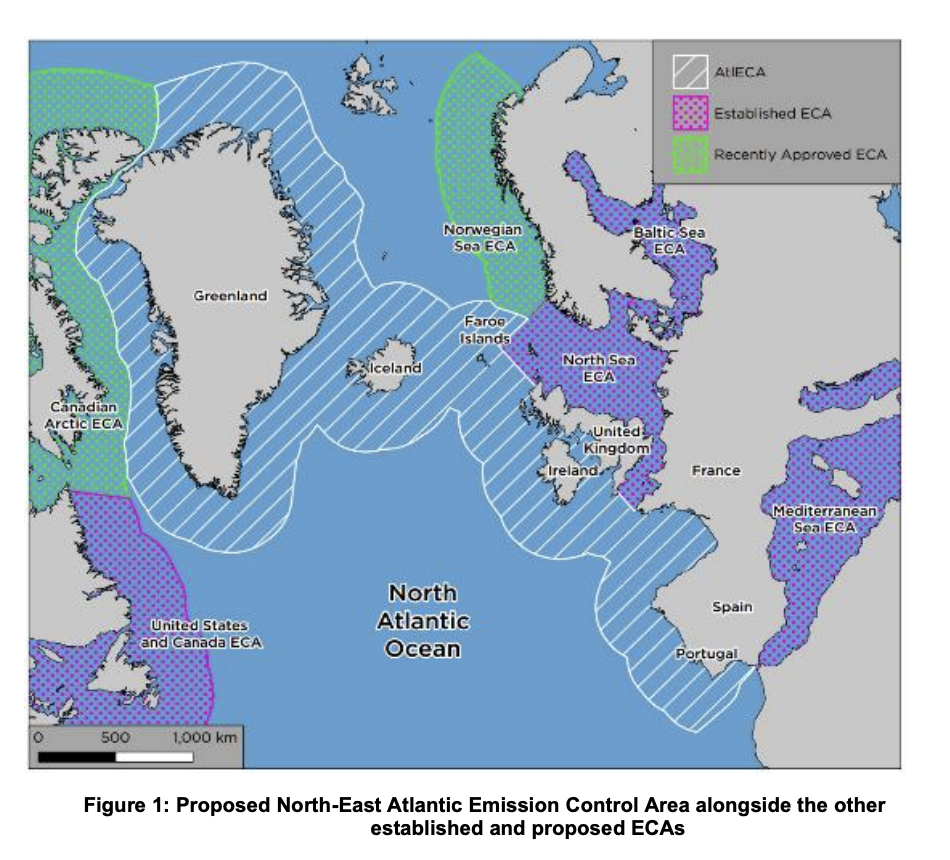
Proposal to designate the North-East Atlantic Ocean as an Emission Control Area for sulphur oxides, particulate matter and nitrogen oxides (MEPC 83/12)

The approved draft amendments to Annex VI of MARPOL anticipate being formally adopted at an extraordinary session of the Marine Environment Protection Committee (14-17 October 2025), which would foresee an entry into force 16 months later, under the tacit acceptance procedure, i.e. 17 February 2027. Two Particularly Sensitive Sea Areas (PSSAs) were, in principle, agreed for designation (“Reserva Nacional Dorsal de Nasca” (Nasca Ridge National Reserve) and “Reserva Nacional Mar Tropical de Grau” (Grau Tropical Sea National Reserve)), but Peru was invited to further develop the proposed associated protective measures for submission and approval consideration at the 84th MEPC Session.

1 Comment

Filed under International Organizations

Competitions: 2025 China ILOSMCC

The China Institute of Boundary and Ocean Studies (CIBOS) at Wuhan University and the Chinese Society of the Law of the Sea (CSLOS) announced the new edition of the China International Law of the Sea Moot Court Competition (2025 CHINA ILOSMCC). The oral rounds of the competition have been scheduled to take place on 25-26 October 2025. Registration is open until 26 May 2025. Further information is available here.

Leave a comment

Filed under Competitions

HRC: The human right to a clean, healthy and sustainable environment – the ocean and human rights

On 3 April 2025, the UN Human Rights Council adopted with a vote a resolution, entitled, Human right to a clean, healthy and sustainable environment: ocean and human rights (A/HRC/58/L.26/Rev.1). Among other important statements and calls, the Resolution provides:

Affirming that respect for and the protection and fulfilment of the human right to a clean, healthy and sustainable environment contribute to addressing ocean degradation, and at the same time recognizing that maintaining a healthy and clean ocean contributes to the protection of a range of human rights,
[…]
Emphasizing the importance of States taking decisive action to address plastic pollution throughout the full life cycle of plastic, including in the marine environment, and highlighting the specific and severe impacts of plastic pollution, climate change and biodiversity loss on the ocean, which jeopardize the realization of human rights, including the human right to a clean, healthy and sustainable environment, while underscoring the transboundary nature of plastic pollution and the need for enhanced global cooperation to effectively address this crisis,
[…]
Recognizing the guidance provided by the International Tribunal for the Law of the Sea in its advisory opinion in reply to the Request for an advisory opinion submitted by the Commission of Small Island States on climate change and international law rendered on 21 May 2024, on the obligation of States to protect the ocean from climate change drivers and impacts,
[…]
Noting with satisfaction that States have recognized that the ocean, seas and coastal areas form an integrated and essential component of the Earth’s ecosystem and are critical to ensure its sustainability, and that international law, including the United Nations Convention on the Law of the Sea and its implementing agreements, provides the legal framework for the conservation and sustainable use of the ocean and its resources, […]
5. Calls upon States:
(a) To respect, protect and fulfil human rights, including in all actions undertaken to address environmental challenges, including climate change, marine biodiversity loss, pollution and land degradation;
(b) To adopt and implement strong laws ensuring, among other things, the rights to participation, to access to information and to justice, including to an effective remedy, in environmental matters;
[…]
(g) To establish, maintain and strengthen effective legal and institutional frameworks to regulate the activities of public and private actors in order to prevent, reduce and remedy harm to biodiversity and ecosystems, taking into account human rights obligations and commitments relating to the enjoyment of a clean, healthy and sustainable environment;
(h) To implement, in all their activities, the precautionary principle or precautionary approach, as appropriate, for the effective protection of marine and coastal ecosystems;
[…]
6. Encourages States:
(a) To adopt ecosystem-based integrated, intersecting and holistic national and local policies and an effective legal framework that acknowledges the need to protect and restore the ocean for the enjoyment of the human right to a clean, healthy and sustainable environment;
[…]
(e) To cooperate with other States to advance the protection, conservation and remediation of the ocean and coastal areas, including through the implementation of international law and the incorporation of international human rights law obligations, standards and guidelines for ocean management;
[…]
(o) To ratify the Agreement under the United Nations Convention on the Law of the Sea on the Conservation and Sustainable Use of Marine Biological Diversity of Areas beyond National Jurisdiction;
[…]
11. Calls upon all States to conserve, protect and restore healthy ecosystems and biodiversity and to ensure their sustainable management and use by applying a human rights based approach that emphasizes participation, inclusion, transparency and accountability in the management of natural resources;

HRC Resolution:Human right to a clean, healthy and sustainable environment: ocean and human rights

Leave a comment

Filed under International Organizations

Summer School: Kadir Has Law of the Sea 2025

Kadir Has University shall host an International Law of the Sea Summer Academy21 July-6 August 2025, Istanbul (Türkiye). For more information see here.

Leave a comment

Filed under Courses

ISA: Secretary-General and Delegates Respond to TMC Announcement Concerning Seabed Mining Permits under US Regulation

On 27 March 2025, The Metals Company (TMC) released a press release which included the announcement:

“that its subsidiary The Metals Company USA LLC (“TMC USA”) has formally initiated a process with NOAA under the U.S. Department of Commerce to apply for exploration licenses and commercial recovery permits under existing U.S. legislation, the Deep Seabed Hard Mineral Resources Act of 1980 (DSHMRA)”

On 28 March 2025, ISA Secretary-General Leticia Carvalho issued a statement that brought the matter and the ISA-SG’s concerns to the attention of the members of the Council as a matter which may be of interest to the Council. The Council decided to discuss the announcement under ‘other matters’. The USA is not a Party to UNCLOS. The opinion of the ISA-SG stressed:

Any unilateral action would constitute a violation of international law and directly undermine the fundamental principles of multilateralism, the peaceful use of the oceans and the collective governance framework established under UNCLOS.
For over three decades, the absence of claims under any regime outside Part XI has demonstrated the international community’s strong confidence—including that of States not party to the Convention—in the system developed through the Authority.

Statement by Madam Secretary-General of the International Seabed Authority, Leticia Carvalho (28 March 2025)

As reported in Earth Negotiations Bulletin, numerous States expressed serious concerns about the reported intent of TMC USA. Numerous States emphasised that “the seabed, subsoil, and resources thereof in the Area are the common heritage of humankind and under the exclusive mandate of ISA” (Sierra Leone for the African Group, Argentina, The Bahamas, Belgium, Brazil, Cameroon, Chile, China, The Cook Islands, Costa Rica, Denmark, Fiji, Germany, Ghana, Greece, India, Indonesia, Italy, Jamaica, Japan, Lesotho, Mauritius, Mexico, The Netherlands, New Zealand, Norway, Poland, The Philippines, Portugal, The Russian Federation, Singapore, Spain, Switzerland, Trinidad And Tobago, The UK, and Zimbabwe). The common heritage principle, as applicable to the Area and its resources, is codified in Article 136 of UNCLOS, as well as relevant UN General Assembly Resolutions (Brazil, Greece and Mexico).

Numerous States also emphasised Article 137(1) of UNCLOS, which provides “No State shall claim or exercise sovereignty or sovereign rights over any part of the Area or its resources, nor shall any State or natural or juridical person appropriate any part thereof. No such claim or exercise of sovereignty or sovereign rights nor such appropriation shall be recognized” (Brazil, Greece, Mexico and others). “Germany and others noted Article 137 as customary international law”, while “France called for preserving the integrity and universality of the UNCLOS legal framework”.

Ireland, Jamaica, Singapore, and others rejected the TMC assertion that because the ISA has not yet adopted the Exploitation Regulations the ISA is somehow “in breach of its treaty obligations under UNCLOS and the 1994 Agreement”. Observers were critical of the timing of the TMC announcement and intentions perceived thereof.

Leave a comment

Filed under International Organizations, Non-State Actors, State Practice

Portugal: Law 36/2025 Establishing A Moratorium on Seabed Mining in Portugal’s Maritime Zones

On 31 March 2025 Portugal published Law 36/2025 (Diário da República n.º 63/2025, Série I de 2025-03-31) which seeks to establishes a moratorium on deep-sea mining in the maritime zones of Portugal until 2050 (Art 1). This is principally done through the addition of Article 11-A to Law 17/2014 (Diário da República n.º 71/2014, Série I de 2014-04-10), which concerns Portugal’s marine spatial planning and management:

Article 11-A
Moratorium
A moratorium on ocean floor mining in the national maritime space is hereby established, covering prospecting and exploration activities, until 1 January 2050

Law 36/2025, Article 3 (machine translation)

Of note, the external objectives of Portugal’s framework climate policy, as found in Article 15 of Law No. 98/2021 (Diário da República n.º 253/2021, Série I de 2021-12-31), is also amended with the addition of:

Article 15.
Climate foreign policy
1 – The Government adopts a global and integrated vision of the pursuit of climate objectives, respecting the limits of sustainable use of the planet’s natural resources and the development paths of each country, actively defending, in terms of foreign policy within the framework of climate diplomacy:
[…]
(g) The establishment of an international moratorium on deep-sea mining, as long as this is justified by the precautionary principle.

Law 36/2025, Article 4 (machine translation)

Leave a comment

Filed under State Practice