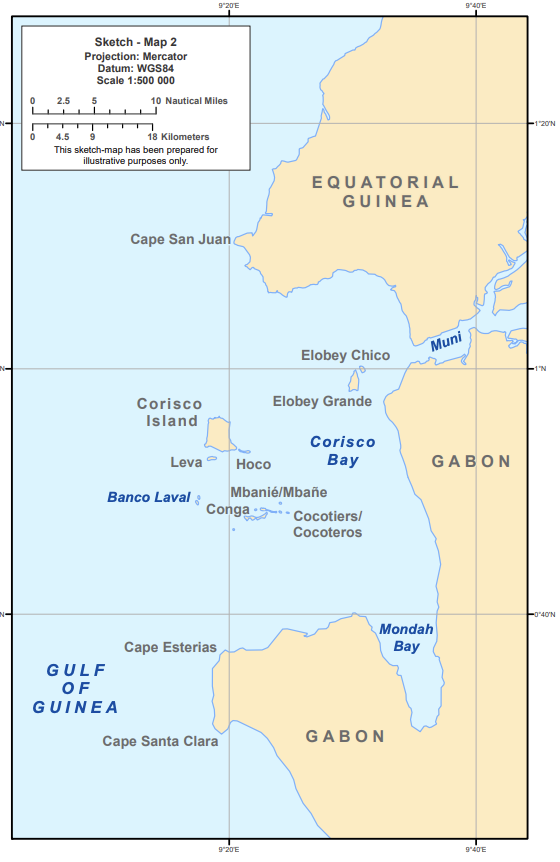
On 19 May 2025 the ICJ delivered its Judgment in Land and Maritime Delimitation and Sovereignty over Islands (Gabon/Equatorial Guinea). Despite the name of the case, the “Court has not been asked therein to delimit the land and maritime boundary or determine sovereignty over the three islands, but only to determine whether the legal titles, treaties and international conventions invoked by the Parties have the force of law in their relations in so far as they concern the dispute between them” (Judgment, para 30). This is detailed in Article 1 of the Special Agreement (2016) which conferred jurisdiction on the ICJ to resolve the dispute.
The operative paragraph of the Judgment provides:
For these reasons, The Court,
(1) By fourteen votes to one,
Finds that the document entitled “Convention delimiting the land and maritime frontiers of Equatorial Guinea and Gabon” (“Bata Convention”) invoked by the Gabonese Republic is not a treaty having the force of law in the relations between the Gabonese Republic and the Republic of Equatorial Guinea and does not constitute a legal title within the meaning of Article 1, paragraph 1, of the Special Agreement;
(2) Unanimously,
Finds that the legal titles invoked by the Gabonese Republic and the Republic of Equatorial Guinea that have the force of law in the relations between them in so far as they concern the delimitation of their common land boundary are the titles held on 17 August 1960 by the French Republic and on 12 October 1968 by the Kingdom of Spain on the basis of the Special Convention on the delimitation of French and Spanish possessions in West Africa, on the coasts of the Sahara and the Gulf of Guinea, signed in Paris on 27 June 1900, to which titles the Gabonese Republic and the Republic of Equatorial Guinea respectively succeeded;
(3) By thirteen votes to two,
Finds that, of the legal titles invoked by the Gabonese Republic and the Republic of Equatorial Guinea, the title that has the force of law in the relations between them in so far as it concerns sovereignty over the islands of Mbanié/Mbañe, Cocotiers/Cocoteros and Conga is the title held by the Kingdom of Spain on 12 October 1968, to which the Republic of Equatorial Guinea succeeded;
(4) Unanimously,
Finds that the Special Convention on the delimitation of French and Spanish possessions in West Africa, on the coasts of the Sahara and the Gulf of Guinea, signed in Paris on 27 June 1900, constitutes a legal title within the meaning of Article 1, paragraph 1, of the Special Agreement to the extent that it has established the terminus of the land boundary between the Gabonese Republic and the Republic of Equatorial Guinea, which shall be the starting-point of the maritime boundary delimiting their respective maritime areas;
(5) Unanimously,
Finds that the 1982 United Nations Convention on the Law of the Sea is an international convention that has the force of law in the relations between the Gabonese Republic and the Republic of Equatorial Guinea, within the meaning of Article 1, paragraph 1, of the Special Agreement, in so far as that Convention concerns the delimitation of their maritime boundary.
Land and Maritime Delimitation and Sovereignty over Islands (Gabon/Equatorial Guinea), Judgment of 19 May 2025 (2025) , para 213.
One Dissenting Opinion (Dissenting opinion of Judge ad hoc Pinto) and two Separate Opinions (Separate opinion of Judge Yusuf; Separate opinion of Judge Tladi) are appended to the Judgment, together with three Declarations (Declaration of Judge Xue; Declaration of Judge Aurescu; Declaration of Judge ad hoc Wolfrum). An area of differences among Judges was in approaching sovereignty over the islands of Mbanié/Mbañe, Cocotiers/Cocoteros and Conga, which Judge Xue notes the “disputed islands became attractive largely because of the subsequent development of the law of the sea and the discovery of maritime non-living resources” (Declaration of Judge Xue, para 20).
In response to pleadings on UNCLOS, the Judgment stated “Although UNCLOS may ‘concern’ the delimitation of the Parties’ common maritime boundary, it is not itself the source of a right to specific maritime areas. Thus, in the view of the Court, UNCLOS does not constitute a legal title within the meaning of Article 1 of the Special Agreement. However, it is an international convention which has the force of law in the relations between the Parties within the meaning of that Article” (Judgment, para 211).
Judges ad hoc Wolfrum and Pinto concurred with the Court’s discussion of UNCLOS, although the latter would not have included it within the operative paragraph of the Judgment (Dissenting opinion of Judge ad hoc Pinto, paras 12, 21). “As far as land territories are concerned, the Convention does not provide for rules or procedures to establish a legal title […] As far as maritime spaces are concerned, recourse to the rules governing the acquisition of land is not applicable in respect of maritime zones. Rights to maritime zones such as the territorial sea (sovereignty), exclusive economic zones and continental shelves (sovereign rights) are developed by recourse to the sovereignty over the relevant land” (Declaration of Judge ad hoc Wolfrum (para 10)). Wolfrum further notes, that the “Judgments of international courts and tribunals in respect of the adjudication of overlapping claims are declaratory in nature, and not constitutive” (Declaration of Judge ad hoc Wolfrum (para 10)).
For more information see the ICJ press release and summary of the Judgment.
 De Maribus