On June 18, 2025, the Government of the Russian Federation issued Resolution No. 914, introducing a significant update to the country’s maritime boundaries in the Baltic Sea. This resolution establishes a new set of geographic coordinates for the baselines from which Russia measures the width of its territorial sea, contiguous zone, and continental shelf off its mainland coast and islands in the Baltic Sea. Notably, it also invalidates the corresponding section of the 1985 Soviet-era baseline list, signaling a shift in Russia’s approach to maritime delimitation in the region. See the resolution here.
Category Archives: State Practice
Mauritius/UK: Chagos Archipelago Agreement Signed
On 22 May 2025 the UK and Mauritius signed the Agreement between the Government of the United Kingdom of Great Britain and Northern Ireland and the Government of the Republic of Mauritius concerning the Chagos Archipelago including Diego Garcia (Chagos Archipelago Agreement), which will enter into force following completion of the respective domestic procedures and notification of the other Party (Art 18). The UK requires amended primary and secondary legislation, while it is estimated the required Mauritian Ministerial decisions will take less than 6 months (Explanatory Memorandum, pp. 11-12).
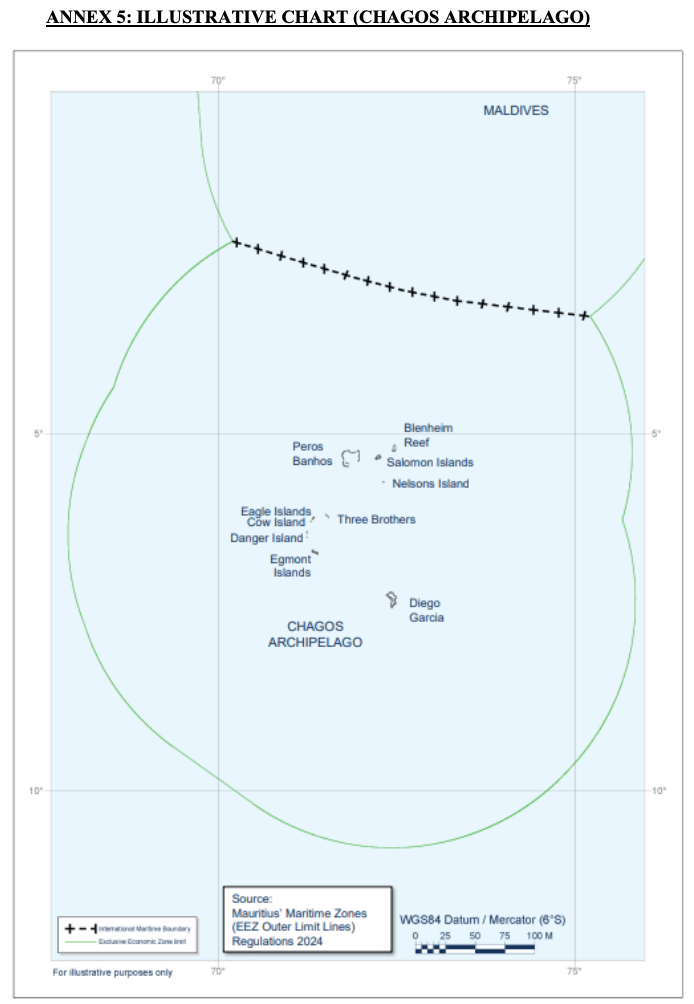
From a UK perspective, “The purpose of the treaty is to secure the long-term, secure and effective operation of the UK-United States of America (US) military base on Diego Garcia, which is critical for the UK’s national security; to ensure legal certainty over the operation of the Base while respecting partners’ interests; and to uphold the international rule of law” (Explanatory Memorandum, p.2; US State Department). The UK believed the sustainability of the UK operation of the Base was at significant risk, including most notably as a result of the decisions of international courts and tribunals, including the International Court of Justice, relating to the Chagos Archipelago (Chagos Archipelago Agreement, Preamble) and the foreseeability of a future binding decision upon the UK. “Sovereignty was also routinely challenged in the Indian Ocean Tuna Commission, which carried risk of legal challenge leading to an ICJ judgment” (Explanatory Memorandum, p. 3; see further IOTC Agreement, Art 23, which might e.g. be raised in disputes on ‘coastal State’ membership, Art 4). Tellingly, this matter is addressed in Article 8 and the Exchange of Letter on the Interpretation of Article 8 of the Chagos Archipelago Agreement (22 May 2025), which provides that upon entry into force, among others, the UK confirms its membership of the Indian Ocean Tuna Commission (IOTC) in respect of Chagos Archipelago transfers to Mauritius and the UK will not claim ‘Coastal State’ but ‘Distant Water Fishing Nation’ membership status at IOTC. The Explanatory Memorandum also made it clear that Mauritius made “frequent public commitments to continue pursuing its legal campaign to secure a binding judgment. The UK government of the day (and all subsequent governments) recognised that there were multiple pathways by which Mauritius could achieve this”.
From a Mauritius perspective, the Chagos Archipelago Agreement “recognises the sovereignty of Mauritius over the entirety of the Chagos Archipelago, including Diego Garcia […] [and] marked a significant step in the completion of the decolonisation process of Mauritius” (Prime Minister Navinchandra Ramgoolam’s Remarks; Chagos Archipelago Agreement, Preamble). Recognising the “wrongs of the past”, the Chagos Archipelago Agreement shall address the past treatment of Chagossians and their continuing welfare.
The Chagos Archipelago Agreement is designed as a comprehensive agreement in ‘full and final resolution of the differences’ related to the Chagos Archipelago and therefore addressed an array of ocean governance issues. A unique compulsory dispute settlement procedure by arbitration, which can only be triggered by the UK, is provided in Article 15(4)-(5) and Annex 4 concerning disputes on if a ground for termination exists and the dispute cannot be resolved by other means. A non-exhaustive selection of key provisions for ocean governance is provided below:
Article 1 Sovereignty
Chagos Archipelago Agreement (2025)
Mauritius is sovereign over the Chagos Archipelago in its entirety, including Diego Garcia.
Article 2 Authorisation in respect of Diego Garcia
1. As sovereign, Mauritius authorises the United Kingdom to exercise the rights and authorities of Mauritius with respect to Diego Garcia in accordance with the terms of this Agreement.
2. The authorisation under paragraph 1 shall comprise all rights and authorities that the United Kingdom requires for the long-term, secure and effective operation of the Base, including for the Defence and Security Requirements, Conditions and Procedures in Annex 1 and the Jurisdiction and Control Arrangements in Annex 2.
3. Mauritius retains title over the land and the territorial sea of Diego Garcia, including the seabed and subsoil, as well as all rights and authorities not authorised under paragraphs 1 and 2, including:[…]
f. sovereignty over natural resources, including fisheries;
g. conservation and protection of the environment, including the marine environment;
Article 3 Defence and Security
1. The Parties agree to the Defence and Security Requirements, Conditions and Procedures in Annex 1 […]
3. The Parties shall cooperate on matters relating to maritime security, including trafficking in narcotics, arms and persons, people smuggling and piracy.
Article 5 Environment
1. The United Kingdom shall exercise the rights and authorities under Article 2 in accordance with applicable international law on environmental protection, and with due regard to applicable Mauritian environmental laws.
2. The United Kingdom agrees to provide support and assistance to Mauritius in the establishment and management of its Marine Protected Area in the Chagos Archipelago, in accordance with terms to be agreed between the Parties by a separate written instrument.
3. The Parties shall cooperate on other matters relating to the protection of the environment, including in relation to oil and other spills, and illegal, unreported and unregulated fishing.
Article 8 International Organisations
1. The United Kingdom agrees to ensure its membership in international organisations is consistent with Article 1.
Article 12 Joint Commission
A Joint Commission to facilitate the implementation of this Agreement shall be established. The composition, functions and procedures of the Joint Commission are set out in Annex 3 [which provides for a composition of UK and Mauritius representatives, with the USA having observer status].
Article 19 Definitions
For the purposes of this Agreement: […]
“Chagos Archipelago” means the islands, including Diego Garcia, and maritime zones of the Chagos Archipelago, including the internal waters, territorial sea, archipelagic waters and the exclusive economic zone, and the airspace above and seabed and subsoil below [without prejudice to Mauritius’ claims in respect of the continental shelf].
“Diego Garcia” means the island of Diego Garcia and a twelve (12) nautical mile zone surrounding the island of Diego Garcia, and includes the airspace above and seabed and subsoil below.
Annex 1: Defence And Security Requirements, Conditions And Procedures
Diego Garcia
1. In accordance with this Agreement and with reference to Article 2(5) and Annex 2, in respect of Diego Garcia, Mauritius agrees the United Kingdom shall have:
a. unrestricted access, basing and overflight for United Kingdom and United States of America aircraft and vessels to enter into the sea and airspace of Diego Garcia;
b. unrestricted ability to: […]
v. authorise the installation, operation and repair of new and existing communication systems and electronic systems and associated cables; […]
viii. permit access, basing and overflight for non-United Kingdom and non-United States of America aircraft and vessels, upon notification to Mauritius; and
ix. manage, use and develop the land and surrounding waters and seabed for defence purposes. This excludes the construction of any artificial islands.
Chagos Archipelago beyond Diego Garcia
3. In accordance with this Agreement, in respect of the Chagos Archipelago beyond Diego Garcia, Mauritius agrees:
a. vessels and aircraft of the United Kingdom and the United States of America shall have unrestricted rights of overflight, navigation and undersea access. States operating with the United Kingdom or the United States of America shall also have such unrestricted rights, save in respect of overflight or undersea access, which require notification;
b. the United Kingdom shall have rights of access for maintenance and upgrades of equipment, following notification to Mauritius, after having advised Mauritius of the location of all such equipment; […]
f. between twelve (12) and twenty-four (24) nautical miles surrounding the island of Diego Garcia, Mauritius and the United Kingdom shall jointly decide on the construction or emplacement of any maritime installation, sensor, structure or artificial island.
Mauritian Security Review
4. Before approving or proceeding with a proposal for:
a. the construction or emplacement of any maritime installation, sensor, structure or artificial island in an area beyond the twenty-four (24) nautical miles surrounding the island of Diego Garcia; or
b. any proposal for development in the land territory of the Chagos Archipelago beyond Diego Garcia, Mauritius shall conduct a Security Review in accordance with paragraph 6 [which provides for information exchanges with the UK, as well as possible decision making by the Joint Commission. An emerging risks procedure is also found in para 7].
11. For the purposes of this Annex:
a. “access” refers to the grant of rights or permissions which would not otherwise exist in international law. Nothing in this Agreement modifies or affects any rights, including rights of overflight or navigation, which exist as a matter of international law;
b. “Chagos Archipelago beyond Diego Garcia” means any area within the Chagos Archipelago that is beyond Diego Garcia;
c. “unrestricted” means not requiring permission or notification, subject to the standing authorisations and notifications separately agreed between the Parties to meet the requirements of international or domestic Mauritian law or current practice.
Annex 2: Jurisdiction And Control Arrangements
Mauritian criminal jurisdiction
3. On Diego Garcia, Mauritius shall exercise all prescriptive, enforcement and adjudicative criminal jurisdiction conferred on it by its laws in relation to allegations against […]
b. all persons not connected to the operation of the Base, including persons involved in offences relating to unlicensed commercial fishing and the trafficking in arms or narcotics.
Cooperation in the exercise of criminal jurisdiction
8. In order to support the exercise of jurisdiction by Mauritius on Diego Garcia, the United Kingdom agrees to provide assistance to Mauritius in: […]
e. the prevention of unlicensed commercial fishing, and trafficking of arms, persons and narcotics and illegal migration.
Miscellaneous
15. Mauritius shall exercise criminal and civil jurisdiction in respect of activities such as irregular migration and unlicensed commercial fishing, provided such exercise of jurisdiction is in conformity with the requirements of this Agreement.
Finally, the signing of the Chagos Archipelago Agreement was accompanied by the signing of a new Strategic Partnership Framework. Among other items, it will address:
- Deepening cooperation on maritime security and irregular migration in areas such as “irregular migration, drugs trafficking, piracy, and illegal, unregulated and unreported fishing”. This will include “Cooperation agreements and capacity building to secure Mauritius’s Exclusive Economic Zone; Consideration of patrolling capability across the Chagos Archipelago to support a secure maritime domain; Cooperation to counter and manage irregular migration; and Provision of training and institutional partnerships to boost Mauritian maritime security capability and strengthen fisheries protection”.
- Cooperation in addressing climate change. This will include “Mitigation and adaptation projects to tackle the immediate effects of climate change including coral restoration, coastal erosion and indigenous species conservation; and Technical expertise to develop and manage the Chagos Archipelago Marine Protected Area, pursuant to the agreement on the exercise of sovereignty over the Chagos Archipelago”.
For further information, see previous reporting.
Filed under Jurisprudence, State Practice, Treaties
CoE: Adoption of Convention on the Protection of the Environment through Criminal Law
On 14 May 2025 the Committee of Ministers of the Council of Europe (CoE) adopted the Council of Europe Convention on the Protection of the Environment through Criminal Law. The date of opening for signature will be decided later (anticipated to be in 2025) and the Convention will enter into force following 10 Signatories expressing their consent to be bound, including at least eight Member States of the Council of Europe (Art 53).
The Convention builds upon numerous international treaties with extraterritorial application to the oceans, including –but not limited– to MARPOL, SOLAS, UNCLOS and the Hong Kong Convention. Indeed, the Convention provides:
Recognising that environmental crime has a negative impact on economies, public health, human safety, food security, livelihoods and habitats;
Council of Europe Convention on the Protection of the Environment through Criminal Law, Premable
[…]
Recognising that environmental crime increasingly has extraterritorial effects and takes the form of international trafficking, which, along with the acceleration of degradation phenomena (climate change, erosion of biodiversity, depletion of natural resources, destruction of habitats, etc.), prompts the need for general minimum standards in criminal law as part of a common and collaborative international framework;
The Convention seeks to effectively prevent and combat environmental crime, promote and enhance national and international co-operation against environmental crime and establish minimum rules to guide States in their national legislation (Art 1(1)). Reflecting the period in which the Committee of Experts was drafting the Convention, the Convention explicitly remains applicable in times of peace and in situations of armed conflict, wartime or occupation (Art 2(2)). The application of human rights at sea are evident in its provisions, including non-discrimination (Arts 4, 49, 51(1); see further ECHR, Art 14).
26 Articles address substantive crimes for which Parties shall take the necessary legislative or other measures for their prevention (Art 10). Parties shall also take effective, proportionate and dissuasive sanctions against offenders (Art 35). Substantive crimes shall include inciting or aiding said offences, as well as attempting to commit certain offences (Art 32). Offences with application in an ocean context include: unlawful pollution (Art 12); import or export of regulated chemical substances (Art 14); transport, import, export or disposal of radioactive material or substances (Art 15); import or export of mercury, mercury compounds and mixtures of mercury and mercury-added product (Art 16); import, export, use or release of ozone-depleting substances, or the import or export of products and equipment containing or relying on such substances (Art 17); import, export, use or release of fluorinated greenhouse gases, or the import of products and equipment containing or relying on such gases (Art 18); transport, shipment or disposal of waste (Art 19); operation or closure of an installation in which a dangerous activity is carried out (Art 20; including floating installations – Explanatory Report (paras 123-124); recycling of ships (Art 22); ship-source discharges (Art 23); mining (Art 26); killing, destruction, taking, possession and transboundary trade of protected wild fauna or flora (Arts 27 and 28(2)); deterioration of habitats within a protected site (Art 29) transporting, releasing or spreading invasive alien species (Art 30); and a ‘particularly serious offence’ (Art 31; Explanatory Report (para 172 including ‘ecocide’).
Parties must establish jurisdiction over the defined offences in an ocean context in a number of explicit cases:
- The coastal State for offences committed in its territory, including the internal waters and territorial sea and, for archipelagic States, the archipelagic waters (Art 33(1)(a)) (‘historic waters’ claims are on a case-by-case basis, but would usually fall within the ‘territory’ and thus obligations of the coastal State under this Convention);
- The flag State for offences committed on board a ship flying their flag (Art 33(1)(b));
- The State of registry for offences on board an aircraft registered under its laws (Art 33(1)(c));
- The State of nationality for offences committed by one of its nationals (regardless of the flag State or maritime zone in which the offence occured (Art 33(1)(d));
- Application of the ‘extradite or prosecute‘ principle (Art 33(3)).
Parties may consider to establish jurisdiction over offences committed against one of their nationals (passive personality principle; Art 33(2)). For more information see here.
Filed under State Practice, Treaties
PCA: Ruling in UK-Sandeel Fisheries Dispute
On 28 April 2025 an Arbitral Tribunal (Trade and Cooperation Agreement (TCA), Article 740) established in UK-Sandeel (The European Union v. the United Kingdom of Great Britain and Northern Ireland) issued its Ruling. The European Union challenged the UK’s sandeel fishing prohibition which is composed of two distinct measures (one measure taken by the Scottish Government in respect of Scottish waters and one measure taken by the UK Government in respect of English waters) but both being attributable to the UK as a Contracting Party to the Trade and Cooperation Agreement (Ruling, paras 418-427). In essence the EU challenged the two measures on the basis (a) the fisheries management measures were not based on ‘best available science’ (TCA, Art 496(2)) and (b) the fisheries management measures did not have regard to agreed principles, namely proportionality and non-discrimination (TCA, Art 494(3)(f)). When interpreting the TCA, the Arbitral Tribunal included UNCLOS, WTO Agreements, and fisheries instruments, in particular the FAO Code of Conduct, among the relevant rules of international law.
So long as they are consistent with the TCA, the Parties agreed that fisheries management measures, including fishing prohibitions which impair the rights of a Party, may be adopted to pursue legitimate objectives in respect of the marine environment. The Tribunal affirmed that the rights of other States imposes limits of the exercise of coastal State rights, but “that there is no obligation under UNCLOS to grant access to the surplus of the allowable catch to a particular State” (paras. 447-448). The TCA reaffirms that Parties granted access to the waters of another Party have access conditioned by compliance with the conservation and management measures adopted, and said Party must ensure compliance by its vessels (para 463). But, the TCA does not leave Parties with unfettered regulatory autonomy in respect of fisheries management. The Tribunal agreed that “the requirements laid down in Article 494, Article 496 and Annex 38 to the TCA are important limits to the exercise of regulatory autonomy to adopt fisheries management measures” (para. 467).
The Arbitration Tribunal found that both the English and the Scottish parts of the measure were based on best available scientific advice and that there was an objective connection between the scientific advice and the sandeel fishing prohibition in UK waters:
593. The Arbitration Tribunal therefore finds that the European Union has failed to demonstrate that the sandeel fishing prohibition in UK waters is inconsistent with the United Kingdom’s obligations under Article 496(1) and 496(2) of the TCA, read together with Article 494(3)(c) of the TCA.
On proportionality and non-discrimination, the Tribunal noted the principles must inform the decision-making process on fisheries management measures. “[C]onsideration will be informative but not determinative of the decision to adopt a measure” (para 605).
Proportionate measures “must be adopted ‘for the conservation of marine living resources and the management of fisheries resources’ and be [an] apt or appropriate [means] to secure or contribute to that objective'”, including a weighing and balancing of the measure’s environmental, economic and social costs and benefits (paras 623-624).
On the measure concerning English waters:
689. The failure to take into account the rights of the European Union under the TCA and their systemic importance in securing stability during the adjustment period compromised the weighing and balancing exercise such that the Arbitration Tribunal is of the view that the decision-maker did not have regard to the principle of applying a proportionate measure.
690. For the above reasons, the Arbitration Tribunal finds that the United Kingdom’s decision to close English waters to sandeel fishing was inconsistent with the requirement in Article 496(1), read together with Article 494(3)(f) of the TCA, to have regard to the principle of applying a proportionate measure for the conservation of marine living resources and the management of fisheries resources.
On the measure concerning Scottish waters:
725. Regard was had not only to the benefits of the sandeel prohibition in Scottish waters, but also to the economic costs to the UK and EU fishing and processing industries and the impairment of the rights of the European Union during the adjustment period. Furthermore, these considerations were applied in the actual weighing and balancing that was undertaken by the Scottish decisionmaker. Attention was paid to the TCA adjustment period, ending 30 June 2026, and the need to take measures to build the resilience of Scottish seabird populations due to recent significant declines. In this, the Scottish decision can be contrasted with that of the United Kingdom in respect of the sandeel fishing prohibition in English waters.
726. The Arbitration Tribunal, therefore, finds that the Scottish measure to close Scottish waters to sandeel fishing is not inconsistent with the requirement in Article 496(1), read together with Article 494(3)(f) of the TCA, to have regard to the principle of applying a proportionate measure. As explained above, the decision-maker had regard to the principle of applying a proportionate measure as it took into account the relevant considerations and applied these in a weighing and balancing exercise, thereby satisfying the requirement to “have regard to” the principle of applying a proportionate measure.
On non-discrimination, the Tribunal noted “the principle applies to the measure itself, its application and its consequences, and refers to both de jure and de facto discrimination. This requires consideration of whether the design, content and application of the measure reflects the principle of non-discrimination” (para 631). The EU claim concerned de facto discrimination. “De facto discrimination may occur where differential treatment is not based on a legitimate regulatory objective or where there is a lack of a clear nexus between the differential treatment and the regulatory objective” (para 730). The Tribunal found:
731. […] The differential impact on vessels of the United Kingdom and European Union is due to the quota shares set out in Annex 35 to the TCA.
732. The Arbitration Tribunal does not consider that a Party is required to take into account the TAC quota shares in deciding on a fisheries management measure. Rather, each measure should be decided on in light of its legitimate objectives and the requirement to have regard to applying the principle of non-discrimination […]
733. The Arbitration Tribunal considers that there is a clear nexus between the differential treatment and the legitimate objective, which is to close all UK waters to all UK and EU vessels in order to provide ecosystem benefits.
734. For the above reasons, the Arbitration Tribunal finds that the United Kingdom’s decision to close UK waters to sandeel fishing was not inconsistent with the requirement in Article 496, read together with Article 494(3)(f) of the TCA, to have regard to the principle of applying nondiscriminatory measures for the conservation of marine living resources and the management of fisheries resources.
On the alleged breach of the obligation to grant full access to fish sandeel pursuant to Annex 38 to the TCA:
743. The Arbitration Tribunal is of the view that the European Union has structured its claim of a breach of Article 2(1)(a) of Annex 38 as a purely consequential claim. The claim for a breach of Article 2(1)(a) of Annex 38 therefore stands or falls on the basis of the findings in respect of the claims under Article 496, read together with Article 494 of the TCA. In this sense “the consequential element is symmetrical”. Once a breach of Article 496(1), read together with Article 494, has been found, that is the end of the Arbitration Tribunal’s remit.
744. The Arbitration Tribunal therefore finds, on the basis of its reasoning in Section V.D.3 that the United Kingdom’s decision to close English waters to sandeel fishing was inconsistent with the requirements of Article 496(1), read together with Article 494(3)(f) of the TCA, to have regard to the principle of applying a proportionate measure for the conservation of marine living resources and the management of fisheries resources, and that in consequence, therefore, there has been a breach of Article 2(1)(a) of Annex 38 of the TCA.
For further information see previous reporting.
Filed under Jurisprudence, State Practice
CLCS: Recommendations approved regarding Brazilian, Cuban and Icelandic submissions
The Sixty-Third Session of the Commission on the Limits of the Continental Shelf (CLCS) was held, 17 February–21 March 2025, at United Nations Headquarters (New York, USA). As noted in the progress statement of the chair (UN Doc. CLCS/63/2), the CLCS, pursuant to Article 76(8) of UNCLOS, approved three sets of recommendations concerning three submissions on the limits of the continental shelf beyond 200 nautical miles from the respective baselines of three Coastal States:
- Cuba in respect of the eastern polygon in the Gulf of Mexico (recommendations approved: CLCS/63/2 para. 22).
- Brazil in respect of the Brazilian Equatorial Margin (partial revised submission) (recommendations approved: CLCS/63/2 para. 33).
- Iceland in respect of the western, southern and south-eastern parts of the Reykjanes Ridge (partial revised submission) (recommendations approved: CLCS/63/2 para. 39).
At the time of reporting, only the summary of the Recommendations of the Commission concerning the Brazilian Equatorial Margin is currently public.
Filed under International Organizations, State Practice
USA: Executive Order on Offshore Minerals and Resources
On 24 April 2025, the President of the United States issued an Executive Order, entitled, Unleashing America’s Offshore Critical Minerals and Resources. The Order addresses policies directed at seabed mineral exploration and exploitation both within the U.S. continental shelf and in areas beyond national jurisdiction (the Area), as well as processing capacity in the United States or on United States-flagged vessels, and possible partnering with other States in exploiting the resources of their continental shelf/EEZ.
Of particular note for the law of the sea is the (a) possibility of a unilateral exploration and exploitation regime concerning the mineral resources of the Area (contra, Part XI of UNCLOS) and (b) the possibility of the unilateral definition and implementation of an international benefit-sharing mechanism (contra, the principle of the common heritage of humankind):
Sec. 3. Strategic Seabed Critical Mineral Access. Within 60 days of the date of this order:
Unleashing America’s Offshore Critical Minerals and Resources
(a) The Secretary of Commerce shall:
(i) acting through the Administrator of the National Oceanic and Atmospheric Administration, and in consultation with the Secretary of State and the Secretary of the Interior, acting through the Director of the Bureau of Ocean Energy Management, expedite the process for reviewing and issuing seabed mineral exploration licenses and commercial recovery permits in areas beyond national jurisdiction under the Deep Seabed Hard Mineral Resources Act (30 U.S.C. 1401 et seq.), consistent with applicable law. The expedited process, consistent with applicable law, should ensure efficiency, predictability, and competitiveness for American companies;
[…]
The Secretary of Commerce […] shall […] provide a joint report […] on the feasibility of an international benefit-sharing mechanism for seabed mineral resource extraction and development that occurs in areas beyond the national jurisdiction of any country.
On 25 April 2025 a Spokesperson for the Foreign Ministry of China stated China’s objections to both the proposed exploration and exploitation of mineral resources of the Area/beyond national jurisdiction, as well as the exploration and exploitation of mineral resources on the extended continental shelf of the U.S (the delimitation of which China does not recognise).
On 29 April 2025, The Metals Company (TMC) announced that its U.S. subsidiary, The Metals Company USA LLC (TMC USA), has submitted applications for a commercial recovery permit and two exploration licenses under the Deep Seabed Hard Mineral Resources Act (DSHMRA) and National Oceanic and Atmospheric Administration (NOAA) implementing regulations. This is an expedited timeline ahead of what was previously reported, which already raised preliminary discussions at the Council of the International Seabed Authority.
On 30 April 2025, the Secretary-General of the International Seabed Authority issued a Statement on the US Executive Order (for previous statements, see here), taking note of the order and raising specific concerns, including in respect of the ISA regime and the common heritage principle. The SG-ISA states her view that:
Its issuance is also surprising because for over 30 years the US has been a reliable observer and significant contributor to the negotiations of the International Seabed Authority, actively providing technical expertise to each stage of the development of the ISA regulatory framework.
Statement on the US Executive Order
[…]
[G]eneral principles of international law and customary international law proclaims the Area and its resources as the Common Heritage of Humankind. A direct corollary of this legal status is that no State may claim, acquire, or exercise sovereignty or sovereign rights over any part of the Area or its mineral resources. This includes a prohibition on appropriation and alienation by any State, or by any natural or juridical person.
The Convention and the 1994 Agreement further establishes the International Seabed Authority, clearly mandating that all activities related to mineral resources in the Area must be conducted under the Authority’s oversight to ensure sustainable use, equitable benefit-sharing, and environmental protection. Accordingly, exploration and exploitation activities in the Area must be carried out under the Authority’s control, that is, under a contract with the Authority and in accordance with the rules, regulations, and procedures it establishes; and no State has the right to unilaterally exploit the mineral resources of the Area outside the legal framework established by UNCLOS. It is common understanding that this prohibition is binding on all States, including those that have not ratified UNCLOS.
Filed under International Organizations, State Practice
ISA: Secretary-General and Delegates Respond to TMC Announcement Concerning Seabed Mining Permits under US Regulation
On 27 March 2025, The Metals Company (TMC) released a press release which included the announcement:
“that its subsidiary The Metals Company USA LLC (“TMC USA”) has formally initiated a process with NOAA under the U.S. Department of Commerce to apply for exploration licenses and commercial recovery permits under existing U.S. legislation, the Deep Seabed Hard Mineral Resources Act of 1980 (DSHMRA)”
On 28 March 2025, ISA Secretary-General Leticia Carvalho issued a statement that brought the matter and the ISA-SG’s concerns to the attention of the members of the Council as a matter which may be of interest to the Council. The Council decided to discuss the announcement under ‘other matters’. The USA is not a Party to UNCLOS. The opinion of the ISA-SG stressed:
Any unilateral action would constitute a violation of international law and directly undermine the fundamental principles of multilateralism, the peaceful use of the oceans and the collective governance framework established under UNCLOS.
Statement by Madam Secretary-General of the International Seabed Authority, Leticia Carvalho (28 March 2025)
For over three decades, the absence of claims under any regime outside Part XI has demonstrated the international community’s strong confidence—including that of States not party to the Convention—in the system developed through the Authority.
As reported in Earth Negotiations Bulletin, numerous States expressed serious concerns about the reported intent of TMC USA. Numerous States emphasised that “the seabed, subsoil, and resources thereof in the Area are the common heritage of humankind and under the exclusive mandate of ISA” (Sierra Leone for the African Group, Argentina, The Bahamas, Belgium, Brazil, Cameroon, Chile, China, The Cook Islands, Costa Rica, Denmark, Fiji, Germany, Ghana, Greece, India, Indonesia, Italy, Jamaica, Japan, Lesotho, Mauritius, Mexico, The Netherlands, New Zealand, Norway, Poland, The Philippines, Portugal, The Russian Federation, Singapore, Spain, Switzerland, Trinidad And Tobago, The UK, and Zimbabwe). The common heritage principle, as applicable to the Area and its resources, is codified in Article 136 of UNCLOS, as well as relevant UN General Assembly Resolutions (Brazil, Greece and Mexico).
Numerous States also emphasised Article 137(1) of UNCLOS, which provides “No State shall claim or exercise sovereignty or sovereign rights over any part of the Area or its resources, nor shall any State or natural or juridical person appropriate any part thereof. No such claim or exercise of sovereignty or sovereign rights nor such appropriation shall be recognized” (Brazil, Greece, Mexico and others). “Germany and others noted Article 137 as customary international law”, while “France called for preserving the integrity and universality of the UNCLOS legal framework”.
Ireland, Jamaica, Singapore, and others rejected the TMC assertion that because the ISA has not yet adopted the Exploitation Regulations the ISA is somehow “in breach of its treaty obligations under UNCLOS and the 1994 Agreement”. Observers were critical of the timing of the TMC announcement and intentions perceived thereof.
Portugal: Law 36/2025 Establishing A Moratorium on Seabed Mining in Portugal’s Maritime Zones
On 31 March 2025 Portugal published Law 36/2025 (Diário da República n.º 63/2025, Série I de 2025-03-31) which seeks to establishes a moratorium on deep-sea mining in the maritime zones of Portugal until 2050 (Art 1). This is principally done through the addition of Article 11-A to Law 17/2014 (Diário da República n.º 71/2014, Série I de 2014-04-10), which concerns Portugal’s marine spatial planning and management:
Article 11-A
Law 36/2025, Article 3 (machine translation)
Moratorium
A moratorium on ocean floor mining in the national maritime space is hereby established, covering prospecting and exploration activities, until 1 January 2050
Of note, the external objectives of Portugal’s framework climate policy, as found in Article 15 of Law No. 98/2021 (Diário da República n.º 253/2021, Série I de 2021-12-31), is also amended with the addition of:
Article 15.
Law 36/2025, Article 4 (machine translation)
Climate foreign policy
1 – The Government adopts a global and integrated vision of the pursuit of climate objectives, respecting the limits of sustainable use of the planet’s natural resources and the development paths of each country, actively defending, in terms of foreign policy within the framework of climate diplomacy:
[…]
(g) The establishment of an international moratorium on deep-sea mining, as long as this is justified by the precautionary principle.
Filed under State Practice
G7: Foreign Ministers’ Declaration on Maritime Security and Prosperity
On 14 March 2025, the G7 Foreign Ministers (Canada, France, Germany, Italy, Japan, the United Kingdom, and the United States of America, and the High Representative of the European Union) issued a Declaration on Maritime Security and Prosperity. The Declaration covers a host of topics and practices of interest to the law of the sea, but select paragraphs include:
3. We recognize the role of the UN Convention on the Law of the Sea (UNCLOS) as the legal framework for governing all activities in the oceans and the seas.
[…]5. Attempts to Change the Status Quo by Force: We oppose unilateral attempts to change the status quo, in particular by force or coercion including in the East and South China Seas. We undertake to implement means through which to track systematically and report on attempts to change the status quo by force and by the establishment of new geographical facts, including through coercive and dangerous actions on the oceans and seas that might threaten regional and international peace and security. […]
6. Protecting Critical Maritime and Undersea Infrastructure: We are seized of the fact that vital energy and telecommunications infrastructure under the oceans and seas connects our economies and is vital to our prosperity. We recall the G7 Joint Statement on Cable Connectivity for Secure and Resilient Digital Communications Networks (2024) and the New York Joint Statement on the Security and Resilience of Undersea Cables in a Globally Digitalized World (2024). We share a growing concern that undersea communications cables, subsea interconnectors and other critical undersea infrastructure have been subject to critical damage through sabotage, poor seamanship or irresponsible behaviour which have resulted in potential internet or energy disruption in affected regions, delays in global data transmission, or compromised sensitive communications. We will enhance our cooperation with industry mitigate risks, reduce bottlenecks to operational tasks while strengthening repair capacities in order to improve the overall resilience of critical undersea and maritime infrastructure. In this respect, we welcome the EU Action Plan on Cable Security adopted in February 2025 by the European Commission and the High Representative of the Union for Foreign Affairs and Security Policy.
[…]10. Curtailing Unsafe and Illicit Shipping Practices: The rise of unsafe and illicit shipping practices, including fraudulent registration and registries, poses a significant threat to global trade and environmental sustainability. We are concerned that unsafe and illicit shipping imposes heavy costs on industry, governments and citizens […] We commit to strengthen our coordination, amongst the G7 and with other partners, to prevent the use of unregistered or fraudulently registered, uninsured and substandard vessels engaged in sanctions evasion, arms transfers, illegal fishing and illicit trade. We encourage relevant International Organizations to improve maritime domain awareness by expanding satellite-based vessel tracking and establishing comprehensive data records of the movement of individual ships and of ship-to-ship transfers, as a means of identifying and tracking illicit maritime activities. […]
11. Shadow Fleet Task Force: We invite members of the Nordic-Baltic 8 (Denmark, Estonia, Finland, Iceland, Latvia, Lithuania, Norway, Sweden), and possibly others, to join participating G7 members in a Shadow Fleet Task Force to enhance monitoring and detection and to otherwise constrain the use of shadow fleets engaged in illegal, unsafe or environmentally perilous activities, building on the work of others active in this area. The Task Force will constitute a response by the participating States to the call by the International Maritime Organization in its Resolution A.1192(33) of 6 December 2023 for Members States and all relevant stakeholders to promote actions to prevent illegal operations in the maritime sector by shadow fleets and their flag states, including illegal operations for the purposes of circumventing sanctions, evading compliance with safety or environmental regulations, avoiding insurance costs, or engaging in other illegal activities.
[…]13. Promoting Safe and Resilient Ports and Strategic Waterways: […] We will work with partners and with relevant International Organizations to encourage robust cybersecurity standards for port ICT infrastructure, to increase resilience against malicious cyber incidents on maritime logistical networks, to reduce monopolistic power over key supply chain nodes, to promote secure and transparent port ownership, to limit unsolicited or undue foreign influence over critical infrastructures and strategic waterways, and to otherwise encourage greater focus on such potential vulnerabilities.
14. Unexploded Ordnance (UXO) at sea poses a significant hazard to the marine environment, to the safety of fishermen and other users of the maritime space, and to various marine economic activities. We commit to enhancing diplomatic efforts and to exchanging best practices among national authorities, relevant international and regional organizations, and relevant industry sectors to accelerate the clean-up of UXO from the seas and ocean.
[…]17. This G7 Maritime Security and Prosperity Declaration provides a framework for cooperation with non-G7 Partners, including countries hosting major ports, large merchant fleets, or extensive flag registries as well as relevant regional and International Organizations, such as the International Maritime Organization and ASEAN. We would welcome robust cooperation with Partners to take forward the goals set out in this Declaration, consistent with the principles of sovereignty and territorial integrity, under the efforts of the G7 countries, including a free, open, prosperous and secure Indo-Pacific region, to build a free and open maritime order based on the rule of law, and of commitment to the sustainable development of the world’s maritime spaces.
On 17 March 2025, A Ministry of Foreign Affairs of China Spokesperson offered remarks on the Declaration on Maritime Security and Prosperity, in particular surrounding the paragraphs addressing the Taiwan Strait and the South China Sea.
Filed under State Practice
Norway: WWF v. Norway (Ministry of Energy), Judgment
On 13 February 2025 the Oslo District Court issued judgment in Stiftelsen WWF Verdens Naturfond v. Staten v/ Energidepartementet (Case No. 24-081980TVI-TOSL/04). The case concerned the validity of the Royal Decree of 12 April 2024 on the opening of an area on the Norwegian Continental Shelf for mineral activities (previously reported). WWF challenged whether the mandatory impact assessment prior to opening of new areas on the continental shelf for mineral activities met the substantive requirements under Section 2-2 of the Seabed Minerals Act, as interpreted by other domestic and international law, including Article 206 of UNCLOS and the precautionary principle. The Decree was also challenged for being based on materially incorrect facts. The Decree was not invalidated, although WWF have signalled they will appeal the decision. On law of the sea:
It has not been alleged that Norway has not fulfilled its reporting obligations under Article 205 of [UNCLOS], or that the obligation to assess the potential environmental impacts ‘as far as practicable’ extends beyond the obligation to conduct an impact assessment under Section 2-2 of the [Seabed Minerals Act].
WWF v. Ministry of Energy, Judgment p. 26 (machine translation)
Overall, the district court finds that Norwegian law interpreted in accordance with international and national law requires that both probable and possible, but not theoretical or constructed, environmental consequences of an opening decision must be ‘illuminated’ in an impact assessment prepared by the ministry before the government can decide on new areas opened for mineral activities [Section 2-2 of the Seabed Minerals Act]. International law requirements indicate that the verb ‘illuminate’ means that the probable and possible environmental consequences must both be identified, described and assessed.
The impact assessment is obliged to use all available knowledge and assessment methods. Depending on the circumstances, new scientific studies may also be necessary where the knowledge base falls short […] The international and EU law investigation requirement is also not absolute, but is limited by a reasonableness, materiality, probability and/or proportionality limitation that, in the end, is not found to deviate significantly in content from the domestic law requirements.
WWF v. Ministry of Energy, Judgment pp. 30-31 (machine translation)
Filed under Jurisprudence, State Practice
China: Letter on Continental States’ “Archipelago” Baselines
On 28 February 2025, the Permanent Representative of China to the United Nations addressed a Letter to the UN Secretary-General which appears to largely be in response to the Letter dated 5 December 2024 from the Permanent Representative of the United States of America to the United Nations addressed to the Secretary-General.
In short, the USA Letter of 5 December 2024 referred to the 2022 study, Limits in the Seas No. 150, as well as 2022 State Practice Supplement, to emphasis the primary US position that the baseline provisions of UNCLOS are ‘comprehensive’, regulating the drawing of all baselines, including those pertaining to “continental States’ outlying archipelagos”. In the alternative, the US affirms that if the drawing of baselines pertaining to “continental States’ outlying archipelagos” is not regulated by the baseline provisions of UNCLOS, but rather customary international law, then the relevant rules of customary law must be demonstrative through State practice and opinio juris. The USA refutes that there is sufficient evidence in State practice and opinio juris to establish a customary legal basis for non-archipelagic States to establish straight baselines around outlying island groups.
The China Letter of 28 February 2025 affirms, first that the UNCLOS provisions on baselines are non-exhaustive and the “question of continental States’ outlying archipelagos was deferred”, and second, that the “practice regarding continental States’ outlying archipelagos [is] long-established in international law”. China rejects the findings of the US State Department Study, and affirms China’s position that the existing straight baselines at Xisha Qundao/Paracel Islands are consistent with international law and that “China has yet to draw its territorial sea baselines for other archipelagos”. To constitute an ‘archipelago’ in general international law, China suggests the maritime features must “constitute a legal whole”, with the conditions being “constitutes an entity in geographic, economic and political terms, and has been regarded as an entity respectively throughout history” (see, similarities to Article 46(b) of UNCLOS which defines archipelago for the purposes of UNCLOS).
Note, it is the shared position of both States, evident in the letters, that only Archipelagic States may establish archipelagic baselines, as provided in Part IV of UNCLOS. Continental States are by definition not Archipelagic States (Article 46 of UNCLOS) and therefore may not establish archipelagic baselines as governed by UNCLOS (Article 47 of UNCLOS; South China Sea Award (2016) para 573). The differences concern whether there are (a) lawful baselines circumstances outside of UNCLOS, and (b) whether this includes straight baselines around ‘archipelagos’ by Non-Archipelagic States (on both, note South China Sea Award (2016) paras 575-576).
Filed under State Practice, Treaties
Viet Nam: Baselines in the Gulf of Bac Bo/Tonkin
On 21 February 2025, Viet Nam’s Ministry of Foreign Affairs announced the establishment of straight (Article 1; mainland territory) and normal (Article 2; Bach Long Vi Island) baselines in the Gulf of Tonkin. The Government of Viet Nam notes this practice was adopted in accordance with the 2012 Law of the Sea of Viet Nam. The Statement also defines the outer limit of Viet Nam’s territorial sea in the Gulf of Tonkin (Article 3), points 1-9 reflecting the territorial sea delimitation line with China, while point 10, according to the Statement, is “located within the waters of Viet Nam”. Consistent with the obligations of Viet Nam under Article 16 of UNCLOS, the list of geographical coordinates of points, specifying the geodetic datum, as well as a chart showing straight baselines and outer limits of the territorial sea, have been given due publicity and a copy deposited with the Secretary-General of the United Nations on 7 March 2025.
Filed under State Practice
EU: Action Plan on Cable Security
On 21 February 2025, the European Commission and High Representative of the Union for Foreign Affairs and Security Policy presented a Joint Communication to the European Parliament and the Council, entitled, EU Action Plan on Cable Security, with the objective of strengthening the security and resilience of submarine cables. Actions across the target areas will be of interest to ocean governance, including, for example deterrence measures against ‘shadow fleet’ vessels or other ‘vessels of interest’ and launching “a reflection at international level on how to make full use of the International Law of the Sea Framework to enhance the security of submarine cables”, including the possible establishment of “a common understanding of relevant provisions of the International law of the sea enabling Member States, as coastal and flag States, to more effectively protect critical infrastructure and take action in relation to the shadow fleet of vessels and any vessels of interests operating on the high seas. In particular, the legal framework for interception or boarding of vessels representing risks for the EU should be carefully assessed, in full compliance with United Nation Conventions on the Law of the Sea (UNCLOS)” (p. 16).
Filed under State Practice
BBNJ Agreement: Exceptions on Non-Retroactivity Utilised
On 4 February 2025 Spain ratified the Agreement under the United Nations Convention on the Law of the Sea on the conservation and sustainable use of marine biological diversity of areas beyond national jurisdiction (BBNJ Agreement). This was shortly followed thereafter by France ratifying the BBNJ Agreement on 5 February 2025. Both States submitted declarations upon ratification. These declarations are consistent with the previously reported EU law, whereby the exception to retroactive effect, as set in Article 10(1) of BBNJ Agreement, will be employed upon signature or ratification of the BBNJ Agreement. Relevant provisions of the BBNJ Agreement will therefore, for France and Spain, apply only to activities with respect to marine genetic resources and digital sequence information on marine genetic resources of areas beyond national jurisdiction collected or generated after the entry into force of the BBNJ Agreement for France and Spain, respectively. Other interesting points are also included in the declaration of France.
Filed under State Practice, Treaties
ITLOS: The “Zheng He” Case, Order of 3 February 2025
On 3 February 2025 the President of ITLOS, in respect of The “Zheng He” Case (Luxembourg v. Mexico), issued Order 2025/1 of 3 February 2025. The Order extends the time limit for the submission of the Memorial of Luxembourg and the Counter-Memorial of Mexico, respectively. Of note, the Order responds to requests from both parties to the dispute following the entry “into a phase of bilateral negotiations” (Order 2025/1 of 3 February 2025, para 3). For more information, see the previously reported incidental provisional measure proceedings.
Filed under Jurisprudence, State Practice
WCPFC: Adopts Legally Binding Conservation & Management Measure on Fishing Labour Conditions
The Western Central Pacific Fisheries Commission (WCPFC), at its 21st Regular Session of the Commission (28 November to 3 December 2024), continued its leadership among regional fisheries management organisations (RFMOs) by adopting (para 63) the world’s first legally binding conservation and management measure (CMM) addressing labour conditions for crew members onboard authorized fishing vessels: CMM 2024-04 for Labour Standards, which will enter into force 1 January 2028 (para 19, although Members, Participating Territories and Cooperating Non-Members are encouraged to implement measures as soon as possible).
CMM 2024-04 for Labour Standards addresses the crew’s (‘persons of any age on board a fishing vessel’) working conditions, as well as the flag State’s responsibilities in the event of a death, serious injury or illness, crew missing or presumed fallen overboard, or reasonable grounds to believe (a) a crew member’s health and safety is endangered or (b) a crew member has been subjected to forced or compulsory labour and other mistreatment. Port State responsibilities are triggered when the port State is notified by either disembarked crew or the flag State of alleged/possible forced or compulsory labour and other mistreatment (paras 13-14). The State of Nationality, among others, is expected to cooperate and provide support in relation to cases of forced or compulsory labour and other mistreatment on fishing vessels, such as collecting evidence ‘where possible’ (para 15).
This follows initial steps of adopting non-binding resolutions at numerous RFMOs on the path to binding labour standards at the regional level, including WCPFC Resolution 2018-01 On Labour Standards for Crew on Fishing Vessels; NAFO Resolution (1/23) Non-Binding Resolution relating to Core Principles on Labour Standards in NAFO Fisheries; ICCAT Resolution 2023-20 on Core Principles on Labor Standards in ICCAT Fisheries; and 2024 NPFC Resolution on Core Principles on Labor Standards in NPFC Fisheries.
For further information, see the WCPFC’s Provisional Meeting Outcomes and Attachments for the 21st Commission Session, including further actions to incorporate climate change considerations into fisheries conservation and management.
Filed under State Practice
INC on Plastic Pollution: Fifth Session Adjourned
Consistent with the mandate established under para 1 of UNEP Resolution 5/14, the fifth session of the Intergovernmental Negotiating Committee to develop an international legally binding instrument on plastic pollution, including in the marine environment (INC-5) was held 25 November – 1 December 2024, with the ambition of conclude negotiations and finalize the text of an international legally binding instrument on plastic pollution, including in the marine environment, by the end of 2024.
While progress was made, a finalised text was not achieved and so the session has been suspended and negotiations scheduled to continue in 2025. Some representatives expression concern and disappointment at the limited progress made and some identified reasons for the lack of progress in their opinion (INC-5 Draft Report, paras. 55-59). The session adjourned “with agreement on a ‘Chair’s Text’ that will serve as the starting point for negotiations at a resumed session in 2025″.
Filed under International Organizations, State Practice
EU: ‘maritime safety’ package adopted by the Council
The Council of the European Union adopted on 18 November 2024 four new pieces of legislation of the so-called ‘maritime safety’ legislative package, namely those amending the relevant directives on:
– the investigation of accidents in the maritime transport sector
– ship-source pollution
– compliance with flag state requirements, and
– port state control.
The revised ‘package’ achieves a balance between, on the one hand, the need to ensure a high quality of shipping and, on the other, the need to safeguard the competitiveness of the European shipping sector, while also maintaining reasonable costs for operators and member states’ administrations. Overall, it will equip the EU with modern tools to support clean shipping by aligning EU rules with international standards while improving implementation and enforcement through an enhanced cooperation framework between European and national authorities.
The four legislative proposals form part of the maritime safety ‘package’ together with the one on the European Maritime Safety Agency (EMSA). They were submitted by the Commission on 1 June 2023 aiming to modernise EU rules on maritime safety and reduce water pollution from ships. With 75% of the EU’s external trade being seaborne, maritime transport is not only the artery of a globalised economy, but also a lifeline for the EU’s islands and peripheral and remote maritime regions. Although maritime safety in EU waters is currently very high, with few fatalities and no recent major oil spills, more than 2,000 marine accidents and incidents are still reported every year. Provisional agreements between the co-legislators on the four legislative proposals were reached in February this year.
Further information in the EU press release.
Filed under International Organizations, State Practice
PCA: EU v. UK Arbitral Tribunal Established
As previously reported, on 25 October 2024 the EU had initiated arbitral proceedings against the UK concerning the –as characterised by the EU– “sandeel fisheries prohibition”. On 18 November 2024, the Arbitration Tribunal (Trade and Cooperation Agreement, Article 740) was established and the case added to the PCA’s list of cases in which it is acting as registry: The European Union v. The United Kingdom of Great Britain and Northern Ireland (PCA Case No. 2024-45).
To-date, documents available in the Sandeel Fisheries Prohibition Arbitration (EU v. UK) include the EU Request for the Establishment of the Arbitration Tribunal.
Filed under Jurisprudence, State Practice
AOSIS: Declaration on Sea Level Rise and Statehood
Building on the previously reported Alliance of Small Island States (AOSIS) Leaders’ Declaration 2021, which, notwithstanding any physical changes connected to climate change-related sea-level rise, addressed the fixing of baselines and maritime zones, on 23 September 2024 the Heads of State and Government of AOSIS adopted the AOSIS Leaders Declaration on Sea Level Rise and Statehood. Among other pronouncements, the Declaration provides:
AOSIS Leaders Declaration on Sea Level Rise and Statehood
- Declare that international law is premised on a principle of continuity of statehood, consistent with broad state practice over the past century,
- Affirm that consistent with the principles of equity, fairness and sovereign equality of states, statehood cannot be challenged under any circumstances of climate change related sea-level rise,
- Declare that the statehood and sovereignty of SIDS and our membership in the United Nations, its specialized agencies and other intergovernmental organizations will continue, and the rights and duties inherent thereto will be maintained, notwithstanding the impacts of climate change related sea-level rise,
Filed under State Practice
EU/UK: EU Requests Establishment of Arbitral Tribunal in Sandeel Fisheries Dispute
As previously reported, in April 2024 the EU had submitted a written request for consultations with the UK under the dispute settlement mechanism of the EU-UK Trade and Cooperation Agreement (TCA) regarding the UK’s decision to prohibit the fishing of sandeel in UK waters. On 25 October 2024, the EU announced that “consultations concluded without reaching such a mutually agreed solution” and has now requested the establishment of an Arbitration Tribunal under the dispute settlement mechanism of the EU–UK Trade and Cooperation Agreement (TCA) concerning the UK’s decision to prohibit the fishing of sandeel.
Filed under Jurisprudence, State Practice
China: Announcement of Straight Baselines at Scarborough Shoal
On 10 November 2024, China released a Statement on the Baselines and Base Points of the Territorial Sea Adjacent to Huangyan Dao (machine translation), stating the baselines were established in accordance with UNCLOS. On 12 November 2024, the Philippines filed a diplomatic protest on the grounds of both disputed sovereignty over the maritime feature and the legal basis to establish straight baselines around the maritime feature.
Filed under State Practice
The Philippines: Philippine Maritime Zones Act & Philippine Archipelagic Sea Lanes Act
On 7 November 2024, the Philippines’ enactment of the Philippine Maritime Zones Act and the Philippine Archipelagic Sea Lanes Act was completed following signed into law by President Marcos. In accordance with Section 19 of the Philippine Maritime Zones Act and Section 28 of the Philippine Archipelagic Sea Lanes Act, each law takes effect 15 days after publication. The National Mapping and Resource Information Authority of the Philippines has produced an illustrative map of the possible archipelagic sea lanes through the Philippines, but as noted this is subject to finalisation and fixing through the respective IMO and ICAO processes, followed by proclamation by the President.
On 8 November 2024 The Ministry of Foreign Affairs of The People’s Republic of China released a statement objecting to both acts, stating its objections to the Philippine Maritime Zones Act while objecting to the Philippine Archipelagic Sea Lanes Act without further detail. Likewise, on 8 November 2024, the USA expressed its support to the Philippines’ enactment of the Maritime Zones Act. Finally, as indicated in the records of The Parliament of Malaysia (14 November 2024), Malaysia has sent an objection note to the Philippines concerning the passage of said laws and their touching upon sovereignty over Sabah.
Filed under State Practice
ISA: June 2025 Submission of Application for Plan of Work for Exploitation Announced
On 12 November 2024, Nauru Ocean Resources Inc (NORI), falling under the responsibilities the Republic of Nauru as the applicable Sponsoring State, has signalled that it expects to submit an application for a plan of work for the commercial exploitation of mineral resources in the Area to the International Seabed Authority (ISA) on 27 June 2025. The submission date appears to have been selected to directly follow Part I of the Council’s scheduled meeting (17 – 28 March 2025) and directly before Part II of the Council’s scheduled meeting (7 – 18 July 2025) during the 30th Session of the International Seabed Authority. Consultation and support of Nauru as the Sponsoring State is evident in the reported actions, whereby “the Republic of Nauru has requested in a formal letter that the ISA clarify the submission and review process during the March session [Part I], with the goal of providing certainty for all stakeholders and allowing for review to begin immediately after NORI’s submission under an agreed-upon process [Part II]”. An accompanying statement suggests the NORI submission strategy is to seek review of its application for a plan of work for exploitation in 2025, regardless of whether the Mining Code has been finalised and adopted i.e. including ISA’s possible review of the application based on the draft regulations.
USA: Denial of port privileges for lack of corrective action on IUU fishing & bycatch of PLMRs
Following negative certifications in the 2023 Report to Congress (see: 16 USC 1826a; 50 CFR §§ 300.200 – 300.209), effective 10 October 2024, certain fishing vessels from 17 States will be denied U.S. port privileges (port access & port services, subject to strict exceptions):
- Longline fishing vessels operating in International Commission for the Conservation of Atlantic Tunas (ICCAT) fisheries beyond national jurisdictions and flagged to Algeria, Barbados, Côte d’Ivoire, Cyprus, France, Greece, Italy, Malta, Namibia, Senegal, Spain, Trinidad and Tobago, Tunisia, and Türkiye (Bycatch of Protected Living Marine Resources).
- Mexican-flagged vessels operating in gillnet fisheries in the Gulf of Ulloa (Bycatch of Protected Living Marine Resources). See further, port restrictions on all Mexican fishing vessels that fish in the Gulf of Mexico effective 7 February 2022, which remain in effect following continued 2023 negative certification (Illegal, Unreported, and Unregulated Fishing).
- Russian-flagged fishing vessels authorised under the Commission for the Conservation of Antarctic Marine Living Resources (CCAMLR) to target toothfish (Illegal, Unreported, and Unregulated Fishing).
- People’s Republic of China-flagged longline fishing vessels authorized under Western & Central Pacific Fisheries Commission (WCPFC), Inter-American Tropical Tuna Commission (IATTC) and ICCAT (Illegal, Unreported, and Unregulated Fishing).
This represents an expansion in the exercise of such port denials. Previously, the USA has rarely resorted to imposing measures because foreign States or Fishing Entities are generally given a positive certification in the Report to Congress following identification for IUU fishing, PLMRs bycatch or activities that target or incidentally catch sharks (Mexico previously being an exception).
Filed under State Practice
USA/Canada: Joint Task Force on Beaufort Sea Boundary
On 24 September 2024, Canada and the USA established a Joint Task Force to Negotiate Beaufort Sea Boundary, whose function is to “undertake negotiations on the maritime boundary in the Beaufort Sea including resolving the overlap in the continental shelf in the Central Arctic Ocean”. Bilateral negotiations shall include “meaningful engagement with state, territorial, and Indigenous partners”. The final agreement should seek to resolve the maritime boundary, as well as take into account “the responsible conservation and sustainable use of Arctic resources for the mutual benefit of Americans and Canadians, including Indigenous Peoples”.
Filed under State Practice
Mauritius/UK: Political Agreement on Chagos Archipelago
On 3 October 2024, a Joint Statement between the Governments of the Republic of Mauritius and the United Kingdom of Great Britain and Northern Ireland concerning the Chagos Archipelago, including Diego Garcia was issued confirming a political agreement on the exercise of sovereignty over the Chagos Archipelago was reached between the Parties. The “political agreement is subject to the finalisation of a treaty and supporting legal instruments, which both sides have committed to complete as quickly as possible”, but the treaty shall include:
- UK agreement that Mauritius is sovereign over the Chagos Archipelago, including Diego Garcia;
- Commitment to ensure the long-term, secure and effective operation of the UK/USA military base on Diego Garcia, including agreement “for an initial period of 99 years, the United Kingdom will be authorised to exercise with respect to Diego Garcia the sovereign rights and authorities of Mauritius required to ensure the continued operation of the base well into the next century”;
- Mauritius is free to implement a programme of resettlement on the islands of the Chagos Archipelago (other than Diego Garcia);
- UK will capitalise a new trust fund and provide other separate support for the benefit of Chagossians;
The Joint Statement signals further economic, security and environmental partnership between the UK and Mauritius, including on “environmental protection, maritime security, combating illegal fishing, irregular migration and drug and people trafficking within the Chagos Archipelago”. Concrete examples listed include:
- Indexed annual payments by the UK for the duration of the agreement;
- Establishment of an infrastructure partnership underpinned by UK grant funding;
- The establishment of a Mauritian Marine Protected Area.
For further information see the respective UK (2) and Mauritius press releases. The Joint Statement notes the support and assistance provided by the USA & India, who both welcomed the political agreement.
Filed under State Practice, Treaties
BBNJ Agreement: 10 Parties (NiF)
On 24 September 2024, Singapore and the Maldives deposited their instruments of ratification to the Agreement under the United Nations Convention on the Law of the Sea on the Conservation and Sustainable Use of Marine Biological Diversity of Areas beyond National Jurisdiction (BBNJ Agreement; not in force), bringing the Parties to a total of 10. The BBNJ Agreement shall enter into force 120 days after the date of deposit of the sixtieth instrument of ratification, approval, acceptance or accession (BBNJ Agreement, Art 68(1)). The addition of Singapore and the Maldives also adds, respectively, the first Southeast Asian and South Asian State to the geographical representation of the existing Parties (which currently also includes: East Africa, Europe, Oceania, the Caribbean, South America and Central America).
Filed under State Practice, Treaties
EU: BBNJ Agreement – Declaration of Competence & Exception on Non-retroactivity
On 19 July 2024, Council Decision (EU) 2024/1830 of 17 June 2024 was published in the Official Journal of the European Union, accompanied by Declaration 2024/1832 and Declaration 2024/1833.
Council Decision (EU) 2024/1830 approved, on behalf of the European Union, the Agreement under the United Nations Convention on the Law of the Sea on the conservation and sustainable use of marine biological diversity of areas beyond national jurisdiction (BBNJ Agreement), completing the internal process to allow the EU to formally deposit its instrument of approval (not yet occurred). The instrument of approval (BBNJ Agreement, Art 66) will be accompanied by a Declaration of Competence (BBNJ Agreement, Art 67(2)) and an Exception (BBNJ Agreement, Arts 70, 10(1)). Declaration 2024/1832 provides what will be in the Declaration of Competence of the European Union concerning the BBNJ Agreement. Declaration 2024/1833 provides what will be in an authorised exception submitted by the European Union concerning BBNJ Agreement. The declared exception provides:
The European Union declares the exception of the retroactive effects as set out in the second sentence of Article 10(1), therefore the provisions of this Agreement shall apply for the Union only to activities with respect to marine genetic resources and digital sequence information on marine genetic resources of areas beyond national jurisdiction collected and generated after the entry into force of this Agreement for the Union.
Declaration 2024/1833
Other Parties (all others to-date) without a declared exception upon signature or ratification consent to apply relevant BBNJ Agreement provisions with retroactive effect: “The application of the provisions of this Agreement shall extend to the utilization of marine genetic resources and digital sequence information on marine genetic resources of areas beyond national jurisdiction collected or generated before entry into force” (BBNJ Agreement, Art 10(1)). Consistent with Articles 67 and 10, the Declaration of Competence and Article 10-based Exception must be submitted in writing when signing, ratifying, approving, accepting or acceding to the BBNJ Agreement. “The conclusion of the Agreement by the Union is without prejudice to the Member States’ competence as regards the ratification, approval or acceptance of the Agreement” (Council Decision (EU) 2024/1830, recital 9) and “The Union and its Member States aim to ratify the Agreement prior to the United Nations Ocean Conference that will take place in 2025” (Council Decision (EU) 2024/1830, recital 4).
Filed under State Practice, Treaties
CLCS: Partial Submission by Viet Nam (Central Area)
On 17 July 2024, in accordance with Article 76(8) of UNCLOS, Viet Nam submitted to the Commission on the Limits of the Continental Shelf (CLCS) information on the limits of the continental shelf beyond 200 nautical miles from the baselines from which the breadth of the territorial sea is measured in respect of the Central Area (VNM-C).
This follows the separate May 2009 Joint Partial Submission by Malaysia and Viet Nam in the southern part of the South China Sea and May 2009 Partial Submission by Viet Nam in respect of the North Area (VNM-N), both of which have proceeded as far as the presentation of the submission by coastal State representatives at a session of the Commission (CLCS/64, paras 87-92; 102-106).
Note, on the same date as the VNM-C Partial Submission, Viet Nam submitted a Communication (17 July 2024) on the previously reported June 2024 Partial Submission by the Philippines (West Palawan Region). At the time of writing, communications received and published with regard to the VNM-C Partial Submission include China (29 July 2024).
Filed under International Organizations, State Practice
UNCLOS: 170 Parties
Following the completion of a domestic process on 20 March 2024 resulting in Decreto Consiliare 20/03/2024 n. 61 “Adesione alla Convenzione delle Nazioni Unite sul Diritto del Mare”, San Marino submitted an instrument acceding to the United Nations Convention on the Law of the Sea (UNCLOS) on 19 July 2024, bringing the total number of UNCLOS Parties to the milestone of 170 Parties. Consistent with Article 308(2) of UNCLOS, the Convention shall enter into force for San Marino on 18 August 2024.
Note, consistent with Article 4(1) of the Agreement relating to the Implementation of Part XI of the United Nations Convention on the Law of the Sea of 10 December 1982 (1994 Agreement), the instrument of accession to UNCLOS also represents consent to be bound by the 1994 Agreement. San Marino therefore effected its consent to be bound to the 1994 Agreement on 19 July 2024. Consistent with Article 6(2) of the 1994 Agreement, the Agreement shall enter into force for San Marino on 18 August 2024. The 1994 Agreement currently has 153 Parties.
Filed under State Practice, Treaties
ITLOS: The “Zheng He” Case, Order of 27 July 2024
As noted in previous reporting, incidental proceedings arose in The “Zheng He” Case (Luxembourg v. Mexico) following a request from Luxembourg for provisional measures. On 27 July 2024 the International Tribunal for the Law of the Sea (ITLOS) delivered its Order of 27 July 2024 in The “Zheng He” Case (Luxembourg v. Mexico), Provisional Measures.
As the dispute on the merits is before ITLOS, and consistent with Article 290(1) of UNCLOS, the Tribunal first considered that prima facie it does have jurisdiction over the dispute regarding the “Zheng He” vessel (paras. 52-106). Concerning the applicability and/or fulfilment of Article 295 of UNCLOS, in light of the circumstances of the case, the Tribunal decided “the issue of exhaustion of local remedies should be examined at a future stage of the proceedings” (para. 105).
Following previous precedents, the ‘preservation’ of rights (UNCLOS, Article 290(1)) was interpreted by the Tribunal to include a requirement that the rights claimed must be plausible. On the plausibility of the rights the applicant seeks to protect –and given the prima facie jurisdiction finding concerning Article 131 of UNCLOS– the Tribunal found that the rights claimed by Luxembourg on the basis of Article 131 are plausible (paras. 107-125).
Likewise, while ‘urgency’ is not explicitly mentioned as a requirement under Article 290(1) of UNCLOS (in contrast to Article 290(5)-based proceedings), previous interpretations and application of Article 290 have suggested urgency as an important element in considering all requests for provisional measures. The Order of 27 July 2024 adopts this approach whereby “The Tribunal may prescribe provisional measures if the urgency of the situation so requires. Urgency implies that there is a real and imminent risk that irreparable prejudice may be caused to the rights of the parties to the dispute, pending the final decision” (para. 126). However, “[o]n the basis of the factual information and legal arguments presented by the Parties, the Tribunal considers that there is at present no urgency, in the sense that there is no real and imminent risk of irreparable prejudice to the rights claimed by Luxembourg” (para. 143). This finding was made in the context of assurances given by Mexico during the oral hearings to which the Tribunal “takes note” (paras. 144-145). Thus, the operative paragraph provides:
The Tribunal
Order of 27 July 2024, para. 149
By 22 votes to 1 ,
Finds that the circumstances, as they now present themselves to the Tribunal, are not such as to require the exercise of its powers to prescribe provisional measures under article 290, paragraph 1, of the Convention.
Appended to the Order of 27 July 2024, one will find a Declaration of Judge Kittichaisaree; Joint declaration of Judges Infante Caffi and Kamga; Separate opinion of Judge Kulyk; and Dissenting opinion of Judge ad hoc Kohen.
Filed under Jurisprudence, State Practice
HRC: Resolution on Human Rights of Seafarers
On 11 July 2024, the UN Human Rights Council adopted without a vote: Resolution 56/18: Promoting and protecting the enjoyment of human rights by seafarers (currently available as UN. Doc A/HRC/56/L.4 with oral revision). The Philippines was the main sponsor. As highlighted by the Department of Foreign Affairs of the Republic of the Philippines, the Philippine initiative “co-sponsored by 28 countries, as of this date, is the first-ever resolution on seafarers to be introduced and adopted in the UN HRC”. Among the contents of the Resolution –to be read in full–, Resolution 56/18 provides:
The Human Rights Council,
HRC Resolution 56/18
[…]
Recognizing the human rights, as well as labour rights, of seafarers, including the right to freedom of association and the effective recognition of collective bargaining, the elimination of all forms of forced or compulsory labour, the effective abolition of child labour and the elimination of discrimination in respect of employment and occupation, as well as a safe and secure workplace, fair terms of employment, decent working and living conditions on-board ships, health protection, medical care, welfare measures and other forms of social protection,
[…]
2. Calls upon States parties, shipowners’ representatives and seafarers’ representatives to enhance the enforcement of the Maritime Labour Convention, 2006, as amended, to ensure safe and decent living and working conditions for all seafarers;
3. Calls upon States and other relevant shipping industry stakeholders to promote and protect effectively the enjoyment of human rights and fundamental freedoms by seafarers, including their right to life, right to the enjoyment of just and favourable conditions of work, including safe and healthy working conditions, and right to the enjoyment of the highest attainable standard of physical and mental health;
4. Urges shipping industry stakeholders to respect the right of seafarers to the opportunity to gain their living by work that they freely choose or accept, including decisions on whether to sail or continue sailing in high-risk areas, and that the realization of this right should not negatively affect a seafarer’s employment competitiveness or future deployment;
5. Urges States to continue efforts to eliminate all forms of forced or compulsory labour in the shipping industry;
Filed under International Organizations, State Practice
USA: bill prohibiting seabed mining in Hawai‘i’s state marine waters signed
The Governor of the State of Hawaii signed bill SB 2575 on 8 July 2024, which prohibits seabed mining in Hawai‘i’s state marine waters, citing environmental risks. The legislature found that Seabed mineral mining is not consistent with the public interest, including the right that each person has to a clean and healthy environment. This bill prohibits the mining, extraction, and removal of minerals from the seabed in all state marine waters, with certain exemptions. It also prohibits the issuance of any permit for or in connection with the development or operation of any facility or infrastructure associated with the mining, extraction, or removal of minerals from the seabed within state marine waters. See the press release from the Governor’s office and see also Bill SB 2575; the relevant section can be read below:
§190D- Seabed mining; permits; prohibited.
(a) Notwithstanding any law to the contrary, the mining, extraction, and removal of minerals from the seabed shall be prohibited in state marine waters.
(b) No permit shall be issued for or in connection with the development or operation of any facility or infrastructure associated with the mining, extraction, or removal of minerals from the seabed within state marine waters.
(c) Notwithstanding subsections (a) and (b), the collection of sand from state marine waters to replenish beaches in the State shall be permitted; provided that prior approval from the board is obtained.
(d) This section shall not be construed to prohibit scientific research or collections conducted by or on behalf of an educational, scientific, or research institution or a governmental agency.
(e) Nothing contained in this section shall diminish, alter, or amend any existing rights, privileges, or practices of the Native Hawaiian people, nor shall the obligations of the State to the Native Hawaiian people be absolved.
(f) As used in this section, “minerals” means natural deposits of valuable minerals, including metals and placer deposits of metals, nonmetallic minerals, gemstones, ores, gold, silver, copper, lead, iron, manganese, silica, chrome, platinum, tungsten, zirconium, titanium, garnet, phosphorous, polymetallic nodules, and cobalt-rich ferromanganese crusts.
Filed under State Practice
China: Coast Guard Order #3 enters into force
China Coast Guard CCG Order #3 issued 15 May 2024 entitled Provisions on Administrative Enforcement Procedures for Coast Guard Agencies 2024 entered into force on 15 June 2024. The order sets the conditions for exercising detention and review powers to Coast Guard commanders (see below unofficial machine-generated translation from the original in Chinese) [emphasis added]:
Chapter 14
Handling of Foreign-Related Administrative Cases
Article 257
Foreigners suspected of violating entry and exit control who meet any of the following circumstances and whose suspicion cannot be ruled out after on-the-spot questioning or continued questioning and who need further investigation may be detained for investigation upon approval by the head of the maritime police agency:
(1) Those suspected of illegally entering or leaving the country;
(2) Suspected of assisting others to illegally enter or exit the country;
(3) Those suspected of illegal residence or illegal employment;
(4) Suspected of endangering national security and interests, disrupting social public order, or engaging in other illegal or criminal activities.
When implementing detention and review, the detention and review decision letter shall be produced and questioning shall be conducted within twenty-four hours.
The detention and review period shall not exceed 30 days. If the case is complicated, it may be extended to 60 days with the approval of the higher-level maritime police agency. For those whose nationality and identity are unknown, the detention and review period shall be calculated from the date when their nationality and identity are clarified. If the provincial maritime police bureau makes a detention and review decision and needs to extend the detention and review period, it can be approved by the maritime police agency that made the decision.
In accordance with the Coast Guard Law of the People’s Republic of China, this order is to apply in “sea areas under the jurisdiction of the People’s Republic of China” (Article 3) and may be oriented towards “major maritime rights protection” (Article 15); more specifically, Article 17 provides the legal basis for the exercise of detention powers being now defined in CCG Order #3. Further to that, Article 22 provides the legal basis for use of force by coast guard vessels for acts that infringe on China’s national sovereignty or jurisdiction.
An English translation of the 2021 Coast Guard Law of the People’s Republic of China may be found here; the original version can be retrieved from FAOLEX; CCG Order # 3 may be found here (in Chinese).
Filed under State Practice
CLCS: Partial Submission by the Philippines (West Palawan Region)
On 14 June 2024, in accordance with Article 76(8) of UNCLOS, the Philippines submitted to the Commission on the Limits of the Continental Shelf (CLCS) information on the limits of the continental shelf beyond 200 nautical miles from the baselines from which the breadth of the territorial sea is measured in the West Palawan Region. Consistent with UNCLOS, “[t]his Submission is made without prejudice to the right of the Philippines to make other Submissions on other areas at a future time” (Executive Summary (2024) p. 1).
This follows the seperate April 2009 submission of the Philippines in the Benham Rise region, for which recommendations (April 2012) and subsequent final and binding outer limits of the continental shelf were established based on said recommendations (UNCLOS, Article 76(8); ‘Benham Rise’ since renamed ‘Philippine Rise’ in May 2017).
At the time of writing, communications received and published with regard to this partial submission in the West Palawan Region include China (18 June 2024). Further communications may be foreseen given that the Executive Summary (2024) provides:
The Philippines notes that the 2009 joint submission of Malaysia and Viet Nam, the 2009 submission of Viet Nam in the northern area and the 2019 submission of Malaysia that were submitted to the CLCS cover areas that may overlap with the area of this Submission.
Executive Summary (2024) p. 4
These earlier submissions were based on Article 76 of UNCLOS and are generally consistent with the principles affirmed in the 2016 Award on the Merits in the South China Sea Arbitration. The Philippines manifests its willingness to discuss with the relevant States the delimitation of the maritime boundaries.
The delineation of the continental shelf beyond 200 M is without prejudice to future delimitation with the limits of the territorial sea areas of individual high tide features in the South China Sea.
For more information see the statement of the Philippines Department of Foreign Affairs.
Filed under International Organizations, State Practice
ITLOS: The “Zheng He” Case, Provisional Measures Request
As previously suggested, on 7 June 2024 the International Tribunal for the Law of the Sea (ITLOS) received a request from Luxembourg for the prescription of provisional measures in The “Zheng He” Case (Luxembourg v. Mexico) (UNCLOS, Article 290(1)). According to the Request for Provisional Measures of Luxembourg:
79. In accordance with article 17, paragraph 2, of the Statute of the Tribunal, Luxembourg appoints Professor Marcelo Gustavo Kohen to sit as a member of the Tribunal.
80. For the reasons set out above, Luxembourg respectfully requests the Tribunal to prescribe the following provisional measures:
1. In order to safeguard the basic rights and freedoms of the crew:Request for Provisional Measures of Luxembourg, paras 79-80 (80 as translated in ITLOS/Press 352)
- Order Mexico to continue to ensure the freedom of circulation of the crew members off board the vessel and their access to health-care establishments, places of worship and recreational facilities;
- Order Mexico to continue to ensure that there will be no impediments to the renewal of the crew and the necessary rotations;
- Order Mexico to continue to ensure that the crew will not be compelled by law enforcement agencies to disembark from the vessel nor be prevented from reembarking the vessel;
2. In order to safeguard the rights of Luxembourg as the flag State:- Order Mexico to allow Luxembourg to effectively exercise its jurisdiction and control in administrative, technical and social matters over the vessel, and to enable any measures necessary for the preventive and corrective maintenance of the Zheng He in order to ensure its compliance with the national, European and international standards applicable to vessels flying the flag of Luxembourg;
- Prohibit Mexico from directly or indirectly exploiting the vessel Zheng He;
- Prohibit Mexico from taking any measures to create or transfer real rights to the vessel and from changing the flag of the vessel Zheng He;
3. In order to avoid aggravating or extending the dispute:- Prohibit Mexico from collecting the customs fine of 1,616,462,343.52 Mexican pesos imposed on European Dredging Company SA;
- Prohibit Mexico from immobilizing, confiscating and expropriating, in any proceeding whatsoever, vessels related to the vessel Zheng He flying the flag of Luxembourg, whether they be the property of European Dredging Company SA, its parent company SOFIDRA or any other subsidiary of SOFIDRA;
- Prohibit Mexico from initiating new national proceedings or new actions against the Zheng He, European Dredging Company SA, its parent company SOFIDRA or any other subsidiary of SOFIDRA;
4. In order to ensure equality of the parties in the proceedings before the Tribunal:- Authorize the agents of Luxembourg to conduct on the territory of Mexico, without restriction, any investigations in connection with the present proceedings, in particular to ascertain the condition of the vessel Zheng He and to collect any relevant evidence;
- Transmit to Luxembourg, at its request and after verification by the Tribunal, the information and documents to which Luxembourg was unable to gain access relating to the non-contentious and contentious proceedings under Mexican law concerning the Zheng He, including forthwith:
- The identification of the different quays in the Port of Tampico, with their official and/or common names, and the GPS coordinates of the endpoints of each quay;
- The regulatory texts of Mexico in force on 21 October 2023 that were officially published relating to the tax and customs regime of each quay in the Port of Tampico.
One may note that the Request for Provisional Measures by Luxembourg refers to a request being made, “pending settlement of the merits of the dispute, whether resulting from a judgment of the Tribunal or an amicable agreement reached during the proceedings” (para 8).
Filed under Jurisprudence, State Practice
Netherlands: 2024 Amendments of the Ocean Cleanup Agreement
On 8 June 2018, The Netherlands and Ocean Cleanup signed an Agreement between the State of the Netherlands and The Ocean Cleanup concerning the deployment of systems designed to clean up plastic floating in the upper surface layer of the high seas to facilitate and support the activities of ‘The Ocean Cleanup’ on the high seas, whilst also fulfilling the duty of care of the Netherlands under UNCLOS at the State of nationality of ‘The Ocean Cleanup’ (a dutch entity) concerning its activities on the high seas. Consistent with Article 7, this Agreement was extended in 2023 following an evaluation, with the intention of the Parties to seek amending and updating the Agreement. This update sought to address developments in how the activities of the Ocean Cleanup occur, as well as developments in the international regulatory field, notably the adoption of the BBNJ Agreement and updated safety standards (Ministry of Infrastructure and Water Management Decision Note (2024)).
On 29 May 2024, The Netherlands and Ocean Cleanup signed an Agreement to amend and update the Agreement between the State of the Netherlands and The Ocean Cleanup concerning the deployment of systems designed to clean up plastic floating in the upper surface layer of the high seas to “extend the Agreement as well as to update it to take into account the latest insights and developments”. The amended agreement contains numerous elements of interest to the law of the sea, including the promotion of “national and international cooperative measures to reduce plastic pollution in the marine environment, including existing plastic pollution” (UNEP Resolution 5/14 (2022), para 3(c); 2024 Amendments – Explanatory notes, p. 2).
To highlight here, one may note the existence of State practice reflecting relevant “best practice” for implementing the environmental impact assessment pillar (Part IV) of the BBNJ Agreement (not formally provisional application under BBNJ Agreement, Article 69). The wording of Article 3.1a of the Agreement “has been based as far as possible on the wording of the recently signed BBNJ Agreement” (2024 Amendments – Explanatory notes, p. 3).
Article 1.2 Interests
2018 Agreement between Netherlands and Ocean Cleanup (as amended, 29 May 2024) [amendments in bold]
The Parties will take appropriate precautionary measures to secure the safety of shipping, the protection of the marine environment and marine biodiversity and other uses of the high seas.
[…]
Article 3.1a Environmental impact assessment
The Minister may carry out an evaluation of the screening or the environmental impact assessment or have it carried out by an independent third party. If the conclusions of the third party differ from the screening or assessment by The Ocean Cleanup, the parties may consult with each other about this.
The Ocean Cleanup shall conduct a screening for any significant change made to the design of the system or to the manner in which the system operates, when it is expected that this significant change may have more than a minor or transitory effect on the marine environment or when the effect of this significant change are unknown or poorly understood, to determine whether an environmental impact assessment is required.
If reasonable grounds are found for believing that the significant change referred to in paragraph 1 may cause substantial pollution of or significant and harmful changes to the marine environment, The Ocean Cleanup shall conduct an environmental impact assessment on the basis of relevant national or international legislation. This involves identifying, as much as reasonably possible, the possible effects on the ecosystem and the costs and benefits of the cleanup activities on the marine environment.
The Ocean Cleanup will inform the Minister in good time that the screening or environmental impact assessment, as the case may be, is being carried out and will submit the results to the Minister as soon as reasonably possible.
Filed under Non-State Actors, State Practice
ITLOS: The “Zheng He” Case (Luxembourg v. Mexico)
On 3 June 2024, Luxembourg instituted proceedings before the International Tribunal for the Law of the Sea (ITLOS) against Mexico in a dispute regarding the detention of the “Zheng He”, a dredger flying the flag of Luxembourg. Both States have exercised their rights in selecting ITLOS in respect of their choice of procedure for the settlement of disputes concerning the interpretation or application of UNCLOS (UNCLOS, Article 287(1); Mexico (1983): 1. ITLOS, 2. ICJ, 3. Annex VIII Tribunals; Luxembourg (2024) 1. ITLOS).
According to the Application submitted by Luxembourg:
2. The dispute concerns, among other things, the violation by Mexico of the provisions of the Convention relating to the freedom and right of navigation and/or the uses of the sea for other internationally lawful purposes referred to in article 58 of the Convention.
Application submitted by Luxembourg, paras 2 & 16 [See original in French]
[…]
16. For these reasons, Luxembourg asks the Tribunal to rule that:
a. Mexico has violated the provisions of Articles 2, 17, 18, 19, 21, 58, 87, 90, 92, 131 and 300 of the Convention. Consequently, Mexico’s international responsibility is engaged.
[…]
According to the Application submitted by Luxembourg, Luxembourg will also seek to exercise other rights available under UNCLOS:
5. As the Tribunal does not include any members of its nationality, in accordance with the provisions of article 17(3) of the Statute [UNCLOS, Annex VI], Luxembourg intends to designate as soon as possible a person of its choice to sit as a member of the Tribunal and to hear the present case.
Application submitted by Luxembourg, paras 5 & 17 [See original in French]
[…]
17. On or about the date of the filing of this Application instituting proceedings before the International Tribunal for the Law of the Sea, Luxembourg will institute a request for the prescription of provisional measures in accordance with article 290, paragraph 1, of the Convention.
For more information see The “Zheng He” Case (Luxembourg v. Mexico).
Filed under Jurisprudence, State Practice
Further Expanded North Sea MoU on Cooperation Regarding the International Operation of Maritime Autonomous Surface Ships (MASS)
On 10 May 2024, Norway joined the UK, Belgium, Denmark, and the Netherlands in an expanded MoU on Cooperation Regarding the International Operation of Maritime Autonomous Surface Ships MASS, which supersedes a previous MoU on Cooperation Regarding the International Operation of Maritime Autonomous Surface Ships MASS signed by the UK, Belgium, Denmark, and the Netherlands (i.e. without Norway) on 27 November 2023 – itself superseding a smaller MoU (i.e. without the Netherlands) signed on 13 September 2023. The 2024 edition of the MoU is not currently available, but no reported differences from the 2023 MoUs (beyond the expanded Signatories) are reported in the press release. The MoU provides “[t]he current Signatories of this Memorandum, after due diligence and agreement, would welcome other North Sea countries to join as new Signatories”.
The MoU is “intended to encourage and facilitate collaboration between the Signatories on the international operations of MASS and other autonomous vessels, including non-SOLAS size MASS in the North Sea”. The context explicitly notes that the MoU is to foster opportunities to safely support open-sea operation, tests and trials of MASS in different maritime environments, including the EEZ and on the high seas.
Filed under State Practice
Norway: MoUs on Cross-Border Transportation of CO2 with the Purpose of Permanent Geological Storage
Following previous relevant arrangements on the international transport and storage of carbon (e.g. 2022 Belgium-Denmark MoU), on 15 April 2024 Norway signed a series of Memorandum of Understanding (MoU) with neighbouring States on Cross-Border Transportation of CO2 with the Purpose of Permanent Geological Storage:
- Memorandum of Understanding (MoU) Between the Minister for Environment of the Flemish Region and The Federal Minister for the North Sea of Belgium and the Minister for Energy and Climate of the Walloon Region and the Minister of Energy of Norway on Cross-Border Transportation of CO2 with the Purpose of Permanent Geological Storage.
- Memorandum of Understanding (MoU) Between the Ministry of Climate, Energy and Utilities of Denmark and the Ministry of Energy of Norway on Cross-Border Transportation of CO2 with the Purpose of Permanent Geological Storage.
- Memorandum of Understanding (MoU) Between the Ministry of Economic Affairs and Climate Policy of the Netherlands and the Ministry of Energy of Norway on Cross-Border Transportation of CO2 with the Purpose of Permanent Geological Storage.
- Memorandum of Understanding (MoU) Between the Ministry of Climate and the Environment [sic] in Sweden and the Ministry of Energy of Norway on Cross-Border Transportation of CO2 with the Purpose of Permanent Geological Storage.
Denmark and Sweden also signed a similar bilateral arrangement:
- Memorandum of Understanding (MoU) Between the Ministry of Climate, Energy and Utilities of Denmark and the Ministry of Climate and the Enterprise in Sweden on Cross-Border Transportation of CO2 with the Purpose of Permanent Geological Storage.
The MoUs represent State practice on arrangements in the sense of London Protocol, Article 6(2), as amended by Resolution LP. 3(4) (2009) (not in force) and provisional application thereof under Resolution LP.5(14) (2019). As required, all states have previously deposited a declaration on provisional application of the 2009 amendment of the London Protocol pending its entry into force. In related news, Norway had announced two areas in the North Sea for applications related to CO2 injection and storage on the Norwegian continental shelf. “The Ministry will now process the applications received and aims to award exploration licenses in the second half of 2024”.
Filed under State Practice
UNGA: Resolution Establishing a Preparatory Commission for the BBNJ Agreement
On 24 April 2024 the UN General Assembly (UNGA) adopted Resolution 78/272 ‘Agreement under the United Nations Convention on the Law of the Sea on the Conservation and Sustainable Use of Marine Biological Diversity of Areas beyond National Jurisdiction’ (currently available as UN Doc A/78/L.41) with a vote (164-2-2; Russia and Syria voting against, Togo and Angola abstaining). Singapore led consultations on the text, which establishes a Preparatory Commission to prepare for the entry into force of the BBNJ Agreement and the convening of the first meeting of the Conference of the Parties to the BBNJ Agreement.
3. Decides to establish a preparatory commission, which shall meet at United Nations Headquarters unless otherwise decided, on dates to be determined, to prepare for the entry into force of the Agreement and to prepare for the convening of the first meeting of the Conference of the Parties to the Agreement, at the conclusion of which the commission will cease to exist;
UNGA Resolution 78/272
[…]
11. Further decides that the commission shall hold a three-day organizational meeting in the first half of 2024 with full conference services, including documentation, to discuss organizational matters, including the election of the Co-Chairs and a Bureau of the commission consisting of up to 15 members with up to 3 members from each regional group and taking into account gender balance, the dates of the meetings of the commission and the programme of work of the commission;
In a Letter dated 30 June 2023, the President of the Intergovernmental Conference that developed the text of the BBNJ Agreement had previously highlighted “the desire expressed by several delegations that efforts be undertaken with a view to supporting the early entry into force of the Agreement as well as its early implementation, including through a preparatory process such as a preparatory commission” (UN Doc A/77/945, p. 2). The Statement of Singapore on the introduction of the draft resolution provides further useful information on the inspiration and objectives of key elements in the resolution.
The Preparatory Commission is open to all UN Member States, members of the specialized agencies and Parties to UNCLOS (para. 4), with a broad invitation to other qualified entities, organizations and bodies to attend as observers (paras 5-6). The voluntary trust fund for the BBNJ Intergovernmental Conference is extended to the Preparatory Commission to assist developing countries attend meetings.
On decision-making of the Preparatory Commission:
8. Further decides that, after 20 September 2025 or the date of entry into force of the Agreement, whichever comes earlier, the taking of decisions by the commission shall only be by States and regional economic integration organizations that have signed the Agreement or have ratified, approved, accepted or acceded to the Agreement;
UNGA Resolution 78/272
9. Decides that the commission will take decisions on any recommendations to the Conference of Parties to the Agreement at the final meeting of the commission;
A proposed amendment by Russia to remove references to past and future milestones in the BBNJ Agreement, as well as the BBNJ Agreement’s addition as a sub-item to the provisional agenda of the seventy-ninth session of UNGA, was not adopted (UN Doc. A/78/L.43). A proposed amendment by Russia to include a strict sunset clause on the existence of the preparatory commission, as at the latest 20 September 2025, was also not adopted (UN Doc. A/78/L.43; contrast UN Doc. A/78/L.41 para 3 (as adopted)).
Filed under International Organizations, State Practice, Treaties
EU/UK: Fisheries Dispute Settlement Proceedings initiated under Trade & Cooperation Agreement
Following public consultations in 2023 on sandeel fisheries management in English and Scottish waters, on 31 January 2024 the UK government announced its “decision to prohibit the fishing of sandeels within English waters of ICES Area 4 (North Sea)”, effective 26 March 2024. On 1 February 2024, the Sandeel (Prohibition of Fishing) (Scotland) Order 2024 was also made (effective 26 March 2024), providing that “[f]ishing for sandeel is prohibited within the Scottish zone”. The measures applies to all vessels of any nationality and took effect prior to the start of the sandeel fishing season on 1 April 2024. The stated aims of the prohibitions are to bring “about wider environmental and ecosystem benefits”, by reference to sustainable fisheries management, the protection of sensitive marine species and the precautionary approach to the protection of marine ecosystems.
On 16 April 2024, the EU submitted a written request for consultations with the UK under the dispute settlement mechanism of the EU-UK Trade and Cooperation Agreement (TCA) regarding the UK’s decision to prohibit the fishing of sandeel in UK waters. The EU states the “measure[s] significantly restricts access for EU vessels to this fishery. The EU questions the compatibility of the full and permanent closure of the fishery with the principles and obligations under the TCA”. Sandeels are a shared stock (TCA Annex 35, #57), for which an agreed allocation of the share of the total allowable catch for 2024 was agreed 11 December 2023 (3.11% UK/96.89% EU), followed by the tonnes of total allowable catches signed 12 March 2024. Note, since 2021 the UK has not allocated the UK quota for English waters nor Scottish waters to any UK vessels. This is the first formal initiation of dispute settlement proceedings under the TCA dispute settlement mechanism. If consultations are unsuccessful, arbitration before an arbitral tribunal may be initiated.
Filed under Jurisprudence, State Practice
ICJ: Written Statements in Obligations of States in Respect of Climate Change AO
On 12 April 2024, the information department of the ICJ provided an update (PR No. 2024/31) on the previously reported written statements round in respect of Obligations of States in respect of climate change (Request for an Advisory Opinion). It reported a record-breaking 91 written statements being filed with the ICJ Registry, namely 88 statements within the time-limit set and 3 authorised late filings (in order of receipt):
Portugal; the Democratic Republic of the Congo; Colombia; Palau; Tonga; the Organization of the Petroleum Exporting Countries; the International Union for Conservation of Nature; Singapore; Peru; Solomon Islands; Canada; the Cook Islands; Seychelles; Kenya; Denmark, Finland, Iceland, Norway and Sweden (jointly); the Melanesian Spearhead Group; the Philippines; Albania; Vanuatu; the Federated States of Micronesia; Saudi Arabia; Sierra Leone; Switzerland; Liechtenstein; Grenada; Saint Lucia; Saint Vincent and the Grenadines; Belize; the United Kingdom of Great Britain and Northern Ireland; the Kingdom of the Netherlands; the Bahamas; the United Arab Emirates; the Marshall Islands; the Parties to the Nauru Agreement Office; the Pacific Islands Forum; France; New Zealand; Slovenia; Kiribati; the Pacific Islands Forum Fisheries Agency; China; Timor-Leste; the Republic of Korea; India; Japan; Samoa; the Alliance of Small Island States; the Islamic Republic of Iran; Latvia; Mexico; South Africa; Ecuador; Cameroon; Spain; Barbados; the African Union; Sri Lanka; the Organisation of African, Caribbean and Pacific States; Madagascar; Uruguay; Egypt; Chile; Namibia; Tuvalu; Romania; the United States of America; Bangladesh; the European Union; Kuwait; Argentina; Mauritius; Nauru; the World Health Organization; Costa Rica; Indonesia; Pakistan; the Russian Federation; Antigua and Barbuda; the Commission of Small Island States on Climate Change and International Law; El Salvador; the Plurinational State of Bolivia; Australia; Brazil; Viet Nam; the Dominican Republic; Ghana; Thailand; Germany […] Nepal; Burkina Faso; and The Gambia.
PR No. 2024/31, p. 1
This completes the first round of written submissions. Pursuant to Article 66(4) of the ICJ Statute and the Order of 15 December 2023, a second round of written submissions will now occur until 24 June 2024 (unless extended). States and organizations having presented written statements may submit written comments on the other written statements. Pursuant to Article 106 of the Rules of Court, the Court may decide to make the written statements accessible to the public on or after the opening of the oral proceedings in the case.
Pursuant to Article 105(b) of the Rules of Court, the ICJ may decide whether oral proceedings shall take place at which statements and comments may be submitted. To-date, the orders of the ICJ have reserved the subsequent procedure for further decision. Nonetheless, press releases by States (Tonga) and the ICJ (PR No. 2023/20) anticipate oral proceedings. All States and organizations invited to submit written statements are then invited to make an oral statement at public sittings held on dates fixed by the Court, whether or not they have participated in the written phase.
Russia: Remarks on the Delineation of Extended Continental Shelf Limits by the USA
On 18 March 2024 the Permanent Representative of the Russian Federation to the International Seabed Authority stated its position on the question of delineating the outer continental shelf limits of Non-Parties to the United Nations Convention on the Law of the Sea, more specifically the previously reported practice of the USA concerning its announcement of outer limits. The Russian statement objects to the US announcement of outer continental shelf limits without the USA first obtaining recommendations from the Commission on the Limits of the Continental Shelf, upon which final and binding boundaries can be established (UNCLOS, Art 76(8)). Russia also raises concerns regarding application of Article 82 of UNCLOS concerning the payments or contributions in kind with respect to the exploitation of the extended continental shelf. The statement concludes:
[T]he Russian Federation declares that it does not recognise the outer limits of the continental shelf that were unilaterally established by the United States.
Doc No. 545-25-03-2024, https://mid.ru/en/foreign_policy/news/1940722/
The USA’s position on possible submission to the Commission on the Limits of the Continental Shelf, as detailed in the Executive Summary (2023) is:
The United States has prepared a package of data and documents on its continental shelf limits for submission to the Commission on the Limits of the Continental Shelf […] The United States will file its submission package with the Commission upon accession to the Convention. The United States is also open to filing its submission package with the Commission as a non-Party to the Convention.
Executive Summary (2023), p. 6
Filed under State Practice, Treaties
Singapore/Indonesia: 2022 Expanded Framework Agreements Enter into Force
As provided for under the Exchange of Letters (25 January 2022) and following realignment (2) of the flight information regions, the 2022 Expanded Framework Agreements simultaneously entered into force (2) on 21 March 2024, namely the 2022 Agreement on the Realignment of the Boundary between the Jakarta Flight Information Region and the Singapore Flight Information Region, the 2022 Treaty for the Extradition of Fugitives, and the 2007 Defence Cooperation Agreement.
Filed under State Practice, Treaties
ISA: Report of the Secretary-General on the Nauru Ocean Resources Inc Incident of 2023
On 19 March 2024 an advanced unedited report of the Secretary-General of the ISA was released, entitled, Incidents in the NORI-D contract area of the Clarion-Clipperton Zone, 23 November to 4 December 2023 (ISBA/29/C/4/Rev.1). The 2024 Secretary-General Report seeks to provide additional information so as to facilitate the invitation to the ISA Council to address the incidents in the NORI-D Contract Area during Part I of the 29th Session (18-29 March 2024), including if further actions under Article 162 of UNCLOS are warranted (see, Statement by the President and Vice-Presidents of the Council on recent incidents in the NORI-D Contract Area (15 December 2023), para. 5). The report refers to the responsibilities of the Council to supervise ‘activities’ in the Area (UNCLOS, Article 162) as well as the responsibilities of the Secretary-General to assist the Council and to “act promptly and efficiently in the interests of the Authority and to protect the Authority’s rights” (referencing implied competencies) (2024 Secretary-General Report, para. 2).
Furthermore, the 2024 Secretary-General Report states:
The Secretary-General recalls that the immediate measures were intended to call for and facilitate the swift and efficient resolution of the situation unfolding in the NORI-D contract area, and their purpose was not to impose “orders” on any party. The Secretary-General, as the chief administrative officer of the Authority, is fully entitled to call upon any party causing interference with contractual rights granted by the Authority to cease such interference.
2024 Secretary-General Report, para. 9.
Concerning the adjudicative jurisdiction of the Netherlands, the Secretary-General argues:
The [previously reported preliminary relief judgment] finding rests on the implied premise that the Amsterdam District Court has jurisdiction over alleged protests interfering with activities in the Area. While the application by NORI to the Amsterdam District Court, subject to the relevant rules of Dutch law, may be regarded as consent to such jurisdiction, it is concerning that the Amsterdam District Court did not address the issue of the Authority’s competence over the matter at length. To the extent that the Court’s decision touches upon the role of the Authority, its position appears to be thinly reasoned and vague. The Secretary-General invites the Council to consider the implications of the decision, in the light of the relevant provisions of the United Nations Convention on the Law of the Sea conferring upon the Authority the competence to control activities in the Area;
2024 Secretary-General Report, paras. 11(c) and 18.
[…]
The Court’s decision disposed of the matter as between NORI and Greenpeace, upon the application and submission by NORI to the jurisdiction of the Court, but the Authority was not party to the proceedings culminating in the Court’s decision. Consequently, the measures of the Authority could not have formed, and did not form, the subject matter of the proceedings before the Amsterdam District Court. In any event, the courts of Member States do not have jurisdiction to adjudicate on the measures of the Authority or its organs (let alone in circumstances where the Authority or its organs do not even participate in any capacity in the court proceedings), or to sanction conduct that interferes with the rights and interests of the Authority. Consequently, the Amsterdam District Court had no jurisdiction to make any pronouncement as to whether the immediate measures had legal basis or carried legal effects.
Concerning the scope of actors subject to immediate measures, the position of the Secretary-General is:
The Secretary-General notes that the regulations on prospecting and exploration for polymetallic nodules in the Area do not impose any a priori constraint on the categories of immediate measures which the Secretary-General may promulgate, or on the legal effect of such immediate measures. Contrary, therefore, to the suggestions of Greenpeace, the Secretary-General had the authority to promulgate the immediate measures and to address certain provisions of the immediate measures specifically to Greenpeace considering the interference caused to the rights and obligations pertaining to the contract signed between the Authority and NORI.
2024 Secretary-General Report, para. 19.
The position of the Secretary-General concerning the rationale and basis for the promulgation of immediate measures of a temporary nature are addressed in the Interim Report on the Immediate Measures of the Secretary-General of the Authority dated 27 November 2023 (4 December 2023) and Second Report on the Immediate Measures of the Secretary-General of the Authority dated 27 November 2023 (12 January 2024). The 2023 Interim Report suggests the Greenpeace activities prevented NORI and TOML activities as well as “preventing the Authority from accessing critical environmental data as to the post-disturbance impacts of the collection system one year after the test of the system” (paras. 3, 17). In particular, on promulgating immediate measures:
[G]iven the reported refusal of the Arctic Sunrise to maintain a safe distance from the MV Coco, I noted that the contingency measures in place to prevent a threat of serious harm to the environment and avoid the collision of an exploration vessel with other vessels (in accordance with Section 6 of Appendix II of the Contract) were constrained by a series of factors pertaining to the refusal of Greenpeace to follow the call of NORI addressed to them.
2023 Interim Report, paras 4,7; see further Second Report, para. 17.
[…]
I was compelled to conclude, on a prima facie basis, that the circumstances unfolding in the NORI-D Contract Area presented a serious threat to the safety of life at sea and potential threat to the marine environment. Since Greenpeace did not deny that it had disregarded the warnings of the MV Coco concerning a minimum safe distance between vessels, and considering the fact that the MV Coco deploys equipment on the seabed, I further concluded that the issuance of immediate measures was necessary to prevent a threat of serious harm to the marine environment from materializing. The standard clauses in Annex IV of the Regulations (Section 6) provide that warnings issued to avoid a situation where another vessel is about to enter the immediate vicinity of the contractor’s vessel are measures aimed precisely at the prevention of environmental harm. Consequently, the fact that such warnings, provided for in the Regulations, were not complied with, means that a key measure devised to avoid environmental harm was ignored by the crew of the Artic Sunrise.
The report proceeds to state immediate measures of a temporary nature are taken on an “assessment of the facts alleged proceeded on a prima facie basis” and with due regard to the precautionary approach (2023 Interim Report, paras 8-9). The Secretary-General invites the Council to consider Articles 87, 138-139, 146, and 157 of UNCLOS in addressing the events and the rights and responsibilities of various actors (2023 Interim Report, para. 37).
Annex IV of the Second Report includes a previously unpublished Note Verbale from the Netherlands of 15 December 2023 (Ref: Min-BuZa.2023.20081-42), suggesting a difference of opinion between the Netherlands and the Secretary-General of the ISA concerning the interpretation and application of the UNCLOS framework.
First, on the promulgation of immediate measures of a temporary nature under Regulation 33(3) of the Regulations on Prospecting and Exploration for Polymetallic Nodules, the Netherlands “expresses its concern to the approach of the Secretary-General that is not in conformity with Regulation 33” (Ref: Min-BuZa.2023.20081-42, p. 6). This is on the basis that (a) the facts and circumstances do not qualify as a situation envisaged under that provision and (b) immediate measures of a temporary nature are limited to prevent, contain and minimize serious harm or threat of serious harm to the marine environment. In response, the observations of the Secretary-General of the ISA notes the “intrinsic link between the safety of navigation and the prevention of threats of serious harm to the marine environment” and the possibility that a breach of certain obligations of the Authority towards contractors may expose the Authority to liability (Second Report, para. 17).
Second, on the right of protest at sea, the Netherlands refers to the affirmation in The Arctic Sunrise Arbitration (Netherlands v. Russia) and the balance between having due regard to activities in the Area with the tolerance of some level of nuisance through civilian protest (Ref: Min-BuZa.2023.20081-42, p. 5). The lawfulness of protest actions at sea must be considered on a case-by-case basis, with any restrictions taking account of international human rights law and the law of the sea. The flag state jurisdiction of the Netherlands includes adjudicatory jurisdiction to determine the limits of the right to protest at sea, including in the vicinity of and aboard foreign vessels. The view of the Secretary-General of the ISA, however, differs:
“While the Kingdom of the Netherlands has jurisdiction over the Arctic Sunrise, it is not within the jurisdiction of the Kingdom of the Netherlands to authorize any interference with exploration activities of Contractors, let alone to define the circumstances in which any interference with contractors’ rights is permissible (whether on the basis of a “right to protest” or otherwise). These matters are squarely within the competence of the Authority, consistent with Article 153(4) of UNCLOS. As such, I consider that a unilateral endorsement of interferences with activities under the control of the Authority, such as the scientific campaign of NORI, encroaches upon the competences conferred on the Authority”.
Second Report, para. 17
Third, the Secretary-General supports the application of a 500m safety zone to the M/V Coco, a vessel, on the basis “the deployment of scientific equipment in support of scientific activities, conducted pursuant to an exploration contract granted by the Authority, is fully consistent with the objectives of Article 260 and UNCLOS” (2023 Interim Report, para. 22). The Second Report further points to IMO practice concerning safety zones around offshore installations and structures, some state practice on vessels, and an apparently unlimited discretion of the Secretary-General in determining the scope of ‘appropriate measures’ under Regulation 33 (Second Report, para. 17). By contrast, the Netherlands considers the M/V Coco a vessel operating as a ship, not an installation covered by the aformentioned Article 260 of UNCLOS. As the Netherlands is not aware of any generally accepted international standards authorising 500m safety or operating zones for ships, the requirement is a request not a mandatory requirement. In any event, as a possible limitation on the right to peaceful protest at sea, such a requirement must fulfil the tests of reasonableness, necessity, and proportionality (Ref: Min-BuZa.2023.20081-42, p. 7).
Netherlands: Investigation Report on Nauru Ocean Resources Inc Incident of 2023
In March 2024, the Ministry of Foreign Affairs of the Netherlands submitted a Note Verbale (Ref: Min-BuZa.2O242O479-12) (14 March 2024) to the International Seabed Authority (ISA) concerning the previously reported Nauru Ocean Resources Inc Incident of 2023 (see previously, here, here and here). Enclosed therein was a report of the “investigation by the Human Environment and Transport inspectorate [ILT] into the events related to the actions by Greenpeace International carried out from the Dutch flagged vessel MV Arctic Sunrise in the vicinity and on board the Danish flagged vessel MV Coco, operated by Nauru Ocean Resources Inc (NORI), from 22 November to 4 December 2023” [Note Verbale (Ref: Min-BuZa.2O242O479-12), p. 1].
The investigation was conducted following, among other reasons, a notification from Nauru to the Netherlands under Article 94(6) of UNCLOS, requesting “an immediate investigation by the Netherlands of the conduct of the MV Arctic Sunrise and for all necessary action to be taken by the Netherlands to ensure compliance by the MV Arctic Sunrise with the immediate measures and any future measures issued by the Authority” [ILT, Investigation M.V. Arctic Sunrise, para. 2]. The investigation concerned the safety aspects of the actions of MV Arctic Sunrise and kayaks launched from thereon, but not the safety aspects of the presence of Greenpeace International protesters onboard the MV Coco [ILT, Investigation M.V. Arctic Sunrise, para. 10].
Of interest in the context of the previously reported immediate measures of a temporary nature under Regulation 33(3) of the Regulations on Prospecting and Exploration for Polymetallic Nodules, two findings of the investigation are noteworthy:
11. The Inspectorate has not been made aware of any danger of oil spills originating from the kayaks or other dangers to the marine life. In any event, it is very unlikely that an event could have unfolded as a result of these hazards, that would have had the severity or magnitude to cause a serious impact on the marine environment. Therefore, the Inspectorate will not include the danger to marine life or the environment in this investigation.
[ILT, Investigation M.V. Arctic Sunrise, paras. 11 and 17]
[…]
17. With respect to the purported requirement of maintaining a safety or operating zone of 500 meters around the MV Coco, the Inspectorate found no (legal) basis, whether under the (provisions of the) 1972 Convention on the International Regulations for Preventing Collisions at Sea (COLREGS) or otherwise, for prescribing and maintaining a safety or operating zone of 500 meter around the MV Coco. It refers to the position of the Government of the Netherlands as expressed in its Note verbale to the Secretariat of the International Seabed Authority, MinBuZa.2023.20081-42 dated 15 December 2023.
Based on the results of the investigation and taking into account the previously reported Dutch court proceedings, the Ministry of Infrastructure and Water Management of the Netherlands reaffirmed the right to peaceful protect at sea, but will continue discussions with Greenpeace International to observe relevant international safety standards, including Resolution MSC.303(87) (2010) of the IMO Maritime Safety Committee [Note Verbale (Ref: Min-BuZa.2O242O479-12), p. 2]. In particular, the manoeuvres of the MV Arctic Sunrise were not dangerous or unlawful, nor did they compromise the safety of navigation. However, the positioning of “Greenpeace activists in kayaks at the stern of the MV Coco created [avoidable] safety hazards towards these activists” [ILT, Investigation M.V. Arctic Sunrise, paras. 13 & 16].
Filed under Jurisprudence, Non-State Actors, State Practice
Joint Statement Endorsing the Activation of a Maritime Corridor to Deliver Humanitarian Assistance to Gaza
On 8 March 2024, the European Commission, the Republic of Cyprus, the United Arab Emirates, the United States, and the United Kingdom issued a Joint Statement Endorsing the Activation of a Maritime Corridor to Deliver Humanitarian Assistance to Gaza. As the Joint Statement notes, “Cyprus’ leadership in establishing the Amalthea Initiative—which outlines a mechanism for securely shipping aid from Cyprus to Gaza via sea—was integral to enabling this joint effort to launch a maritime corridor”, the UAE mobilised support for the Initiative, and the United States announced an emergency mission to establish a temporary pier in Gaza. The first vessel, Open Arms, reportedly departed the port of Larnaca (Cyprus) on 12 March 2024.
Filed under Non-State Actors, State Practice
China: Declaration of Straight Baselines in the Northern Gulf of Tonkin
On 1 March 2024, China issued a Statement of the Government of the People’s Republic of China on the Baseline of the Territorial Sea in the Northern Gulf of Tonkin, which provides for straight baselines connecting 7 designated base points in the northern waters of the Gulf of Tonkin. The announcement is made pursuant to Article 15 of the Law on the Territorial Sea and the Contiguous Zone (25 February 1992). For further information and context see the previous deposits and submissions of baselines and lines of delimitation to the Secretary-General of the United Nations (UNCLOS 16, 75, 84), as well as the additional relevant material for the publicly available position of other states available here.
Filed under State Practice
 De Maribus