Category Archives: Jurisprudence

Jurisprudence: ruling on jurisdiction in the Repsol Case delivered

On 21 May 2025, the District Court of The Hague ruled in a case brought by Stichting Environment and Fundamental Rights (the Foundation) against three companies from the Repsol Group over the 2022 oil spill off the coast of Peru (see case ECLI:NL:RBDHA:2025:8700). The Foundation, representing over 34,000 victims, claimed that Repsol Perú B.V. (Netherlands), Refinería La Pampilla S.A.A. (Peru), and Repsol S.A. (Spain) were jointly liable for the damage.

The applicants argued that Repsol Perú B.V. could serve as an “anchor defendant” under Article 8(1) Brussels I-bis and Article 7(1) Dutch Code of Civil Procedure (DCCP, or Wetboek van Burgerlijke Rechtsvordering), enabling the Dutch court to hear the claims against the other Repsol entities. It pointed to shareholding ties, overlapping directors, and strategic oversight as proof of a close connection. The Court rejected this. In paragraph 4.18 of its decision, it held that general corporate ties do not suffice to establish jurisdiction over foreign co-defendants. The Foundation failed to show concrete operational involvement by Repsol Perú B.V. in the Peruvian refinery or the oil spill. Therefore, the claims were not based on the same factual and legal grounds, and the Dutch court lacked jurisdiction over Repsol S.A. and La Pampilla.

The defendants argued that the Dutch court lacked jurisdiction based on the 1992 Civil Liability Convention (CLC). The court found that the CLC applies only to claims against the shipowner and does not exclude other claims under national law. However, it held that there was no sufficient connection between the claims against the Dutch entity and the foreign companies to justify jurisdiction over the latter. The court also rejected the argument that the Foundation was misusing Dutch civil procedure by avoiding the WAMCA collective action framework (Wet afwikkeling massaschade in collectieve actie). As a result, the court declared itself incompetent to hear the claims against the Peruvian and Spanish companies but allowed the case against Repsol Perú B.V. to proceed.

The ruling confirms that to invoke Article 8(1) Brussels I bis or Article 7(1) DCCP, claimants must demonstrate specific and direct involvement by the Dutch entity in the harmful acts, and not just corporate connections. Further information about the case, from the perspective of the applicants can be found here; the perspective of the defendants can be found here.

Leave a comment

Filed under Jurisprudence

ICJ: Judgment in Land and Maritime Delimitation and Sovereignty over Islands

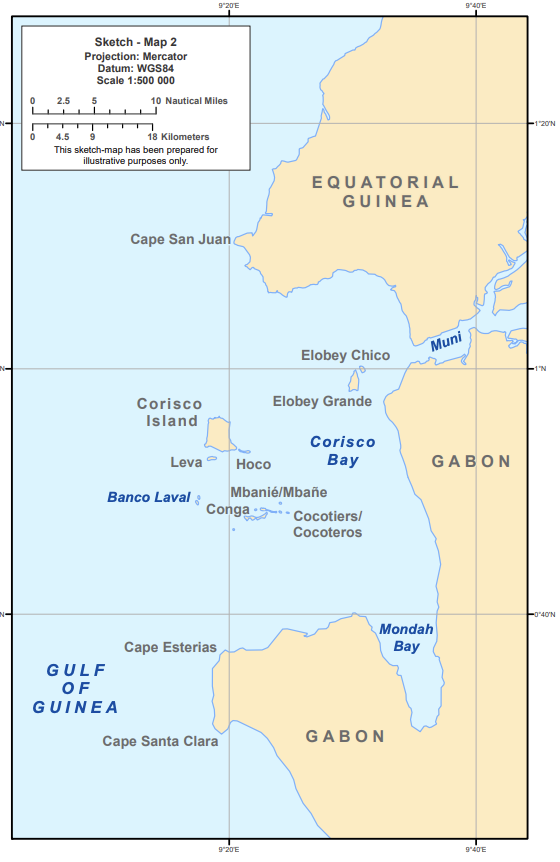
On 19 May 2025 the ICJ delivered its Judgment in Land and Maritime Delimitation and Sovereignty over Islands (Gabon/Equatorial Guinea). Despite the name of the case, the “Court has not been asked therein to delimit the land and maritime boundary or determine sovereignty over the three islands, but only to determine whether the legal titles, treaties and international conventions invoked by the Parties have the force of law in their relations in so far as they concern the dispute between them” (Judgment, para 30). This is detailed in Article 1 of the Special Agreement (2016) which conferred jurisdiction on the ICJ to resolve the dispute.

The operative paragraph of the Judgment provides:

For these reasons, The Court,
(1) By fourteen votes to one,
Finds that the document entitled “Convention delimiting the land and maritime frontiers of Equatorial Guinea and Gabon” (“Bata Convention”) invoked by the Gabonese Republic is not a treaty having the force of law in the relations between the Gabonese Republic and the Republic of Equatorial Guinea and does not constitute a legal title within the meaning of Article 1, paragraph 1, of the Special Agreement;
(2) Unanimously,
Finds that the legal titles invoked by the Gabonese Republic and the Republic of Equatorial Guinea that have the force of law in the relations between them in so far as they concern the delimitation of their common land boundary are the titles held on 17 August 1960 by the French Republic and on 12 October 1968 by the Kingdom of Spain on the basis of the Special Convention on the delimitation of French and Spanish possessions in West Africa, on the coasts of the Sahara and the Gulf of Guinea, signed in Paris on 27 June 1900, to which titles the Gabonese Republic and the Republic of Equatorial Guinea respectively succeeded;
(3) By thirteen votes to two,
Finds that, of the legal titles invoked by the Gabonese Republic and the Republic of Equatorial Guinea, the title that has the force of law in the relations between them in so far as it concerns sovereignty over the islands of Mbanié/Mbañe, Cocotiers/Cocoteros and Conga is the title held by the Kingdom of Spain on 12 October 1968, to which the Republic of Equatorial Guinea succeeded;
(4) Unanimously,
Finds that the Special Convention on the delimitation of French and Spanish possessions in West Africa, on the coasts of the Sahara and the Gulf of Guinea, signed in Paris on 27 June 1900, constitutes a legal title within the meaning of Article 1, paragraph 1, of the Special Agreement to the extent that it has established the terminus of the land boundary between the Gabonese Republic and the Republic of Equatorial Guinea, which shall be the starting-point of the maritime boundary delimiting their respective maritime areas;
(5) Unanimously,
Finds that the 1982 United Nations Convention on the Law of the Sea is an international convention that has the force of law in the relations between the Gabonese Republic and the Republic of Equatorial Guinea, within the meaning of Article 1, paragraph 1, of the Special Agreement, in so far as that Convention concerns the delimitation of their maritime boundary.

Land and Maritime Delimitation and Sovereignty over Islands (Gabon/Equatorial Guinea), Judgment of 19 May 2025 (2025) , para 213.

One Dissenting Opinion (Dissenting opinion of Judge ad hoc Pinto) and two Separate Opinions (Separate opinion of Judge Yusuf; Separate opinion of Judge Tladi) are appended to the Judgment, together with three Declarations (Declaration of Judge Xue; Declaration of Judge Aurescu; Declaration of Judge ad hoc Wolfrum). An area of differences among Judges was in approaching sovereignty over the islands of Mbanié/Mbañe, Cocotiers/Cocoteros and Conga, which Judge Xue notes the “disputed islands became attractive largely because of the subsequent development of the law of the sea and the discovery of maritime non-living resources” (Declaration of Judge Xue, para 20).

In response to pleadings on UNCLOS, the Judgment stated “Although UNCLOS may ‘concern’ the delimitation of the Parties’ common maritime boundary, it is not itself the source of a right to specific maritime areas. Thus, in the view of the Court, UNCLOS does not constitute a legal title within the meaning of Article 1 of the Special Agreement. However, it is an international convention which has the force of law in the relations between the Parties within the meaning of that Article” (Judgment, para 211).

Judges ad hoc Wolfrum and Pinto concurred with the Court’s discussion of UNCLOS, although the latter would not have included it within the operative paragraph of the Judgment (Dissenting opinion of Judge ad hoc Pinto, paras 12, 21). “As far as land territories are concerned, the Convention does not provide for rules or procedures to establish a legal title […] As far as maritime spaces are concerned, recourse to the rules governing the acquisition of land is not applicable in respect of maritime zones. Rights to maritime zones such as the territorial sea (sovereignty), exclusive economic zones and continental shelves (sovereign rights) are developed by recourse to the sovereignty over the relevant land” (Declaration of Judge ad hoc Wolfrum (para 10)). Wolfrum further notes, that the “Judgments of international courts and tribunals in respect of the adjudication of overlapping claims are declaratory in nature, and not constitutive” (Declaration of Judge ad hoc Wolfrum (para 10)).

For more information see the ICJ press release and summary of the Judgment.

Leave a comment

Filed under Jurisprudence, Treaties

Mauritius/UK: Chagos Archipelago Agreement Signed

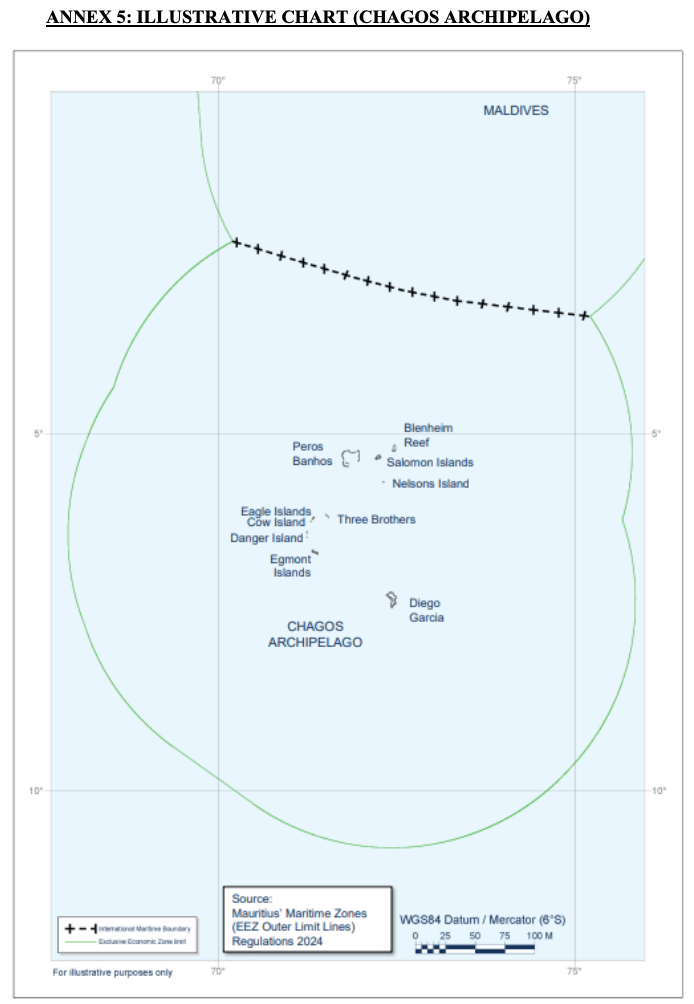
On 22 May 2025 the UK and Mauritius signed the Agreement between the Government of the United Kingdom of Great Britain and Northern Ireland and the Government of the Republic of Mauritius concerning the Chagos Archipelago including Diego Garcia (Chagos Archipelago Agreement), which will enter into force following completion of the respective domestic procedures and notification of the other Party (Art 18). The UK requires amended primary and secondary legislation, while it is estimated the required Mauritian Ministerial decisions will take less than 6 months (Explanatory Memorandum, pp. 11-12).

From a UK perspective, “The purpose of the treaty is to secure the long-term, secure and effective operation of the UK-United States of America (US) military base on Diego Garcia, which is critical for the UK’s national security; to ensure legal certainty over the operation of the Base while respecting partners’ interests; and to uphold the international rule of law” (Explanatory Memorandum, p.2; US State Department). The UK believed the sustainability of the UK operation of the Base was at significant risk, including most notably as a result of the decisions of international courts and tribunals, including the International Court of Justice, relating to the Chagos Archipelago (Chagos Archipelago Agreement, Preamble) and the foreseeability of a future binding decision upon the UK. “Sovereignty was also routinely challenged in the Indian Ocean Tuna Commission, which carried risk of legal challenge leading to an ICJ judgment” (Explanatory Memorandum, p. 3; see further IOTC Agreement, Art 23, which might e.g. be raised in disputes on ‘coastal State’ membership, Art 4). Tellingly, this matter is addressed in Article 8 and the Exchange of Letter on the Interpretation of Article 8 of the Chagos Archipelago Agreement (22 May 2025), which provides that upon entry into force, among others, the UK confirms its membership of the Indian Ocean Tuna Commission (IOTC) in respect of Chagos Archipelago transfers to Mauritius and the UK will not claim ‘Coastal State’ but ‘Distant Water Fishing Nation’ membership status at IOTC. The Explanatory Memorandum also made it clear that Mauritius made “frequent public commitments to continue pursuing its legal campaign to secure a binding judgment. The UK government of the day (and all subsequent governments) recognised that there were multiple pathways by which Mauritius could achieve this”.

From a Mauritius perspective, the Chagos Archipelago Agreement “recognises the sovereignty of Mauritius over the entirety of the Chagos Archipelago, including Diego Garcia […] [and] marked a significant step in the completion of the decolonisation process of Mauritius” (Prime Minister Navinchandra Ramgoolam’s Remarks;  Chagos Archipelago Agreement, Preamble). Recognising the “wrongs of the past”, the Chagos Archipelago Agreement shall address the past treatment of Chagossians and their continuing welfare.

The Chagos Archipelago Agreement is designed as a comprehensive agreement in ‘full and final resolution of the differences’ related to the Chagos Archipelago and therefore addressed an array of ocean governance issues. A unique compulsory dispute settlement procedure by arbitration, which can only be triggered by the UK, is provided in Article 15(4)-(5) and Annex 4 concerning disputes on if a ground for termination exists and the dispute cannot be resolved by other means. A non-exhaustive selection of key provisions for ocean governance is provided below:

Article 1 Sovereignty
Mauritius is sovereign over the Chagos Archipelago in its entirety, including Diego Garcia.

Article 2 Authorisation in respect of Diego Garcia
1. As sovereign, Mauritius authorises the United Kingdom to exercise the rights and authorities of Mauritius with respect to Diego Garcia in accordance with the terms of this Agreement.
2. The authorisation under paragraph 1 shall comprise all rights and authorities that the United Kingdom requires for the long-term, secure and effective operation of the Base, including for the Defence and Security Requirements, Conditions and Procedures in Annex 1 and the Jurisdiction and Control Arrangements in Annex 2.
3. Mauritius retains title over the land and the territorial sea of Diego Garcia, including the seabed and subsoil, as well as all rights and authorities not authorised under paragraphs 1 and 2, including:[…]
f. sovereignty over natural resources, including fisheries;
g. conservation and protection of the environment, including the marine environment;

Article 3 Defence and Security
1. The Parties agree to the Defence and Security Requirements, Conditions and Procedures in Annex 1 […]
3. The Parties shall cooperate on matters relating to maritime security, including trafficking in narcotics, arms and persons, people smuggling and piracy.

Article 5 Environment
1. The United Kingdom shall exercise the rights and authorities under Article 2 in accordance with applicable international law on environmental protection, and with due regard to applicable Mauritian environmental laws.
2. The United Kingdom agrees to provide support and assistance to Mauritius in the establishment and management of its Marine Protected Area in the Chagos Archipelago, in accordance with terms to be agreed between the Parties by a separate written instrument.
3. The Parties shall cooperate on other matters relating to the protection of the environment, including in relation to oil and other spills, and illegal, unreported and unregulated fishing.

Article 8 International Organisations
1. The United Kingdom agrees to ensure its membership in international organisations is consistent with Article 1.

Article 12 Joint Commission
A Joint Commission to facilitate the implementation of this Agreement shall be established. The composition, functions and procedures of the Joint Commission are set out in Annex 3 [which provides for a composition of UK and Mauritius representatives, with the USA having observer status].

Article 19 Definitions
For the purposes of this Agreement: […]
Chagos Archipelago” means the islands, including Diego Garcia, and maritime zones of the Chagos Archipelago, including the internal waters, territorial sea, archipelagic waters and the exclusive economic zone, and the airspace above and seabed and subsoil below [without prejudice to Mauritius’ claims in respect of the continental shelf].
“Diego Garcia” means the island of Diego Garcia and a twelve (12) nautical mile zone surrounding the island of Diego Garcia, and includes the airspace above and seabed and subsoil below.

Annex 1: Defence And Security Requirements, Conditions And Procedures
Diego Garcia
1. In accordance with this Agreement and with reference to Article 2(5) and Annex 2, in respect of Diego Garcia, Mauritius agrees the United Kingdom shall have:
a. unrestricted access, basing and overflight for United Kingdom and United States of America aircraft and vessels to enter into the sea and airspace of Diego Garcia;
b. unrestricted ability to: […]
v. authorise the installation, operation and repair of new and existing communication systems and electronic systems and associated cables; […]
viii. permit access, basing and overflight for non-United Kingdom and non-United States of America aircraft and vessels, upon notification to Mauritius; and
ix. manage, use and develop the land and surrounding waters and seabed for defence purposes. This excludes the construction of any artificial islands.

Chagos Archipelago beyond Diego Garcia
3. In accordance with this Agreement, in respect of the Chagos Archipelago beyond Diego Garcia, Mauritius agrees:
a. vessels and aircraft of the United Kingdom and the United States of America shall have unrestricted rights of overflight, navigation and undersea access. States operating with the United Kingdom or the United States of America shall also have such unrestricted rights, save in respect of overflight or undersea access, which require notification;
b. the United Kingdom shall have rights of access for maintenance and upgrades of equipment, following notification to Mauritius, after having advised Mauritius of the location of all such equipment; […]
f. between twelve (12) and twenty-four (24) nautical miles surrounding the island of Diego Garcia, Mauritius and the United Kingdom shall jointly decide on the construction or emplacement of any maritime installation, sensor, structure or artificial island.

Mauritian Security Review
4. Before approving or proceeding with a proposal for:
a. the construction or emplacement of any maritime installation, sensor, structure or artificial island in an area beyond the twenty-four (24) nautical miles surrounding the island of Diego Garcia; or
b. any proposal for development in the land territory of the Chagos Archipelago beyond Diego Garcia, Mauritius shall conduct a Security Review in accordance with paragraph 6 [which provides for information exchanges with the UK, as well as possible decision making by the Joint Commission. An emerging risks procedure is also found in para 7].

11. For the purposes of this Annex:
a. “access” refers to the grant of rights or permissions which would not otherwise exist in international law. Nothing in this Agreement modifies or affects any rights, including rights of overflight or navigation, which exist as a matter of international law;
b. “Chagos Archipelago beyond Diego Garcia” means any area within the Chagos Archipelago that is beyond Diego Garcia;
c. “unrestricted” means not requiring permission or notification, subject to the standing authorisations and notifications separately agreed between the Parties to meet the requirements of international or domestic Mauritian law or current practice.

Annex 2: Jurisdiction And Control Arrangements
Mauritian criminal jurisdiction
3. On Diego Garcia, Mauritius shall exercise all prescriptive, enforcement and adjudicative criminal jurisdiction conferred on it by its laws in relation to allegations against […]
b. all persons not connected to the operation of the Base, including persons involved in offences relating to unlicensed commercial fishing and the trafficking in arms or narcotics.

Cooperation in the exercise of criminal jurisdiction
8. In order to support the exercise of jurisdiction by Mauritius on Diego Garcia, the United Kingdom agrees to provide assistance to Mauritius in: […]
e. the prevention of unlicensed commercial fishing, and trafficking of arms, persons and narcotics and illegal migration.

Miscellaneous
15. Mauritius shall exercise criminal and civil jurisdiction in respect of activities such as irregular migration and unlicensed commercial fishing, provided such exercise of jurisdiction is in conformity with the requirements of this Agreement.

Chagos Archipelago Agreement (2025)

Finally, the signing of the Chagos Archipelago Agreement was accompanied by the signing of a new Strategic Partnership Framework. Among other items, it will address:

  • Deepening cooperation on maritime security and irregular migration in areas such as “irregular migration, drugs trafficking, piracy, and illegal, unregulated and unreported fishing”. This will include “Cooperation agreements and capacity building to secure Mauritius’s Exclusive Economic Zone; Consideration of patrolling capability across the Chagos Archipelago to support a secure maritime domain; Cooperation to counter and manage irregular migration; and Provision of training and institutional partnerships to boost Mauritian maritime security capability and strengthen fisheries protection”.
  • Cooperation in addressing climate change. This will include “Mitigation and adaptation projects to tackle the immediate effects of climate change including coral restoration, coastal erosion and indigenous species conservation; and Technical expertise to develop and manage the Chagos Archipelago Marine Protected Area, pursuant to the agreement on the exercise of sovereignty over the Chagos Archipelago”.

For further information, see previous reporting.

Leave a comment

Filed under Jurisprudence, State Practice, Treaties

PCA: Ruling in UK-Sandeel Fisheries Dispute

On 28 April 2025 an Arbitral Tribunal  (Trade and Cooperation Agreement (TCA), Article 740) established in UK-Sandeel (The European Union v. the United Kingdom of Great Britain and Northern Ireland) issued its Ruling. The European Union challenged the UK’s sandeel fishing prohibition which is composed of two distinct measures (one measure taken by the Scottish Government in respect of Scottish waters and one measure taken by the UK Government in respect of English waters) but both being attributable to the UK as a Contracting Party to the Trade and Cooperation Agreement (Ruling, paras 418-427). In essence the EU challenged the two measures on the basis (a) the fisheries management measures were not based on ‘best available science’ (TCA, Art 496(2)) and (b) the fisheries management measures did not have regard to agreed principles, namely proportionality and non-discrimination (TCA, Art 494(3)(f)). When interpreting the TCA, the Arbitral Tribunal included UNCLOS, WTO Agreements, and fisheries instruments, in particular the FAO Code of Conduct, among the relevant rules of international law.

So long as they are consistent with the TCA, the Parties agreed that fisheries management measures, including fishing prohibitions which impair the rights of a Party, may be adopted to pursue legitimate objectives in respect of the marine environment. The Tribunal affirmed that the rights of other States imposes limits of the exercise of coastal State rights, but “that there is no obligation under UNCLOS to grant access to the surplus of the allowable catch to a particular State” (paras. 447-448). The TCA reaffirms that Parties granted access to the waters of another Party have access conditioned by compliance with the conservation and management measures adopted, and said Party must ensure compliance by its vessels (para 463). But, the TCA does not leave Parties with unfettered regulatory autonomy in respect of fisheries management. The Tribunal agreed that “the requirements laid down in Article 494, Article 496 and Annex 38 to the TCA are important limits to the exercise of regulatory autonomy to adopt fisheries management measures” (para. 467).

The Arbitration Tribunal found that both the English and the Scottish parts of the measure were based on best available scientific advice and that there was an objective connection between the scientific advice and the sandeel fishing prohibition in UK waters:

593. The Arbitration Tribunal therefore finds that the European Union has failed to demonstrate that the sandeel fishing prohibition in UK waters is inconsistent with the United Kingdom’s obligations under Article 496(1) and 496(2) of the TCA, read together with Article 494(3)(c) of the TCA.

On proportionality and non-discrimination, the Tribunal noted the principles must inform the decision-making process on fisheries management measures. “[C]onsideration will be informative but not determinative of the decision to adopt a measure” (para 605).

Proportionate measures “must be adopted ‘for the conservation of marine living resources and the management of fisheries resources’ and be [an] apt or appropriate [means] to secure or contribute to that objective'”, including a weighing and balancing of the measure’s environmental, economic and social costs and benefits (paras 623-624).

On the measure concerning English waters:

689. The failure to take into account the rights of the European Union under the TCA and their systemic importance in securing stability during the adjustment period compromised the weighing and balancing exercise such that the Arbitration Tribunal is of the view that the decision-maker did not have regard to the principle of applying a proportionate measure.
690. For the above reasons, the Arbitration Tribunal finds that the United Kingdom’s decision to close English waters to sandeel fishing was inconsistent with the requirement in Article 496(1), read together with Article 494(3)(f) of the TCA, to have regard to the principle of applying a proportionate measure for the conservation of marine living resources and the management of fisheries resources.

On the measure concerning Scottish waters:

725. Regard was had not only to the benefits of the sandeel prohibition in Scottish waters, but also to the economic costs to the UK and EU fishing and processing industries and the impairment of the rights of the European Union during the adjustment period. Furthermore, these considerations were applied in the actual weighing and balancing that was undertaken by the Scottish decisionmaker. Attention was paid to the TCA adjustment period, ending 30 June 2026, and the need to take measures to build the resilience of Scottish seabird populations due to recent significant declines. In this, the Scottish decision can be contrasted with that of the United Kingdom in respect of the sandeel fishing prohibition in English waters.
726. The Arbitration Tribunal, therefore, finds that the Scottish measure to close Scottish waters to sandeel fishing is not inconsistent with the requirement in Article 496(1), read together with Article 494(3)(f) of the TCA, to have regard to the principle of applying a proportionate measure. As explained above, the decision-maker had regard to the principle of applying a proportionate measure as it took into account the relevant considerations and applied these in a weighing and balancing exercise, thereby satisfying the requirement to “have regard to” the principle of applying a proportionate measure.

On non-discrimination, the Tribunal noted “the principle applies to the measure itself, its application and its consequences, and refers to both de jure and de facto discrimination. This requires consideration of whether the design, content and application of the measure reflects the principle of non-discrimination” (para 631). The EU claim concerned de facto discrimination. “De facto discrimination may occur where differential treatment is not based on a legitimate regulatory objective or where there is a lack of a clear nexus between the differential treatment and the regulatory objective” (para 730). The Tribunal found:

731. […] The differential impact on vessels of the United Kingdom and European Union is due to the quota shares set out in Annex 35 to the TCA.
732. The Arbitration Tribunal does not consider that a Party is required to take into account the TAC quota shares in deciding on a fisheries management measure. Rather, each measure should be decided on in light of its legitimate objectives and the requirement to have regard to applying the principle of non-discrimination […]
733. The Arbitration Tribunal considers that there is a clear nexus between the differential treatment and the legitimate objective, which is to close all UK waters to all UK and EU vessels in order to provide ecosystem benefits.
734. For the above reasons, the Arbitration Tribunal finds that the United Kingdom’s decision to close UK waters to sandeel fishing was not inconsistent with the requirement in Article 496, read together with Article 494(3)(f) of the TCA, to have regard to the principle of applying nondiscriminatory measures for the conservation of marine living resources and the management of fisheries resources.

On the alleged breach of the obligation to grant full access to fish sandeel pursuant to Annex 38 to the TCA:

743. The Arbitration Tribunal is of the view that the European Union has structured its claim of a breach of Article 2(1)(a) of Annex 38 as a purely consequential claim. The claim for a breach of Article 2(1)(a) of Annex 38 therefore stands or falls on the basis of the findings in respect of the claims under Article 496, read together with Article 494 of the TCA. In this sense “the consequential element is symmetrical”. Once a breach of Article 496(1), read together with Article 494, has been found, that is the end of the Arbitration Tribunal’s remit.
744. The Arbitration Tribunal therefore finds, on the basis of its reasoning in Section V.D.3 that the United Kingdom’s decision to close English waters to sandeel fishing was inconsistent with the requirements of Article 496(1), read together with Article 494(3)(f) of the TCA, to have regard to the principle of applying a proportionate measure for the conservation of marine living resources and the management of fisheries resources, and that in consequence, therefore, there has been a breach of Article 2(1)(a) of Annex 38 of the TCA.

For further information see previous reporting.

Leave a comment

Filed under Jurisprudence, State Practice

Norway: WWF v. Norway (Ministry of Energy), Judgment

On 13 February 2025 the Oslo District Court issued judgment in Stiftelsen WWF Verdens Naturfond v. Staten v/ Energidepartementet (Case No. 24-081980TVI-TOSL/04). The case concerned the validity of the Royal Decree of 12 April 2024 on the opening of an area on the Norwegian Continental Shelf for mineral activities (previously reported). WWF challenged whether the mandatory impact assessment prior to opening of new areas on the continental shelf for mineral activities met the substantive requirements under Section 2-2 of the Seabed Minerals Act, as interpreted by other domestic and international law, including Article 206 of UNCLOS and the precautionary principle. The Decree was also challenged for being based on materially incorrect facts. The Decree was not invalidated, although WWF have signalled they will appeal the decision. On law of the sea:

It has not been alleged that Norway has not fulfilled its reporting obligations under Article 205 of [UNCLOS], or that the obligation to assess the potential environmental impacts ‘as far as practicable’ extends beyond the obligation to conduct an impact assessment under Section 2-2 of the [Seabed Minerals Act].

WWF v. Ministry of Energy, Judgment p. 26 (machine translation)

Overall, the district court finds that Norwegian law interpreted in accordance with international and national law requires that both probable and possible, but not theoretical or constructed, environmental consequences of an opening decision must be ‘illuminated’ in an impact assessment prepared by the ministry before the government can decide on new areas opened for mineral activities [Section 2-2 of the Seabed Minerals Act]. International law requirements indicate that the verb ‘illuminate’ means that the probable and possible environmental consequences must both be identified, described and assessed.

The impact assessment is obliged to use all available knowledge and assessment methods. Depending on the circumstances, new scientific studies may also be necessary where the knowledge base falls short […] The international and EU law investigation requirement is also not absolute, but is limited by a reasonableness, materiality, probability and/or proportionality limitation that, in the end, is not found to deviate significantly in content from the domestic law requirements.

WWF v. Ministry of Energy, Judgment pp. 30-31 (machine translation)

Leave a comment

Filed under Jurisprudence, State Practice

ITLOS: The “Zheng He” Case, Order of 3 February 2025

On 3 February 2025 the President of ITLOS, in respect of The “Zheng He” Case (Luxembourg v. Mexico), issued Order 2025/1 of 3 February 2025. The Order extends the time limit for the submission of the Memorial of Luxembourg and the Counter-Memorial of Mexico, respectively. Of note, the Order responds to requests from both parties to the dispute following the entry “into a phase of bilateral negotiations” (Order 2025/1 of 3 February 2025, para 3). For more information, see the previously reported incidental provisional measure proceedings.

Leave a comment

Filed under Jurisprudence, State Practice

Ecuador: marine-coastal ecosystems upheld as rights holders by Constitutional Court

The Constitutional Court of Ecuador (Corte Constitucional del Ecuador) issued on November 28, 2024 a landmark decision in Case 95-20-IN. The Court dismissed a claim of unconstitutionality against Article 104 of the Organic Law for the Development of Aquaculture and Fishing (Ley Orgánica para el Desarrollo de la Acuicultura y Pesca, or LODAP). The article establishes an 8-mile coastal zone exclusive to artisanal fisheries, a move contested by members of the industrial fishing sector.

The claimants argued that the contested regulation was incompatible with the right to comprehensive nature conservation and the rights of nature to restoration, asserting that it established an exclusive 8-mile zone for artisanal fishing that limited the authority to implement necessary management measures to protect resources. They contended that the rigid zoning failed to allow adjustments based on scientific evidence, potentially leading to anthropogenic disasters and species extinction, and conflicted with the State’s obligation to implement precautionary measures. The claimants also emphasized that the State must ensure natural cycles and functions through technically supported, sustainable fishing regulations, which they believed the contested regulation failed to achieve.

The Court upheld the 8-mile zone exclusively for artisanal fishing, ruling it consistent with constitutional principles, including the rights of marine-coastal ecosystems, the principle of prevention, and the right to economic activities. It recognized the zoning as a legislative policy grounded in scientific data, aimed at protecting nature, human bioconnected rights, and the artisanal fishing economy. The Court also emphasized that decisions on modifying the zone’s extent are technical matters for the legislature, not within its jurisdiction to evaluate. Overall, the Court concluded that, in abstract terms, the contested provision aligns with constitutional principles, recognizing en passant that marine-coastal ecosystems are holders of rights:

50. Este Organismo no puede dejar de observar la interdependencia que existe entre el derecho de los ecosistemas marinos-costeros de respeto integral a su existencia y la regeneración de los ciclos vitales de las especies que habitan en ellos con su equilibrio ecológico, así como con la vida en armonía con la naturaleza. En esta línea, la protección de estos ecosistemas no solo resulta fundamental a fin de preservar un espacio para la reproducción y desarrollo de los elementos que habitan en ellos. Al contrario, la justificación de esta protección radica en el compromiso de “construir una nueva forma de convivencia ciudadana, en diversidad y armonía con la naturaleza […]”. Aquello, implica la posibilidad de limitar actividades antrópicas con el objetivo de velar por el equilibrio de las cadenas tróficas.

55. Los ecosistemas marinos-costeros son titulares de los derechos reconocidos a la naturaleza. Esta protección, al igual que otros derechos constitucionales, encuentra sus límites. La propia Constitución prevé la posibilidad de que se realicen actividades pesqueras. Sin embargo, estas deben estar reguladas para que sean sostenibles y respeten los ciclos, funciones, estructuras y procesos evolutivos de los ecosistemas marino-costeros, así como su conservación y restauración, a fin de velar por los derechos de la naturaleza y el equilibrio de las cadenas tróficas. De ahí que se establezcan tipos de pesca, espacios para realizarla y zonas de conservación de acuerdo con las características de dichos ecosistemas.

63. Bajo esta consideración, la autoridad competente, al emitir las resoluciones correspondientes, tiene la obligación de garantizar que las actividades pesqueras en esta zona no vulneren los derechos de este ecosistema. Por lo tanto, debe realizar un ejercicio estricto al verificar el cumplimiento de requisitos constitucionales, legales e infralegales y anticipar la responsabilidad que podría implicar la emisión de directrices que impliquen vulneraciones de derechos constitucionales por no haber adoptado las previsiones necesarias.

This decision has the practical effect of recognizing that the Ecuadorian Constitutional Rights of Nature, as enshrined in the Chapter 7 of the Constitution of Ecuador (Articles 71-74), also apply to its maritime domain.

The complete version of this decision is available in Spanish on the website of the Court.

Leave a comment

Filed under Jurisprudence

PCA: EU v. UK Arbitral Tribunal Established

As previously reported, on 25 October 2024 the EU had initiated arbitral proceedings against the UK concerning the –as characterised by the EU– “sandeel fisheries prohibition”. On 18 November 2024, the Arbitration Tribunal (Trade and Cooperation Agreement, Article 740) was established and the case added to the PCA’s list of cases in which it is acting as registry: The European Union v. The United Kingdom of Great Britain and Northern Ireland (PCA Case No. 2024-45).

To-date, documents available in the Sandeel Fisheries Prohibition Arbitration (EU v. UK) include the EU Request for the Establishment of the Arbitration Tribunal.

Leave a comment

Filed under Jurisprudence, State Practice

Netherlands: NORI v. Greenpeace and Phoenix – Appeal Judgment

On 12 November 2024 the Amsterdam Court of Appeal issued judgment in appeal summary proceedings concerning the previously reported preliminary relief in Nauru Ocean Resources Inc (NORI) v. Stichting Greenpeace Council and Stichting Phoenix (ECLI:NL:GHAMS:2024:3127). In confirming the judgment under appeal and rejecting an incidental appeal two matters of principal interest to the law of the sea were addressed.

First, in rejecting an incidental appeal by Greenpeace concerning NORI being inadmissible as only representing the interest of its parent company (The Metals Company (TMC)), the court confirmed “NORI, as a contractual party of [International Seabed Authority] ISA in the contract from which the research on the seabed by COCO in [the NORI-D Contract Area of the Clarion Clipperton Zone] arises, has a legally respectable interest in the claims” (para. 4.4).

Second, in rejecting NORI’s appeal on the dismissal of its second claim in the first instance, that Greenpeace “be prohibited from being within a radius of 500 metres around the COCO for a period of six months after service of the judgment and from taking or facilitating unlawful and obstructive actions there, as long as the COCO is located in the Clarion Clipperton Zone” (para 4.1), the court found that the claim is “inadmissible because there is no urgent interest in it” (para 4.5). The deployment of the COCO to the Clarion Clipperton Zone in the foreseeable future was currently a “purely hypothetical situation”, as was the “need for clarity about the admissibility of any future protest actions by Greenpeace with a view to the budget and planning of new deployment of the COCO” (para 4.5).

However, the court also made several interesting observations on protests at sea when discussing the second claim, affirming the application of both the law of the sea and human rights law, but distinguishing the legal aspects raised by protests in the vicinity of a foreign vessel from those conducted on board a vessel flying a flag of a contracting party to a relevant human rights treaty:

Claim II amounts to a general ban on Greenpeace et al. from carrying out a protest action within a radius of 500 metres from the COCO (as the court understands: in [place], although this is not stated in the conclusion on appeal) for a period of six months (after service of the judgment). As the court assumes, NORI is referring to an action such as that carried out by Greenpeace at the end of 2023 on the high seas against deep-sea mining, with the ARCTIC SUNRISE, canoes and motorised rubber dinghies in close proximity to the COCO and with action on board the COCO.

It is rightly not disputed that the question of whether a protest action on the high seas on board the COCO sailing under the Danish flag, as a result of which Danish law applies on board, must be answered on the basis of Article 10 and/or 11 of the European Convention on Human Rights (ECHR).

With regard to a protest action by the ARCTIC SUNRISE, the canoes and the motorised rubber dinghies on the high seas in the vicinity of (but not on board) the COCO, this question must be answered on the basis of the relevant rules of maritime law. Protest actions at sea are considered to be a lawful use of the sea linked to the freedom of navigation as referred to in Article 87, paragraph 1, introductory phrase and (a), of the United Nations Convention on the Law of the Sea (UNCLOS) (cf. ARCTIC SUNRISE Arbitration, PCA case no. 2014-02, Award on the Merits, 14 August 2015, par. 227). The right to protest on the high seas derives from the internationally recognised freedoms of expression and association, as laid down, inter alia, in the International Covenant on Civil and Political Rights (ICCPR) and the ECHR. Whether a protest on the high seas is permissible depends on the facts and circumstances of the specific case. The right to protest on the high seas is limited by the relevant maritime law, which serves, among other things, the safety and freedom of use of the sea and from which it follows that only peaceful protest actions are permitted (Article 88 UNCLOS). The precise content of the maritime law that is (potentially) relevant here – including the question of whether the Convention for the Suppression of Unlawful Acts against the Safety of Maritime Navigation (SUA Convention) is relevant in this context – can be left undiscussed.

NORI v. Greenpeace & Phoenix (Gerechtshof Amsterdam, 200.337.542/01), para 4.5

For further context, see the Greenpeace and TMC responses following judgment.

Leave a comment

Filed under Jurisprudence

EU/UK: EU Requests Establishment of Arbitral Tribunal in Sandeel Fisheries Dispute

As previously reported, in April 2024 the EU had submitted a written request for consultations with the UK under the dispute settlement mechanism of the EU-UK Trade and Cooperation Agreement (TCA) regarding the UK’s decision to prohibit the fishing of sandeel in UK waters. On 25 October 2024, the EU announced that “consultations concluded without reaching such a mutually agreed solution” and has now requested the establishment of an Arbitration Tribunal under the dispute settlement mechanism of the EU–UK Trade and Cooperation Agreement (TCA) concerning the UK’s decision to prohibit the fishing of sandeel.

Leave a comment

Filed under Jurisprudence, State Practice

Dispute Concerning Detention of Ukrainian Naval Vessels/Servicemen, Ruling and Appointment of Replacement Arbitrators

Following the previously reported Decision on Challenges and resignation of two arbitrators in the Dispute Concerning the Detention of Ukrainian Naval Vessels and Servicemen (Ukraine v. the Russian Federation), on 8 August 2024 the President of ITLOS, following consultations, appointed Mr James Kateka (United Republic of Tanzania) and Ms Joanna Mossop (New Zealand) to fill the vacancies (UNCLOS, Annex VII, Art 3(e)-(f)), as well as appointing Mr Gudmundur Eiriksson (Iceland) as president of the Arbitral Tribunal (UNCLOS, Annex VII, Art 3(e)-(f)).

The appointments follow previous developments under the Arbitral Tribunal, whereby, among others, the Russian Federation had requested the Arbitral Tribunal “proceed with a ruling in respect of the proper procedure for appointment of replacement arbitrators” (Procedural Order No. 9, para 1). The Arbitral Tribunal noted “that the Parties disagree on the proper interpretation and application of Article 3 of Annex VII to the Convention and the Rules of Procedure [..and..] notes especially its reference to the desirability of agreement between the Parties” (Procedural Order No. 9, paras 45-46). While progress was made, no agreement between the Parties on the appointment of replacement arbitrators was reached (Procedural Order No. 9, paras 17-22). In proceeding with the request, the analysis of the Arbitral Tribunal stated:

39. Professor McRae and Judge Wolfrum were appointed as members of the Arbitral Tribunal, and Professor McRae as its President, by the ITLOS President. Thus, in accordance with Article 3, subparagraph (e), of Annex VII, “the manner prescribed for [their] initial appointment” under subparagraph (f) for filling the vacancies resulting from the successful challenges to Professor McRae and Judge Wolfrum is that outlined in Article 3, subparagraph (e).
[…]
43. In Article 6 of its Rules of Procedure, the Arbitral Tribunal chose to deal with the application of the term in Article 3, subparagraph (e), of Annex VII to the Convention, “the manner prescribed for [their] initial appointment”, in the case of filling a vacancy in the event of withdrawal, incapacity or death of an arbitrator […]
44. Notably, Article 6, paragraph 1, of the Rules of Procedure does not refer to the event of disqualification of an arbitrator upon a successful challenge by a Party.

Procedural Order No. 9, paras 39-44

The Arbitral Tribunal ultimately concluded in Procedural Order No. 9 of 18 July 2024:

48. In its request for a ruling, the Russian Federation has not identified any question of procedure which, in the terms of Article 1, paragraph 2, of the Rules of Procedure of the Arbitral Tribunal, “is not expressly governed by these Rules [of Procedure] or by Annex VII to the Convention or other provisions of the Convention”, and the Arbitral Tribunal will not rule, in the abstract, on questions outside this scope.
49. Ukraine has now applied to the ITLOS President to appoint replacements for Professor McRae and Judge Wolfrum. It is not for this Arbitral Tribunal to comment on how the ITLOS President should respond to that request.
50. Accordingly, for the reasons set out above, the Acting President and the other members of the Arbitral Tribunal, by a majority of two to one, reject the request of the Russian Federation that the Arbitral Tribunal rule on the procedure for the appointment of replacement arbitrators.

Procedural Order No. 9, paras 48-50

Professor Vylegzhanin appended a Dissenting Opinion to Procedural Order No. 9 (not yet publicly available).

Leave a comment

Filed under Jurisprudence

ITLOS: The “Zheng He” Case, Order of 27 July 2024

As noted in previous reporting, incidental proceedings arose in The “Zheng He” Case (Luxembourg v. Mexico) following a request from Luxembourg for provisional measures. On 27 July 2024 the International Tribunal for the Law of the Sea (ITLOS) delivered its Order of 27 July 2024 in The “Zheng He” Case (Luxembourg v. Mexico), Provisional Measures.

As the dispute on the merits is before ITLOS, and consistent with Article 290(1) of UNCLOS, the Tribunal first considered that prima facie it does have jurisdiction over the dispute regarding the “Zheng He” vessel (paras. 52-106). Concerning the applicability and/or fulfilment of Article 295 of UNCLOS, in light of the circumstances of the case, the Tribunal decided “the issue of exhaustion of local remedies should be examined at a future stage of the proceedings” (para. 105).

Following previous precedents, the ‘preservation’ of rights (UNCLOS, Article 290(1)) was interpreted by the Tribunal to include a requirement that the rights claimed must be plausible. On the plausibility of the rights the applicant seeks to protect –and given the prima facie jurisdiction finding concerning Article 131 of UNCLOS– the Tribunal found that the rights claimed by Luxembourg on the basis of Article 131 are plausible (paras. 107-125).

Likewise, while ‘urgency’ is not explicitly mentioned as a requirement under Article 290(1) of UNCLOS (in contrast to Article 290(5)-based proceedings), previous interpretations and application of Article 290 have suggested urgency as an important element in considering all requests for provisional measures. The Order of 27 July 2024 adopts this approach whereby “The Tribunal may prescribe provisional measures if the urgency of the situation so requires. Urgency implies that there is a real and imminent risk that irreparable prejudice may be caused to the rights of the parties to the dispute, pending the final decision” (para. 126). However, “[o]n the basis of the factual information and legal arguments presented by the Parties, the Tribunal considers that there is at present no urgency, in the sense that there is no real and imminent risk of irreparable prejudice to the rights claimed by Luxembourg” (para. 143). This finding was made in the context of assurances given by Mexico during the oral hearings to which the Tribunal “takes note” (paras. 144-145). Thus, the operative paragraph provides:

The Tribunal
By 22 votes to 1 ,
Finds that the circumstances, as they now present themselves to the Tribunal, are not such as to require the exercise of its powers to prescribe provisional measures under article 290, paragraph 1, of the Convention.

Order of 27 July 2024, para. 149

Appended to the Order of 27 July 2024, one will find a Declaration of Judge Kittichaisaree; Joint declaration of Judges Infante Caffi and Kamga; Separate opinion of Judge Kulyk; and Dissenting opinion of Judge ad hoc Kohen.


Leave a comment

Filed under Jurisprudence, State Practice

English Court of Appeal: judgment on the MV Ever Given salvage claim dispute rendered

The English Court of Appeal rendered judgment in the dispute between salvors and the shipowners as to whether a salvage contract on commercial terms had been made in connection with the re-floating of the “Ever Given” in the Suez Canal in March 2021 (SMIT Salvage & Ors v. Luster Maritime SA & Anr (The Ever Given) [2024] EWCA Civ 260).

The appellants, the owners of the ‘Ever Given’, contended that such a contract was concluded, leaving other contractual terms to be agreed at a later stage (although they never were), and that its effect is to preclude a claim for salvage under the International Convention on Salvage 1989 or at common law. The salvors said that no such contract was concluded and that they are therefore able to bring their claim for salvage services rendered, with the quantum of their claim to be determined by the Admiralty Court. The Admiralty judge held that no such contract was concluded. He did so on the ground that although what the parties agreed was capable of amounting to a contract as to the remuneration payable to the salvors for any services which they provided, the parties did not on an objective view intend that agreement to be legally binding until the remaining terms (including as to what services the salvors would provide) were also agreed. See Admiralty Court judgment, dated 30 March 2023, here.

The English Court of Appeal dismissed the appeal of the owners highlighting that several issues had not been agreed, including “such basic matters as the nature of the services which SMIT would provide, the standard of care which it would be required to exercise, and the payment terms, and left it for future agreement a detailed contract on the Wreckhire 2010 form”. The court found that the owners did not demonstrate an unequivocal intention to be legally bound, based on the parties’ exchanges; that the ultimatums do not undermine the analysis that no binding contract was formed; and that although the urgency to finalize the contract diminished after the remuneration terms were agreed upon, SMIT’s strong position and likelihood of a salvage award defused the urgency, indicating no prior binding agreement on remuneration terms alone. As the court agreed with the Admiralty judge’s conclusion that no binding contract was formed, it found it unnecessary to consider the standard of review on appeal. See Court of Appeal judgment, dated 19 March 2024, here.

Leave a comment

Filed under Jurisprudence

ITLOS: The “Zheng He” Case, Provisional Measures Request

As previously suggested, on 7 June 2024 the International Tribunal for the Law of the Sea (ITLOS) received a request from Luxembourg for the prescription of provisional measures in The “Zheng He” Case (Luxembourg v. Mexico) (UNCLOS, Article 290(1)). According to the Request for Provisional Measures of Luxembourg:

79. In accordance with article 17, paragraph 2, of the Statute of the Tribunal, Luxembourg appoints Professor Marcelo Gustavo Kohen to sit as a member of the Tribunal.
80. For the reasons set out above, Luxembourg respectfully requests the Tribunal to prescribe the following provisional measures:
1. In order to safeguard the basic rights and freedoms of the crew:

  • Order Mexico to continue to ensure the freedom of circulation of the crew members off board the vessel and their access to health-care establishments, places of worship and recreational facilities;
  • Order Mexico to continue to ensure that there will be no impediments to the renewal of the crew and the necessary rotations;
  • Order Mexico to continue to ensure that the crew will not be compelled by law enforcement agencies to disembark from the vessel nor be prevented from reembarking the vessel;

    2. In order to safeguard the rights of Luxembourg as the flag State:
  • Order Mexico to allow Luxembourg to effectively exercise its jurisdiction and control in administrative, technical and social matters over the vessel, and to enable any measures necessary for the preventive and corrective maintenance of the Zheng He in order to ensure its compliance with the national, European and international standards applicable to vessels flying the flag of Luxembourg;
  • Prohibit Mexico from directly or indirectly exploiting the vessel Zheng He;
  • Prohibit Mexico from taking any measures to create or transfer real rights to the vessel and from changing the flag of the vessel Zheng He;

    3. In order to avoid aggravating or extending the dispute:
  • Prohibit Mexico from collecting the customs fine of 1,616,462,343.52 Mexican pesos imposed on European Dredging Company SA;
  • Prohibit Mexico from immobilizing, confiscating and expropriating, in any proceeding whatsoever, vessels related to the vessel Zheng He flying the flag of Luxembourg, whether they be the property of European Dredging Company SA, its parent company SOFIDRA or any other subsidiary of SOFIDRA;
  • Prohibit Mexico from initiating new national proceedings or new actions against the Zheng He, European Dredging Company SA, its parent company SOFIDRA or any other subsidiary of SOFIDRA;

    4. In order to ensure equality of the parties in the proceedings before the Tribunal:
  • Authorize the agents of Luxembourg to conduct on the territory of Mexico, without restriction, any investigations in connection with the present proceedings, in particular to ascertain the condition of the vessel Zheng He and to collect any relevant evidence;
  • Transmit to Luxembourg, at its request and after verification by the Tribunal, the information and documents to which Luxembourg was unable to gain access relating to the non-contentious and contentious proceedings under Mexican law concerning the Zheng He, including forthwith:
    • The identification of the different quays in the Port of Tampico, with their official and/or common names, and the GPS coordinates of the endpoints of each quay;
    • The regulatory texts of Mexico in force on 21 October 2023 that were officially published relating to the tax and customs regime of each quay in the Port of Tampico.
Request for Provisional Measures of Luxembourg, paras 79-80 (80 as translated in ITLOS/Press 352)

One may note that the Request for Provisional Measures by Luxembourg refers to a request being made, “pending settlement of the merits of the dispute, whether resulting from a judgment of the Tribunal or an amicable agreement reached during the proceedings” (para 8).

Leave a comment

Filed under Jurisprudence, State Practice

ITLOS: The “Zheng He” Case (Luxembourg v. Mexico)

On 3 June 2024, Luxembourg instituted proceedings before the International Tribunal for the Law of the Sea (ITLOS) against Mexico in a dispute regarding the detention of the “Zheng He”, a dredger flying the flag of Luxembourg. Both States have exercised their rights in selecting ITLOS in respect of their choice of procedure for the settlement of disputes concerning the interpretation or application of UNCLOS (UNCLOS, Article 287(1); Mexico (1983): 1. ITLOS, 2. ICJ, 3. Annex VIII Tribunals; Luxembourg (2024) 1. ITLOS).

According to the Application submitted by Luxembourg:

2. The dispute concerns, among other things, the violation by Mexico of the provisions of the Convention relating to the freedom and right of navigation and/or the uses of the sea for other internationally lawful purposes referred to in article 58 of the Convention.
[…]
16. For these reasons, Luxembourg asks the Tribunal to rule that:
a. Mexico has violated the provisions of Articles 2, 17, 18, 19, 21, 58, 87, 90, 92, 131 and 300 of the Convention. Consequently, Mexico’s international responsibility is engaged.
[…]

Application submitted by Luxembourg, paras 2 & 16 [See original in French]

According to the Application submitted by Luxembourg, Luxembourg will also seek to exercise other rights available under UNCLOS:

5. As the Tribunal does not include any members of its nationality, in accordance with the provisions of article 17(3) of the Statute [UNCLOS, Annex VI], Luxembourg intends to designate as soon as possible a person of its choice to sit as a member of the Tribunal and to hear the present case.
[…]
17. On or about the date of the filing of this Application instituting proceedings before the International Tribunal for the Law of the Sea, Luxembourg will institute a request for the prescription of provisional measures in accordance with article 290, paragraph 1, of the Convention.

Application submitted by Luxembourg, paras 5 & 17 [See original in French]

For more information see The “Zheng He” Case (Luxembourg v. Mexico).

Leave a comment

Filed under Jurisprudence, State Practice

ITLOS: Advisory Opinion Delivered in Request Submitted by COSIS

On 21 May 2024, the International Tribunal for the Law of the Sea (ITLOS) delivered its Advisory Opinion on the Request for an Advisory Opinion submitted by the Commission of Small Island States on Climate Change and International Law (Request for Advisory Opinion submitted to the Tribunal). The operative clause provides:

For these reasons,
THE TRIBUNAL,
(1) Unanimously
Decides that it has jurisdiction to give the advisory opinion requested by the Commission.
(2) Unanimously
Decides to respond to the request for an advisory opinion submitted by the Commission.
(3) Unanimously
Replies to Question (a) as follows:
(a) Anthropogenic GHG emissions into the atmosphere constitute pollution of the marine environment within the meaning of article 1, paragraph 1, subparagraph 4, of the Convention.
(b) Under article 194, paragraph 1, of the Convention, States Parties to the Convention have the specific obligations to take all necessary measures to prevent, reduce and control marine pollution from anthropogenic GHG emissions and to endeavour to harmonize their policies in this connection. Such measures should be determined objectively, taking into account, inter alia, the best available science and relevant international rules and standards contained in climate change treaties such as the UNFCCC and the Paris Agreement, in particular the global temperature goal of limiting the temperature increase to 1.5°C above pre-industrial levels and the timeline for emission pathways to achieve that goal. The scope and content of necessary measures may vary in accordance with the means available to States Parties and their capabilities. The necessary measures include, in particular, those to reduce GHG emissions.
(c) The obligation under article 194, paragraph 1, of the Convention to take all necessary measures to prevent, reduce and control marine pollution from anthropogenic GHG emissions is one of due diligence. The standard of due diligence is stringent, given the high risks of serious and irreversible harm to the marine environment from such emissions. However, the implementation of the obligation of due diligence may vary according to States’ capabilities and available resources.
(d) Under article 194, paragraph 2, of the Convention, States Parties have the specific obligation to take all measures necessary to ensure that anthropogenic GHG emissions under their jurisdiction or control do not cause damage by pollution to other States and their environment, and that pollution from such emissions under their jurisdiction or control does not spread beyond the areas where they exercise sovereign rights. This obligation applies to a transboundary setting and is a particular obligation in addition to the obligation under article 194, paragraph 1. It is also an obligation of due diligence. The standard of due diligence under article 194, paragraph 2, can be even more stringent than that under article 194, paragraph 1, because of the nature of transboundary pollution.
(e) In terms of specific sources of pollution, marine pollution from anthropogenic GHG emissions can be characterized as pollution from land-based sources, pollution from vessels, or pollution from or through the atmosphere.
(f) Under articles 207 and 212 of the Convention, States Parties have the specific obligation to adopt laws and regulations to prevent, reduce and control marine pollution from GHG emissions from land-based sources and from or through the atmosphere, respectively, taking into account internationally agreed rules, standards and recommended practices and procedures contained, inter alia, in climate change treaties such as the UNFCCC and the Paris Agreement. To this effect, States Parties have the specific obligations to take other necessary measures and, acting especially through competent international organizations or diplomatic conference, to endeavour to establish global and regional rules, standards and recommended practices and procedures.
(g) Under article 211 of the Convention, States Parties have the specific obligation to adopt laws and regulations to prevent, reduce and control marine pollution from GHG emissions from vessels flying their flag or of their registry, which must at least have the same effect as that of generally accepted international rules and standards established through the competent international organization or general diplomatic conference.
(h) Under articles 213 and 222 of the Convention, States Parties have the specific obligation to enforce their national laws and regulations and to adopt laws and regulations and take other measures necessary to implement applicable international rules and standards established through competent international organizations or diplomatic conference to prevent, reduce and control pollution of the marine environment from anthropogenic GHG emissions from land-based sources and from or through the atmosphere, respectively.
(i) Under article 217 of the Convention, States Parties have the specific obligation to ensure compliance by vessels flying their flag or of their registry with applicable international rules and standards established through the competent international organization or general diplomatic conference and with their laws and regulations for the prevention, reduction and control of marine pollution from GHG emissions from vessels. To this end, they shall adopt laws and regulations and take other measures necessary for their implementation.
(j) Articles 197, 200 and 201, read together with articles 194 and 192 of the Convention, impose specific obligations on States Parties to cooperate, directly or through competent international organizations, continuously, meaningfully and in good faith, in order to prevent, reduce and control marine pollution from anthropogenic GHG emissions. Under article 197, States Parties have the specific obligation to cooperate in formulating and elaborating rules, standards and recommended practices and procedures, consistent with the Convention and based on available scientific knowledge, to counter marine pollution from anthropogenic GHG emissions. Under article 200, States Parties have the specific obligations to cooperate to promote studies, undertake scientific research and encourage the exchange of information and data on marine pollution from anthropogenic GHG emissions, its pathways, risks and remedies, including mitigation and adaptation measures. Under article 201, States Parties have the specific obligation to establish appropriate scientific criteria on the basis of which rules, standards and recommended practices and procedures are to be formulated and elaborated to counter marine pollution from anthropogenic GHG emissions.
(k) Under article 202 of the Convention, States Parties have the specific obligation to assist developing States, in particular vulnerable developing States, in their efforts to address marine pollution from anthropogenic GHG emissions. This article provides for the obligation of appropriate assistance, directly or through competent international organizations, in terms of capacity-building, scientific expertise, technology transfer and other matters. Article 203 reinforces the support to developing States, in particular those vulnerable to the adverse effects of climate change, by granting them preferential treatment in funding, technical assistance and pertinent specialized services from international organizations.
(l) Articles 204, 205 and 206 of the Convention impose on States Parties specific obligations of monitoring, publishing the reports thereof and conducting environmental impact assessments as a means to address marine pollution from anthropogenic GHG emissions. Under article 204, paragraph 1, States Parties have the specific obligation to endeavour to observe, measure, evaluate and analyse the risks or effects of pollution of the marine environment from anthropogenic GHG emissions. Under article 204, paragraph 2, States Parties have the specific obligation to keep under continuing surveillance the effects of activities they have permitted, or in which they are engaged, in order to determine whether such activities are likely to pollute the marine environment through anthropogenic GHG emissions. Under article 205, States Parties have the specific obligation to publish the results obtained from monitoring the risks or effects of pollution from such emissions or to communicate them to the competent international organizations for their dissemination. Under article 206, States Parties have the specific obligation to conduct environmental impact assessments. Any planned activity, either public or private, which may cause substantial pollution to the marine environment or significant and harmful changes thereto through anthropogenic GHG emissions, including cumulative effects, shall be subjected to an environmental impact assessment. Such assessment shall be conducted by the State Party under whose jurisdiction or control the planned activity will be undertaken with a view to mitigating and adapting to the adverse effects of such emissions on the marine environment. The result of such assessment shall be reported in accordance with article 205 of the Convention.
(4) Unanimously
Replies to Question (b) as follows:
(a) The Tribunal’s response to Question (a) is relevant to its response to Question (b). Subparagraphs (j), (k) and (l) of operative paragraph (3) are of particular relevance in this regard.
(b) The obligation under article 192 of the Convention to protect and preserve the marine environment has a broad scope, encompassing any type of harm or threat to the marine environment. Under this provision, States Parties have the specific obligation to protect and preserve the marine environment from climate change impacts and ocean acidification. Where the marine environment has been degraded, this obligation may call for measures to restore marine habitats and ecosystems. Article 192 of the Convention requires States Parties to anticipate risks relating to climate change impacts and ocean acidification, depending on the circumstances.
(c) This obligation is one of due diligence. The standard of due diligence is stringent, given the high risks of serious and irreversible harm to the marine environment from climate change impacts and ocean acidification.
(d) Under article 194, paragraph 5, of the Convention, States Parties have the specific obligation to protect and preserve rare or fragile ecosystems as well as the habitat of depleted, threatened or endangered species and other forms of marine life from climate change impacts and ocean acidification.
(e) Under articles 61 and 119 of the Convention, States Parties have the specific obligations to take measures necessary to conserve the living marine resources threatened by climate change impacts and ocean acidification. In taking such measures, States Parties shall take into account, inter alia, the best available science and relevant environmental and economic factors. This obligation requires the application of the precautionary approach and an ecosystem approach.
(f) The obligation to seek to agree under article 63, paragraph 1, and the obligation to cooperate under article 64, paragraph 1, of the Convention, require States Parties, inter alia, to consult with one another in good faith with a view to adopting effective measures necessary to coordinate and ensure the conservation and development of shared stocks. The necessary measures on which consultations are required must take into account the impacts of climate change and ocean acidification on living marine resources. Under article 118 of the Convention, States Parties have the specific obligation to cooperate in taking measures necessary for the conservation of living marine resources in the high seas that are threatened by climate change impacts and ocean acidification.
(g) Under article 196 of the Convention, States Parties have the specific obligation to take appropriate measures to prevent, reduce and control pollution from the introduction of non-indigenous species due to the effects of climate change and ocean acidification which may cause significant and harmful changes to the marine environment. This obligation requires the application of the precautionary approach.

Advisory Opinion on Request of COSIS, para 441.
Judges Jesus, Pawlak, Kulyk, Kittichaisaree and Infante Caffi availed themselves of the right to attach individual Declarations to the Advisory Opinion of the Tribunal.

Leave a comment

Filed under Jurisprudence

EU/UK: Fisheries Dispute Settlement Proceedings initiated under Trade & Cooperation Agreement

Following public consultations in 2023 on sandeel fisheries management in English and Scottish waters, on 31 January 2024 the UK government announced its “decision to prohibit the fishing of sandeels within English waters of ICES Area 4 (North Sea)”, effective 26 March 2024. On 1 February 2024, the Sandeel (Prohibition of Fishing) (Scotland) Order 2024 was also made (effective 26 March 2024), providing that “[f]ishing for sandeel is prohibited within the Scottish zone”. The measures applies to all vessels of any nationality and took effect prior to the start of the sandeel fishing season on 1 April 2024. The stated aims of the prohibitions are to bring “about wider environmental and ecosystem benefits”, by reference to sustainable fisheries management, the protection of sensitive marine species and the precautionary approach to the protection of marine ecosystems.

On 16 April 2024, the EU submitted a written request for consultations with the UK under the dispute settlement mechanism of the EU-UK Trade and Cooperation Agreement (TCA) regarding the UK’s decision to prohibit the fishing of sandeel in UK waters. The EU states the “measure[s] significantly restricts access for EU vessels to this fishery. The EU questions the compatibility of the full and permanent closure of the fishery with the principles and obligations under the TCA”. Sandeels are a shared stock (TCA Annex 35, #57), for which an agreed allocation of the share of the total allowable catch for 2024 was agreed 11 December 2023 (3.11% UK/96.89% EU), followed by the tonnes of total allowable catches signed 12 March 2024. Note, since 2021 the UK has not allocated the UK quota for English waters nor Scottish waters to any UK vessels. This is the first formal initiation of dispute settlement proceedings under the TCA dispute settlement mechanism. If consultations are unsuccessful, arbitration before an arbitral tribunal may be initiated.

Leave a comment

Filed under Jurisprudence, State Practice

ICJ: Written Statements in Obligations of States in Respect of Climate Change AO

On 12 April 2024, the information department of the ICJ provided an update (PR No. 2024/31) on the previously reported written statements round in respect of Obligations of States in respect of climate change (Request for an Advisory Opinion). It reported a record-breaking 91 written statements being filed with the ICJ Registry, namely 88 statements within the time-limit set and 3 authorised late filings (in order of receipt):

Portugal; the Democratic Republic of the Congo; Colombia; Palau; Tonga; the Organization of the Petroleum Exporting Countries; the International Union for Conservation of Nature; Singapore; Peru; Solomon Islands; Canada; the Cook Islands; Seychelles; Kenya; Denmark, Finland, Iceland, Norway and Sweden (jointly); the Melanesian Spearhead Group; the Philippines; Albania; Vanuatu; the Federated States of Micronesia; Saudi Arabia; Sierra Leone; Switzerland; Liechtenstein; Grenada; Saint Lucia; Saint Vincent and the Grenadines; Belize; the United Kingdom of Great Britain and Northern Ireland; the Kingdom of the Netherlands; the Bahamas; the United Arab Emirates; the Marshall Islands; the Parties to the Nauru Agreement Office; the Pacific Islands Forum; France; New Zealand; Slovenia; Kiribati; the Pacific Islands Forum Fisheries Agency; China; Timor-Leste; the Republic of Korea; India; Japan; Samoa; the Alliance of Small Island States; the Islamic Republic of Iran; Latvia; Mexico; South Africa; Ecuador; Cameroon; Spain; Barbados; the African Union; Sri Lanka; the Organisation of African, Caribbean and Pacific States; Madagascar; Uruguay; Egypt; Chile; Namibia; Tuvalu; Romania; the United States of America; Bangladesh; the European Union; Kuwait; Argentina; Mauritius; Nauru; the World Health Organization; Costa Rica; Indonesia; Pakistan; the Russian Federation; Antigua and Barbuda; the Commission of Small Island States on Climate Change and International Law; El Salvador; the Plurinational State of Bolivia; Australia; Brazil; Viet Nam; the Dominican Republic; Ghana; Thailand; Germany […] Nepal; Burkina Faso; and The Gambia.

PR No. 2024/31, p. 1

This completes the first round of written submissions. Pursuant to Article 66(4) of the ICJ Statute and the Order of 15 December 2023, a second round of written submissions will now occur until 24 June 2024 (unless extended). States and organizations having presented written statements may submit written comments on the other written statements. Pursuant to Article 106 of the Rules of Court, the Court may decide to make the written statements accessible to the public on or after the opening of the oral proceedings in the case.

Pursuant to Article 105(b) of the Rules of Court, the ICJ may decide whether oral proceedings shall take place at which statements and comments may be submitted. To-date, the orders of the ICJ have reserved the subsequent procedure for further decision. Nonetheless, press releases by States (Tonga) and the ICJ (PR No. 2023/20) anticipate oral proceedings. All States and organizations invited to submit written statements are then invited to make an oral statement at public sittings held on dates fixed by the Court, whether or not they have participated in the written phase.

Leave a comment

Filed under International Organizations, Jurisprudence, State Practice

Netherlands: Investigation Report on Nauru Ocean Resources Inc Incident of 2023

In March 2024, the Ministry of Foreign Affairs of the Netherlands submitted a Note Verbale (Ref: Min-BuZa.2O242O479-12) (14 March 2024) to the International Seabed Authority (ISA) concerning the previously reported Nauru Ocean Resources Inc Incident of 2023 (see previously, here, here and here). Enclosed therein was a report of the “investigation by the Human Environment and Transport inspectorate [ILT] into the events related to the actions by Greenpeace International carried out from the Dutch flagged vessel MV Arctic Sunrise in the vicinity and on board the Danish flagged vessel MV Coco, operated by Nauru Ocean Resources Inc (NORI), from 22 November to 4 December 2023” [Note Verbale (Ref: Min-BuZa.2O242O479-12), p. 1].

The investigation was conducted following, among other reasons, a notification from Nauru to the Netherlands under Article 94(6) of UNCLOS, requesting “an immediate investigation by the Netherlands of the conduct of the MV Arctic Sunrise and for all necessary action to be taken by the Netherlands to ensure compliance by the MV Arctic Sunrise with the immediate measures and any future measures issued by the Authority” [ILT, Investigation M.V. Arctic Sunrise, para. 2]. The investigation concerned the safety aspects of the actions of MV Arctic Sunrise and kayaks launched from thereon, but not the safety aspects of the presence of Greenpeace International protesters onboard the MV Coco [ILT, Investigation M.V. Arctic Sunrise, para. 10].

Of interest in the context of the previously reported immediate measures of a temporary nature under Regulation 33(3) of the Regulations on Prospecting and Exploration for Polymetallic Nodules, two findings of the investigation are noteworthy:

11. The Inspectorate has not been made aware of any danger of oil spills originating from the kayaks or other dangers to the marine life. In any event, it is very unlikely that an event could have unfolded as a result of these hazards, that would have had the severity or magnitude to cause a serious impact on the marine environment. Therefore, the Inspectorate will not include the danger to marine life or the environment in this investigation.
[…]
17. With respect to the purported requirement of maintaining a safety or operating zone of 500 meters around the MV Coco, the Inspectorate found no (legal) basis, whether under the (provisions of the) 1972 Convention on the International Regulations for Preventing Collisions at Sea (COLREGS) or otherwise, for prescribing and maintaining a safety or operating zone of 500 meter around the MV Coco. It refers to the position of the Government of the Netherlands as expressed in its Note verbale to the Secretariat of the International Seabed Authority, MinBuZa.2023.20081-42 dated 15 December 2023.

[ILT, Investigation M.V. Arctic Sunrise, paras. 11 and 17]

Based on the results of the investigation and taking into account the previously reported Dutch court proceedings, the Ministry of Infrastructure and Water Management of the Netherlands reaffirmed the right to peaceful protect at sea, but will continue discussions with Greenpeace International to observe relevant international safety standards, including Resolution MSC.303(87) (2010) of the IMO Maritime Safety Committee [Note Verbale (Ref: Min-BuZa.2O242O479-12), p. 2]. In particular, the manoeuvres of the MV Arctic Sunrise were not dangerous or unlawful, nor did they compromise the safety of navigation. However, the positioning of “Greenpeace activists in kayaks at the stern of the MV Coco created [avoidable] safety hazards towards these activists” [ILT, Investigation M.V. Arctic Sunrise, paras. 13 & 16].

Leave a comment

Filed under Jurisprudence, Non-State Actors, State Practice

Dispute Concerning Detention of Ukrainian Naval Vessels/Servicemen, Decision on Challenges

The Arbitral Tribunal (UNCLOS, Annex VII) in respect of the Dispute Concerning the Detention of Ukrainian Naval Vessels and Servicemen (Ukraine v. the Russian Federation), PCA Case No. 2019-28, issued its Decision on Challenges on 6 March 2024. In accordance with Article 19(1) of the Rules of Procedure (22 November 2019) and Paragraph 7 of Procedural Order No. 8 (15 December 2023), the Decision on Challenges is issued by the three unchallenged Members by majority vote [Decision on Challenges, para. 1].

On 17 October 2023 the Russian Federation brought to the Arbitral Tribunal’s attention the fact that Professor McRae and Judge Wolfrum had voted, as members of the Institute of International Law (IDI), in favour of the Declaration of The Institute of International Law on Aggression In Ukraine (1 March 2022), arguing this raised impartiality concerns contrary to Sections 4.7-4.8 of the Terms of Appointment (22 November 2019) [Decision on Challenges, paras. 27, 31]. The Russian Federation submitted its Statement of Challenges on 24 November 2023, requesting the tribunal devise a procedure for deciding on the challenges and requesting the disqualification of Professor McRae and Judge Wolfrum as arbitrators [Decision on Challenges, para. 36]. Procedural Order No. 8 (15 December 2023) established the procedure for a decision on the challenges, while Procedural Order No. 7 (1 December 2023) extended the remaining written submission deadlines and reserved the week of 27 May 2024 for hearings on the merits.

On the standard of independence and impartiality, the Tribunal noted UNCLOS, the Terms of Appointment and the Rules of Procedure “indicate certain general principles pertaining to the qualifications of arbitrators”, while a Tribunal in the Chagos Marine Protected Area Arbitration (Reasoned Decision on Challenge, para. 166) was able to derive the applicable standard for upholding a challenge for lack of independence and impartiality in inter-State arbitration proceeding [Decision on Challenges, para. 87-89]. The “justifiable doubts” standard is an objective standard and the Tribunal agreed with the exhortation to adhere to “the standards applicable to inter-State cases” [Decision on Challenges, paras. 90-92].

The Tribunal continued:

[I]t is the view of the Arbitral Tribunal that it can draw guidance from all materials emanating from bodies called upon to dispense justice with comparable concerns for impartiality, independence and equality of treatment of parties, provided that the Arbitral Tribunal properly examines to what extent any principles or holdings can be appropriately transposed to the interState context.
[…]
[I]n keeping with the established practice of inter-State arbitral tribunals […] The disclosure standard refers to circumstances that are of such a nature that they could give rise to justifiable doubts if their gravity or appreciation in the context of a given case were such as to lead to disqualification […] the significance to be attributed to non-disclosure depends on the circumstances of the case […] failure in this instance was an aberration on the part of two conscientious arbitrators, and does not on its own impact the assessment of their independence and impartiality.

Decision on Challenges, paras. 94-96

On the timelines of the challenges by Russia, the Tribunal noted:

[A] timeliness requirement can be derived from and applied on the basis of the general requirement of good faith, and the international law rules of waiver and acquiescence, both manifestly applicable to arbitral proceedings under Annex VII to UNCLOS. There may also be a stage when bringing such a challenge would impinge on the fair administration of justice and the principles of the equality of the Parties. Such rules […] bar a State from exercising rights that it failed to assert promptly, i.e. that it consciously refrained from exercising within a reasonable period of time.

Decision on Challenges, paras. 98-99

On the specific Challenge to Professor McRae and Judge Wolfrum, the Tribunal decided:

101. Having carefully reviewed the text of the IDI Declaration and the circumstances of its adoption, the Arbitral Tribunal concludes that Professor McRae’s and Judge Wolfrum’s votes in favour of the IDI Declaration raise justifiable doubts as to their impartiality in this arbitration. Accordingly, the Challenges must be upheld.
[…]
103. For the reasons set out above, the three unchallenged Members of the Arbitral Tribunal, with Judge Gudmundur Eiriksson presiding, by two votes to one, uphold the Challenges to Professor McRae and Judge Wolfrum.

Decision on Challenges, paras. 101, 103

Sir Christopher Greenwood attached a Dissenting Opinion (6 March 2024), agreeing with the substantive standards to be applied in deciding on challenges in this case, but disagreeing with its application to the facts of the case. Greenwood posits “The IDI Declaration addressed different events, occurring later in time, and of a fundamentally different character from those with which the Tribunal is concerned. Nor do the rules and principles of international law to which the Declaration refers have any bearing on the decisions which the Tribunal will have to take in the present case.” [Dissenting Opinion, para. 10]. Greenwood also concludes that the challenge was untimely, given Russia’s awareness of the IDI Declaration since Spring of 2022 and its failure in inquire on arbitrators voting records if Russia viewed the IDI Declaration as relevant to proceedings [Dissenting Opinion, paras. 15-19].

Leave a comment

Filed under Jurisprudence

ICSID Arbitral Tribunal: Pildegovics v. Norway Award

On 22 December 2023 the Aribitral Tribunal (ICSID Convention) rendered its Award in Peteris Pildegovics and SIA North Star v. Kingdom of Norway (ICSID Case No. ARB/20/11). The dispute arose “out of measures taken by the Respondent regarding the alleged restriction of the fishing of snow crab in certain zones over which Norway exercises certain sovereign rights, which allegedly undermined the Claimants’ investments in snow crab fishing, resulting in a loss to their investment” (Award, para. 5). Findings, among others, include:

In the present case, the Tribunal is not entitled to rule on the dispute between the different parties to the Svalbard Treaty on whether or not Article 2 of that Treaty requires Norway to allow nationals of the other States parties access to hunting and fishing resources on the continental shelf around Svalbard (para. 295; see further paras 582-585).

Since the Claimants are claiming only for alleged breaches of the BIT [Latvia – Norway BIT (1992)], it is the BIT which the Tribunal must apply. In doing so, it can consider — if it is necessary to do so — the other treaties invoked [Svalbard Treaty, UNCLOS and the NEAFC Convention], as well as other rules of international law. However, whether a provision of one of those treaties is relevant to the determination of whether Norway has breached a provision of the BIT is not a matter on which it is safe to generalise; that question must be considered in the context of the specific facts and allegation raised (para. 448).

The Tribunal agrees with Norway that whether the snow crab is a sedentary species is a matter of law, namely whether it falls within the definition in Article 77(4) [UNCLOS], and that no designation is required (para. 489).

First, while the Tribunal is not called upon to decide whether or not the snow crab is a sedentary species within the UNCLOS definition, Norway’s conclusion that it is a sedentary species cannot be regarded as an outlier…Secondly, such scientific assessment as has been shown to the Tribunal tends to support the conclusion that, at the harvestable stage, snow crab “are unable to move except in constant physical contact with the seabed” (paras 480-481).

The duty to act in good faith in the exercise of a State’s power is expressly provided for in Article 300 of UNCLOS…The Tribunal does not accept that Norway’s treatment of the status of snow crab was arbitrary or that it demonstrated a lack of good faith…Nor can Norway be faulted for the procedure which it followed…That leaves the question whether, once Norway had concluded that snow crab is sedentary, its action in imposing a ban on taking snow crab in the Norwegian sector of the Loop Hole was arbitrary or amounted to a lack of good faith within the meaning of Article 300 of UNCLOS or customary international law. The Tribunal does not accept that that was the case (paras 534-539).

[T]he Tribunal accepts that a State which uses a power that it possesses for an extraneous, improper purpose may be considered to have acted arbitrarily and in abusive or bad faith manner… It is essential, however, to be clear what is the purpose of the power which the State is accused of exercising improperly. In the case of the powers of the coastal State over the resources of the continental shelf, Articles 77(1) and (2) of UNCLOS make clear that those rights are conferred for the purpose of enabling the coastal State to enjoy the benefit of the resources of the continental shelf…The Claimants have argued that Norway acted in order to exclude the EU vessels harvesting snow crab on its continental shelf and reserve the resource for its own fishing industry, but that is exactly what Article 77 provides for. There is nothing extraneous or improper in Norway acting in this way. Nor is there anything wrong with it using its sovereign rights as a bargaining chip with the EU which has done the same in relation to marine resources in the continental shelves and EEZs of its Member States (paras 541-543).

Peteris Pildegovics and SIA North Star v. Kingdom of Norway, Award of 22 December 2023

Leave a comment

Filed under Jurisprudence

Netherlands: NORI v. Greenpeace and Phoenix – Preliminary Relief

As previously noted, on 30 November 2023 the Court of Amsterdam issued a preliminary relief order in summary proceedings, Nauru Ocean Resources Inc (NORI) v. Stichting Greenpeace Council and Stichting Phoenix (ECLI:NL:RBAMS:2023:7600). The court noted that NORI was conducting a post-disturbance monitoring campaign in the NORI-D Contract Area and NORI requested Greenpeace “maintain a safe distance of at least 500 meters from our research vessel to ensure the safety and well-being of all personnel at sea” (paras 2.2, 2.7, 2.10). Greenpeace informed NORI it was “undertaking a peaceful protest at sea” and established direct communication channels (paras 2.6, 2.8).

Greenpeace kayaks, dispatched from the Arctic Sunrise (Netherlands flag) mothership, regularly sailed around the Coco (Denmark flag), attaching a banner to a cable and hindering the loading and unloading of research material from the Coco. Subsequently, four persons from the Arctic Sunrise boarded the Coco without authorization and without intent to leave the vessel in the short term, establishing themselves on the A-frame used to launch/return submersibles, disrupting NORI activities. Having pressed an emergency button, the vessel could not safely move.

The court made a number of observations:

  • The court affirmed Articles 10 and 11 of the European Convention on Human Rights affirms Greenpeace’s right to take action and make its opinion known to the public, subject to restrictions provided for by law which are necessary in a democratic society in the interests of inter alia national security, public safety, the prevention of disorder and criminal offences, the protection of health or morals and the protection of the rights of others. However, the Coco is not a public space, but private property, so NORI does not in principle have to tolerate the presence of the activists there, unless Greenpeace has compelling interests in doing so.
  • Greenpeace is primarily concerned with publicity about its actions. After a week, Greenpeace’s interest in continuing this occupation is limited as plenty of publicity opportunities arose, while NORI’s interest in its responsibilities concerning the safety of all those present on the Coco remain pertinent. The interest in preventing a serious accident outweighs Greenpeace’s interest in continuing the action on the Coco…in addition, the presence of the activists slows down the progress of the investigation.
  • Serious damage to the ship by Greenpeace activists has not occurred and an order for Greenpeace persons to leave the Coco will reduce the nuisance. A certain degree of inconvenience when conducting protest actions is inevitable. Therefore, a claim seeking an injunction to prevent Greenpeace defacing, damaging, impeding or hindering in any way the conduct of NORI’s investigations and Coco’s navigation was rejected.
  • The requested order to cease all possible actions with regard to the Coco goes much further than is necessary for the purpose to be achieved and is therefore rejected.
  • NORI‘s demand that Greenpeace be prohibited from being within a radius of 500 meters around the Coco for a period of six months and from taking or facilitating unlawful or nuisance actions therein as long as the Coco is in the Clarion Clipperton Zone would ban future actions by Greenpeace, which cannot be assumed in advance to be unlawful. Actions on the open sea within a radius of 500 meters around the Coco are not unlawful in advance.
  • The immediate measures of a temporary nature issued by the Secretary-General of ISA, included a call to maintain a safety distance of at least 500 meters from the Coco, but this is not an enforceable measure, and it is unclear to what extent this authority is authorized to actually impose the aforementioned measures on (in this case) Greenpeace.
  • Regulation 6 of the Convention on International Regulations for the Prevention of Collisions at Sea (COLREGS) provides no basis that Greenpeace should maintain a distance of 500 meters around the Coco.
  • While Greenpeace must comply with applicable law and regulations, including COLREGS, imposing a ban on Greenpeace from being located within a radius of 500 meters around the Coco, without there being concrete indications of the necessity, is too great an infringement of Greenpeace’s right to take action. 
  • The operative part of the decision provides:
    • 5.1 Orders Greenpeace with immediate effect to order its people to disembark from the Coco;
    • 5.2 Orders Greenpeace to pay NORI a penalty of €50,000.00 for each day that it fails to comply with the requirements referred to in 5.1, up to a maximum of €500,000.00.

As previously reported, Greenpeace complied with the order.

Leave a comment

Filed under Jurisprudence

CJEU: order in Case T-600/22 (ST v European Border and Coast Guard Agency)

On 28 November 2023, the Court of Justice of the European Union (General Court) issued an order in Case T-600/22 (ST v European Border and Coast Guard Agency), addressing allegations of unlawful inaction by the European Border and Coast Guard Agency (Frontex) in the context of asylum rights and regulatory procedures (Article 46(4), Regulation (EU) 2019/1896). The applicant, ST, sought a declaration of Frontex’s failure to act or, alternatively, the annulment of Frontex’s decision refusing to suspend or terminate activities in the Aegean Sea. The dispute arose from an NGO’s invitation to Frontex, representing an anonymous individual and seeking action regarding Frontex’s Aegean Sea activities. However, the Court found the action inadmissible on the grounds that ST failed to demonstrate being the anonymous person behind the pre-litigation invitation, and lacked a vested, present interest in the annulment of Frontex’s decision. The Court dismissed the action entirely, citing ST’s inability to prove identity and establish the decision’s direct impact on his situation. The order can be read here.

Leave a comment

Filed under Jurisprudence

PIF: 52nd Pacific Islands Forum Communique

The 52nd Pacific Islands Leaders Forum (6-10 November 2023, Cook Islands) adopted the 52nd Pacific Islands Forum Communique (9 November 2023) and a number of annexed instruments which touch upon numerous law of the sea issues:

Leaders welcomed and endorsed the 2050 Strategy Implementation Plan (9 November 2023) for the 2050 Strategy for the Blue Pacific Continent (2022) [para 9].

Leaders endorsed the Pacific Regional Framework on Climate Mobility (9 November 2023) which “firmly acknowledges Forum Members’ fundamental priority to ‘stay in place’ in our ancestral homes, including through land reclamation, and is a global first that aims to provide practical guidance to governments planning for and managing climate mobility, while also respecting Members’ national laws and policies” [para 21]:

  • We will preserve our formal ties to home and, recalling our Declaration on Preserving Maritime Zones in the Face of Climate Change-Related Sea-Level Rise, continue to exercise sovereignty and sovereign rights over maritime zones and resources. The Framework acknowledges and will preserve our right to stay at home and deepen collective responsibility and accountability for the stewardship of the Blue Pacific Continent. We will ensure protection against statelessness and respect associated rights [Pacific Regional Framework on Climate Mobility (9 November 2023) para 16].

Leaders considered and endorsed the 2023 Pacific Islands Forum Declaration on the Continuity of Statehood and the Protection of Persons in the Face of Climate Change-Related Sea Level Rise (9 November 2023) and its Aide-Memoire [para 24]:

  • Affirm that international law supports a presumption of continuity of statehood and does not contemplate its demise in the context of climate change-related sea-level rise,
  • Declare that the statehood and sovereignty of Members of the Pacific Islands Forum will continue, and the rights and duties inherent thereto will be maintained, notwithstanding the impact of climate change-related sea-level rise,
  • Further declare that Members of the Pacific Islands Forum, individually and collectively, bear an important responsibility for ensuring protection of our people, and are committed to protecting such persons affected by climate change-related sea-level rise, including with respect to human rights duties, political status, culture, cultural heritage, identity and dignity, and meeting essential needs [2023 Pacific Islands Forum Declaration on the Continuity of Statehood and the Protection of Persons in the Face of Climate Change-Related Sea Level Rise (9 November 2023) paras 12-14].

Leaders strongly encouraged the participation of all Forum Members in the International Court of Justice Advisory Opinion on Climate Change proceedings and noted the Secretariat has made an official request for permission to make a submission [para 27].

Leaders reaffirmed fisheries as a standing agenda item, and their commitment to sustainably management and development [para 30].

Leaders encouraged the Forum WTO members to ratify the Fisheries Subsidies Agreement and conclude the second wave of negotiations by the thirteenth WTO Ministerial Conference (MC13), including issuance of the Forum Statement on WTO Fisheries Subsidies (9 November 2023) in preparation thereof [para 37]:

  • Leaders noted that 84% harmful fishing subsidies go to capacity enhancing programs that fuel overcapacity and overfishing, which lead to the continuing decline in global fish stocks.
  • Leaders therefore reiterated their call in 2022 for all Forum WTO Members to work together to advance the negotiations and to aim to conclude the second wave of the negotiations towards comprehensive disciplines that include subsidies to overcapacity and overfishing with appropriate and effective special and differential treatment by MC13 in February 2024 [Forum Statement on WTO Fisheries Subsidies (9 November 2023) p 1].

Leaders recognised the sovereignty of Members to determine their own national positions on the discharge by Japan of over a million tonnes of Advanced Liquid Processing System (ALPS) treated nuclear wastewater into the Pacific Ocean [para 44].

Leaders noted the release of the ALPS treated nuclear wastewater into the Pacific Ocean on 24 August 2023 and continuing over the next 30 years, and recommended and encouraged Japan to:
(a) embed the Fukushima issue as a standing item of the [Pacific Leaders Meeting] PALM agenda; and
(b) establish political dialogue annually to ascertain safety issues based on international safety standards and ongoing independent monitoring by the IAEA [para 50].

The 52nd PIF Leaders Statement on the Fukushima ALPS-Treated Nuclear Wastewater Issue (9 November 2023) reaffirms PIF Leaders “are committed to embedding nuclear related discharge as a standing item on the PIF agenda and relevant Pacific partner summits, including PALM, and to a political dialogue annually to consider safety issues based on international safety standards and ongoing independent monitoring by the IAEA”.

Leaders promoted full compliance by the Parties to the provisions of the Rarotonga Treaty, and reiterated the invitation to remaining non-Party Forum Members to accede to the Treaty, and urged the United States to ratify the Treaty Protocols [paras 53-54].

Leaders noted the update provided by Australia in relation to the Trilateral Security Pact between Australia, the United Kingdom and the United States (AUKUS), and welcomed the transparency of Australia’s efforts, and commitment to compliance with international law [para 56].

Leaders encouraged Members to sign onto the BBNJ Agreement, noting that some Members are undertaking necessary national approval processes. Leaders endorsed the proposed way forward to provide coordinated regional support on Members’ implementation of the BBNJ Agreement, through the [Office of the Pacific Ocean Commissioner] OPOC [para 58].

Leaders encouraged Members to join the High Level Ambition Coalition to End Plastic Pollution, and continued support and involvement in the ongoing plastics treaty negotiations [para 59].

Leaders acknowledged the significant interest in deep sea minerals among specific Members and recognised and respected the diversity of positions amongst Members on deep sea minerals development and sovereign decision-making [para 68].

Leaders acknowledged commitments by development partners to support all countries in the region to achieve primary submarine cable connectivity and secure options for redundancy [para 74].

Leave a comment

Filed under International Organizations, Jurisprudence, State Practice, Treaties

PCA: Sea Search-Armada (USA) v. Colombia

On 18 December 2022 agents for Sea Search-Armada LLC submitted a Claimant’s Notice of Arbitration initiating arbitration against the Republic of Colombia pursuant to the United States-Colombia Trade Promotion Agreement and Arbitration Rules of the 2021 United Nations Commission on International Trade Law arguing expropriation of its ‘investment’ concerning the Galeón San José, a shipwreck discovered on the continental shelf of Colombia. On 22 July 2023 Colombia submitted its Respondent’s Submission pursuant to Article 10.20.5 of the Trade Promotion Agreement, rejecting Sea Search-Armada has any ownership rights, or any rights whatsoever, over the Galeón San José, as well as rejecting the jurisdiction of the Arbitral Tribunal over the claims submitted. The arbitration is the latest in numerous proceedings initiated before the domestic courts of Colombia, the USA and the Inter American Commission on Human Rights concerning the San José shipwreck. On 22 August 2023 The Arbitral Tribunal in respect of Sea Search-Armada, LLC (USA) v. The Republic of Colombia issued Procedural Order No. 1 concerning rules of procedure.

Leave a comment

Filed under Jurisprudence, Non-State Actors

ICJ: Question of the Delimitation of the Continental Shelf between Nicaragua and Colombia beyond 200 Nautical Miles from the Nicaraguan Coast (Nicaragua v. Colombia) judgment delivered

The International Court of Justice handed down on 13 July 2023 its Judgment in the case concerning Question of the Delimitation of the Continental Shelf between Nicaragua and Colombia beyond 200 Nautical Miles from the Nicaraguan Coast (Nicaragua v. Colombia). In the Application instituting proceedings, filed in September 2013, Nicaragua requested the Court to delimit the boundaries between, on the one hand, the continental shelf of Nicaragua beyond the 200-nautical-mile limit from the baselines from which the breadth of the territorial sea of Nicaragua is measured and, on the other hand, the continental shelf of Colombia (see previous post).

Map showing the “Provisional Mainland-Mainland Delimitation Line” proposed by Nicaragua (Source: Nicaragua’s Memorial, figure 5.1, p. 128)
Map showing the final delimitation proposed by Nicaragua (Source: Nicaragua’s Reply, figure 7.1, p. 208)

In the operative clause of its Judgment, the Court:

1) Rejects the request made by the Republic of Nicaragua that the Court adjudge and declare that the maritime boundary between the Republic of Nicaragua and the Republic of Colombia in the areas of the continental shelf which, according to the Republic of Nicaragua, appertain to each of them beyond the boundary determined by the Court in its Judgment of 19 November 2012 [in the case concerning Territorial and Maritime Dispute (Nicaragua v. Colombia)] follows geodetic lines connecting the points 1 to 8, the co-ordinates of which are referred to in paragraph 19 [of the Judgment];

2) Rejects the request made by the Republic of Nicaragua that the Court adjudge and declare that the islands of San Andrés and Providencia are entitled to a continental shelf up to a line consisting of 200-nautical-mile arcs from the baselines from which the breadth of the territorial sea of Nicaragua is measured connecting the points A, C and B, the co-ordinates of which are referred to in paragraph 19 [of the Judgment];

3) Rejects the request made by the Republic of Nicaragua with respect to the maritime entitlements of Serranilla and Bajo Nuevo.

The text of the Judgment, the summary and the court’s press release may be found here.

Leave a comment

Filed under Jurisprudence

ECtHR: Judgment in Bryan and Others v. Russia

On 27 June 2023 the European Court of Human Rights (Chamber) delivered its Judgment in Bryan and Others v. Russia (Application no. 22515/14), which concerned the 2013 attempted protest action by Greenpeace & others at the Prirazlomnaya offshore oil drilling platform, located in the Pechora Sea within the exclusive economic zone (“EEZ”) of the Russian Federation, including their subsequent arrest and detention. The applicants complaint concerned a breach of Article 5 (right to liberty and security) and Article 10 (freedom of expression) of the European Convention on Human Rights (ECHR). The situation had also given rise to separate arbitration between the Netherlands and Russia under Annex VII to the United Nations Convention on the Law of the Sea, as well as a settlement agreement (see previous reporting and The Arctic Sunrise Arbitration (Netherlands v. Russia)).

In Bryan and Others v. Russia, observations were submitted by the applicants and Russia. Comments were also submitted by the Netherlands, Sweden and Ukraine, whose nationals were involved, as well as two NGOs given leave to intervene, Media Legal Defence Initiative (MLDI) and ARTICLE 19. The nationals of Denmark, Finland, France, Italy, Poland, Switzerland, Türkiye and the United Kingdom were involved, but these governments chose to not submit any comments.

The Judgment in Bryan and Others v. Russia found:

“1. Holds, unanimously, that the applicants were within the jurisdiction of Russia for the purposes of Article 1 of the Convention; 
2. Holds, unanimously, that the applicants remain victims of the alleged violations within the meaning of Article 34 of the Convention and that it has jurisdiction, under Article 35 §§ 2 (b) and 3 (a) of the Convention, to deal with the applicants’ complaints; 
3. Holds, unanimously, that it has jurisdiction to deal with the applicants’ complaints in so far as they relate to facts that took place before 16 September 2022; 
4. Declares, unanimously, the application admissible; 
5. Holds, unanimously, that there has been a violation of Article 5 § 1 of the Convention; 
6. Holds, unanimously, that there has been a violation of Article 10 of the Convention; 
7. Holds, by five votes to two, that the finding of a violation constitutes in itself sufficient just satisfaction for any non-pecuniary damage sustained by the applicants.

Bryan and Others v. Russia, Judgment, para 105.

A Partly Dissenting Opinion of Judge Serghides is in favour of all the operative elements of the Judgment, but dissents on an element of the reasoning provided for not granting the applicants any monetary amount in respect of non-pecuniary damage.

Leave a comment

Filed under Jurisprudence

ITLOS: Closure of Written Proceedings in Request for an Advisory Opinion Submitted by COSIS

As previously reported, 16 June 2023 was fixed as the time limit within which to present written statements in respect of the Request for an Advisory Opinion submitted by the Commission of Small Island States on Climate Change and International Law (Request for Advisory Opinion submitted to the Tribunal). On the 26 June 2023 ITLOS published the written submissions received to-date, including the submissions of 32 States Parties to UNCLOS (Democratic Republic of the Congo, Poland, New Zealand, Japan, Norway, Germany, Italy, China, European Union, Mozambique, Australia, Mauritius, Indonesia, Latvia, Singapore, Republic of Korea, Egypt, Brazil, France, Chile, Bangladesh, Nauru, Belize, Portugal, Canada, Guatemala, United Kingdom, The Netherlands, Sierra Leone, Micronesia, Djibouti and Rwanda) and 9 invited Intergovernmental Organisations (United Nations, International Union for the Conservation of Nature, International Maritime Organisation, Commission of Small Island States on Climate Change and International Law, Pacific Community, United Nations Environment Programme, African Union, International Seabed Authority and the Food and Agricultural Organization of the United Nations). The written statements of Rwanda and the FAO were received after 16 June 2023, but the President of the Tribunal decided they shall be admitted and included in the case file. A similar situation occurred in the Seabed Dispute Chamber Advisory Opinion proceedings, whereby the late written submission of UNEP was admitted into the case file (Responsibilities and obligations of States with respect to activities in the Area, Advisory Opinion, para 16). An additional 10 statements to assist the Tribunal –falling outside the Rules of the Tribunal and case file but published online– were received (United Nations Special Rapporteurs on Human Rights & Climate Change, Toxics & Human Rights and Human Rights & the Environment; High Seas Alliance; ClientEarth; Opportunity Green; Center for International Environmental Law and Greenpeace International; Advisory Committee on Protection of the Sea; World Wide Fund for Nature; Our Children’s Trust and Oxfam International; Observatory for Marine and Coastal Governance; One Ocean Hub).

On the 30 June 2023, by Order of 30 June 2023, the President of the International Tribunal for the Law of the Sea made the following order:

Fixes 11 September 2023 as the date for the opening of the hearing at which oral statements may be made to the Tribunal by the States Parties to the Convention, the Commission of Small Island States on Climate Change and International Law and the other intergovernmental organizations listed in the annex to the Order of the President of the Tribunal of 16 December 2022, as well as the African Union, the International Seabed Authority and the Pacific Community;

Invites the States Parties to the Convention, the Commission of Small Island States on Climate Change and International Law and the other intergovernmental organizations listed in the annex to the Order of the President of the Tribunal of 16 December 2022, as well as the African Union, the International Seabed Authority and the Pacific Community, to indicate to the Registrar of the Tribunal, not later than 4 August 2023, their intention to make oral statements at the hearing; and

Reserves the subsequent procedure for further decision.

Order of 30 June 2023, p. 3

By fixing the date of oral proceedings, the President has closed the written stage of the Advisory Opinion proceedings (similar to the Seabed Dispute Chamber Advisory Opinion proceedings, but contrast the SRFC Advisory Opinion proceedings, where 2 rounds of written statements were permitted). See further ITLOS/Press 340 and ITLOS/Press 341.

Leave a comment

Filed under International Organizations, Jurisprudence, Non-State Actors, State Practice

Russia Objection to SPRFMO CMM 01-2023, Findings and Recommendations of the Review Panel

On 1 July 2023 a Review Panel established under Article 17 and Annex II of the Convention on the Conservation and Management of High Seas Fishery Resources in the South Pacific Ocean (Review Panel) issued its Findings and Recommendations with regards to the objection by the Russian Federation to the Conservation and Management Measure for Trachurus murphyi (CMM 01-2023) adopted by the Commission of the South Pacific Regional Fisheries Management Organisation (SPRFMO) at its Eleventh Meeting (7-17 February 2023). On 10 April 2023 Russia objected to the determination of its share in the total allowable catch (“TAC”) of Trachurus murphyi in 2023 (Findings and Recommendations, para 4). On 20 April 2023 China also objected to the determination of its share in the TAC of Trachurus murphyi in 2023, but withdrew its objection to CMM 01-2023 shortly after issuance of Procedural Directive No. 1 by the Review Panel (Findings and Recommendations, paras 5, 16 and para 20 on allocation of expenses; unpublished Final Decision of the Review Panel as Comprised of Five Members (7 June 2023)). The South Pacific Regional Fisheries Management Organisation, Russia, Chinese Taipei, European Union, New Zealand, Chile and Peru participated in the written phase of proceedings, while the Hearing was attended (in-person/remotely) by Chile, Chinese Taipei, Russia, China, Denmark (in respect of the Faroe Islands), the Organisation and Peru, with oral interventions by Chile and Russia.

The Findings and Recommendations of the Review Panel:

  1. In light of the foregoing, pursuant to Article 17(5)(e) of the Convention, the Review Panel:

    a. Finds that the Decision to which objection has been presented unjustifiably discriminates in form or in fact against Russia;

    b. Finds that the alternative measures for 2023 adopted by Russia are equivalent in effect to the Decision to which objection has been presented, subject to the following specific modification recommended by the Review Panel:

    Russia will authorise vessels registered in Russia to fish for Trachurus murphyi in the Convention Area in 2023 only up to a catch limit fixed by Russia, which will not exceed 33,974 tonnes for all such vessels;

    c. Finds that all provisions of CMM 01-2023 that are not covered by Russia’s Objection, including in particular the TACs in paragraphs 4 and 9, remain binding upon Russia; and

    d. Finds, without prejudice to the foregoing, that the Decision to which objection has been presented by Russia is not inconsistent with the provisions of the Convention or other relevant international law as reflected in the 1982 Convention or the 1995 Agreement.
Findings and Recommendations, paragraph 145

For more information see PCA Case No. 2023-33.

Leave a comment

Filed under Jurisprudence

ICJ: Authorisation of IUCN & COSIS to participate in Climate Change (AO) proceedings

As previously reported, by Order of 20 April 2023, the ICJ invited states entitled to appear before the ICJ and any international organisations likely to be able to furnish information to submit written statements in respect of Obligations of States in respect of climate change (Request for an Advisory Opinion). It was noted this Order was without prejudice to the possibility of the further addition of participants to the proceedings by authorisation of the ICJ. Pursuant to Article 66 of the ICJ Statute, on 14 June 2023 the ICJ decided that the International Union for Conservation of Nature (IUCN) is likely to be able to furnish information on the questions submitted to the Court by the General Assembly and therefore authorised the IUCN to participate in the proceedings (ICJ Press Release No. 2023/29). Pursuant to Article 66 of the ICJ Statute, on 22 June 2023 the ICJ decided that the Commission of Small Island States on Climate Change (COSIS) is likely to be able to furnish information on the questions submitted to the Court by the General Assembly and therefore authorised the COSIS to participate in the proceedings (ICJ Press Release No. 2023/32).

Leave a comment

Filed under International Organizations, Jurisprudence

ITLOS: The M/T “Heroic Idun” (No. 2) Case

A special chamber of the International Tribunal for the Law of the Sea was formed to deal with “the dispute concerning the M/T “Heroic Idun” and her crew” between the Republic of the Marshall Islands and the Republic of Equatorial Guinea (Order 2023/2 of 27 April 2023). The Parties agreed to transfer the arbitral proceedings instituted by the Marshall Islands under Annex VII of the United Nations Convention on the Law of the Sea to a special chamber of the Tribunal to be constituted pursuant to article 15, paragraph 2, of the Statute of the Tribunal. See ITLOS Press Release 335. See also the press release from the Government of Equatorial Guinea (here). The context of the case leading to this transfer of proceedings can be found in previous De Maribus reports here, and here.

Leave a comment

Filed under Jurisprudence

ITLOS: Judgment in Dispute Concerning Delimitation of the Mauritius/Maldives Maritime Boundary

On 28 April 2023 the Special Chamber of the International Tribunal for the Law of the Sea (ITLOS) formed to deal with the Dispute concerning the delimitation of the maritime boundary between Mauritius and Maldives in the Indian Ocean (Mauritius/Maldives) delivered its Judgment of 28 April 2023. This follows the previously reported Judgment of 28 January 2021 in the incidental proceedings concerning the preliminary objections raised by the Maldives. The operative part of the Judgment of 28 April 2023 unanimously concluded:

(1) Decides that the single maritime boundary delimiting the exclusive economic zones and the continental shelves of the Parties within 200 nm extends from west to east between the intersections of the respective 200 nm limits determined in paragraphs 248 and 250 above and is composed of geodetic lines connecting the following points in WGS 84 as geodetic datum: Point 1 with coordinates 2° 17′ 21.4″ S and 70° 11′ 56.2″ E; turning points 2 to 36 with the coordinates identified in paragraph 249 above; Point X (Point 37) with coordinates 3° 07′ 28.9″ S and 73° 19′ 11.0″ E; and Point Y (Point 38) with coordinates 3° 20′ 54.8″ S and 75° 12′ 52.1″ E.
(2) Finds that its jurisdiction to delimit the continental shelf between the Parties includes the continental shelf beyond 200 nm.
(3) Rejects the objection raised by the Maldives to the admissibility of Mauritius’ claim to the continental shelf beyond 200 nm on the grounds that Mauritius’ submission to the CLCS was not filed in a timely manner.
(4) Finds that, in the circumstances of the present case, it is not in a position to determine the entitlement of Mauritius to the continental shelf beyond 200 nm in the Northern Chagos Archipelago Region and decides that, consequently, it will not proceed to delimit the continental shelf between Mauritius and the Maldives beyond 200 nm.

Dispute concerning delimitation of the maritime boundary between Mauritius and Maldives in the Indian Ocean, Judgment of 28 April 2023, para. 466.

Declarations to the Judgment of 28 April 2023 were attached by Judge Paik, Judge Heidar and Judge ad hoc Schrijver.

Leave a comment

Filed under Jurisprudence

ICJ: Obligations of States in Respect of Climate Change (AO) Order

As previously reported, the ICJ would invite states entitled to appear before the ICJ and any international organisations likely to be able to furnish information to submit written statements in respect of Obligations of States in respect of climate change (Request for an Advisory Opinion). By Order of 20 April 2023, the ICJ:

  1. Decides that the United Nations and its Member States are considered likely to be able to furnish information on the questions submitted to the Court for an advisory opinion and may do so within the time-limits fixed in this Order;
  2. Fixes 20 October 2023 as the time-limit within which written statements on the questions may be presented to the Court, in accordance with Article 66, paragraph 2, of the Statute;
  3. Fixes 22 January 2024 as the time-limit within which States and organizations having presented written statements may submit written comments on the written statements made by other States or organizations, in accordance with Article 66, paragraph 4, of the Statute; and Reserves the subsequent procedure for further decision.
Obligations of States in respect of climate change (Request for an Advisory Opinion), Order of 20 April 2023 (emphasis added)

For more information see the case overview at General List No 187. Note, this Order is without prejudice to the possibility of the further addition of participants to the proceedings by authorisation of the ICJ. For example, this has occurred recently in response to a request from the African Union in other ongoing –but completely separate– ICJ Advisory Opinion proceedings (ICJ Press Release No. 2023/19).

Leave a comment

Filed under Jurisprudence

ICJ: Obligations of States in respect of climate change

Following previous reporting on the United Nations General Assembly’s request for an advisory opinion of the International Court of Justice on the obligations of States in respect of climate change, the advisory opinion request has been received by the ICJ Registrar on 17 April 2023 and added as General List No 187. Following receipt of the advisory opinion request, the Registrar of the ICJ will have notified all states entitled to appear before the ICJ and any international organisations likely to be able to furnish information of the request and invited said states and international organisations to submit written statements (ICJ Statute, Article 66). Said states and international organisations will also be invited to submit oral statements at public sittings to be determined at a later date. For more information see the ICJ Press Release No. 2023/20.

Leave a comment

Filed under Jurisprudence

Norway: Judgment in SIA North Star Ltd v. Staten v/Nærings- og fiskeridepartementet

On 20 March 2023 the Supreme Court of Norway handed down its SIA North Star Ltd v. Staten v/Nærings- og fiskeridepartementet, Judgment HR-2023-491-P (sak nr. 22-134375SIV-HRET). The case concerned the applicability of Articles 1-3 of the Treaty concerning the Archipelago of Spitsbergen (Svalbard Treaty) towards the continental shelf off Svalbard, principally:

Article 1
The High Contracting Parties undertake to recognise, subject to the stipulations of the present Treaty, the full and absolute sovereignty of Norway over the Archipelago of Spitsbergen…

Article 2
Ships and nationals of all the High Contracting Parties shall enjoy equally the rights of fishing and hunting in the territories specified in article 1 and in their territorial waters

Article 3
The nationals of all the High Contracting Parties shall have equal liberty of access and entry for any reason or object whatever to the waters, fjords and ports of the territories specified in Article 1; subject to the observance of local laws and regulations, they may carry on there without impediment all maritime, industrial, mining and commercial operations on a footing of absolute equality.
They shall be admitted under the same conditions of equality to the exercise and practice of all maritime, industrial, mining or commercial entreprises both on land and in the territorial waters, and no monopoly shall be established on any account or for any entreprise whatever…

Treaty concerning the Archipelago of Spitsbergen 2 LNTS 7

The Supreme Court of Norway found that Article 1 affirms Norway’s full and absolute territorial sovereignty over Svalbard, subject only to stipulations and limitations derived from the Svalbard Treaty. Residual rights remain with Norway. Within this context, the term “territorial waters” in Articles 2 and 3 was historically used at the time to refer to the internal waters and territorial sea of a coastal state. The court rejected an argument for an evolutionary interpretation so as to include the continental shelf within territorial waters and thus Articles 2 and 3 for lack of basis. Such a development would have required an agreed amendment. Therefore, the default rules under UNCLOS apply whereby foreign nationals do not have a right of fisheries access or exploitation on the continental shelf (Article 77 of UNCLOS).

For more information see here.

Leave a comment

Filed under Jurisprudence, State Practice

ITLOS: Request for an Advisory Opinion Submitted by COSIS, Order of 15 February 2023

As previously reported, concerning the Request for an Advisory Opinion submitted by the Commission of Small Island States on Climate Change and International Law (Request for Advisory Opinion submitted to the Tribunal) the President of the ITLOS issued an Order of 16 December 2022 inviting State Parties to UNCLOS, the COSIS and the other organizations listed in an annex to present written statements on the questions submitted to the Tribunal for an advisory opinion. 16 May 2023 was fixed as the time limit within which to present written statements. By Order of 15 February 2023, the President has extended this time-limit to 16 June 2023 within which written statements may be presented to ITLOS. The Order also notes that on 2 February 2023 the President of ITLOS affirmatively decided on a request from the African Union, which has now been invited to submit a written statement in addition to the previously invited organisations.

Leave a comment

Filed under Jurisprudence

France: Administrative Decision No 21PA04622 (Environmental Code of Loyalty Islands Province)

On 10 January 2023 the Administrative Court of Appeal of Paris (1st Chamber) issued Administrative Decision No. 21PA04622 concerning the Environmental Code of Loyalty Islands Province (as amended, 2020). In respect of the international law of the sea, the decision addressed the consistency of Articles 232-3, 232-5 and 235-4 of the Environmental Code of Loyalty Islands Province with Part 2 (Section 3) of UNCLOS concerning the innocent passage regime. The Environmental Code of Loyalty Islands Province provided:

Article 232-3
Tout accès de navires au domaine public maritime provincial est soumis à déclaration ou à autorisation.
Les navires doivent communiquer à chaque mouvement leur itinéraire et leur manifeste aux autorités portuaires.

Article 232-5
Tous les autres navires entrant sur le domaine public maritime provincial doivent justifier d’une autorisation.
La demande d’autorisation est déposée par voie électronique et nécessite la production de la carte de navigation, la déclaration de l’état du navire, des marchandises transportées et précise le nombre de personnes à bord.
L’autorisation est délivrée par les services provinciaux compétents dans un délai d’un mois.

Article 235-4
La décision de suspension d’une autorisation d’accès et/ou d’activité mentionne les conditions de levée de la décision de suspension. Elle est levée par décision du président de l’assemblée de Province, après avis conforme des autorités coutumières concernées, dans l’hypothèse où le bénéficiaire s’est conformé aux conditions exposées dans la décision de suspension.

Environmental Code of Loyalty Islands Province (as amended, 2020)

The Administrative Court of Appeal of Paris decided that a system of prior authorisation, in so far as it applies to foreign flagged vessels, is inconsistent with the right of innocent passage in the territorial sea, as codified in Article 17 of UNCLOS. Such an administrative constraint did not fall within the coastal state competence noted in Article 21 of UNCLOS and therefore, given the administrative constraint and hinderance of innocence passage resulting thereof, was inconsistent with the duty of the coastal state in Article 24 of UNCLOS. A system of prior authorisations applicable to the innocent passage of foreign vessels in the territorial sea would “impose requirements on foreign ships which have the practical effect of denying or impairing the right of innocent passage” (Article 24(1)(a) of UNCLOS). The Administrative Court of Appeal of Paris therefore decided that Articles 232-3 and 232-5 are canceled insofar as they apply to foreign vessels.

Leave a comment

Filed under Jurisprudence, State Practice

ITLOS: Request for an Advisory Opinion Submitted by COSIS, Order of 16 December 2022

Following the previously reported Request for an Advisory Opinion Submitted by COSIS, on 16 December 2022 the President of the ITLOS issued an Order of 16 December 2022, the operative paragraphs providing:

Decides, in accordance with article 113, paragraph 2, of the Rules of the Tribunal, that the intergovernmental organization listed in the annex to the present order are considered likely to be able to furnish information on the questions submitted to the Tribunal for an advisory opinion;

Invites, in accordance with article 113, paragraph 3, of the Rules of the Tribunal, the State Parties to the Convention, the Commission and the other organizations referred to above to present written statements on the questions submitted to the Tribunal for an advisory opinion;

Fixes, in accordance with article 133, paragraph 3, of the Rules of the Tribunal, 16 May 2023 as the time limit within which written statements may be presented to the Tribunal;

Decides, in accordance with article 133, paragraph 4, of the Rules of the Tribunal, that oral proceedings shall be held;

Reserves the subsequent procedure for further direction.

Request for an Advisory Opinion Submitted by COSIS, Order of 16 December 2022.

For more information see the ITLOS Press Release.

Leave a comment

Filed under Jurisprudence

ITLOS: Request for an Advisory Opinion Submitted by COSIS

On 12 December 2022 ITLOS received a Request for an Advisory Opinion from the Commission of Small Island States on Climate Change and International Law (COSIS), pursuant to Article 2(2) of the COSIS Agreement and Article 21 of the ITLOS Statute and Article 138 of the Rules of the Tribunal (see previous reporting on COSIS; and on advisory opinion jurisdiction, the SRFC Advisory Opinion).

By unanimous decision of the COSIS Members at the Third Meeting of COSIS on 26 August 2022 (comprising of Antigua and Barbuda; Tuvalu; and the Republic of Palau. Note: Niue, Republic of Vanuatu and Saint Lucia all acceded to the COSIS Agreement after 26 August 2022), COSIS decided to refer the following question to ITLOS for an Advisory Opinion (registered as ITLOS Case No. 31):

What are the specific obligations of State Parties to the United Nations Convention on the Law of the Sea (the “UNCLOS”), including under Part XII:

(a) to prevent, reduce and control pollution of the marine environment in relation to the deleterious effects that result or are likely to result from climate change, including through ocean warming and sea level rise, and ocean acidification, which are caused by anthropogenic greenhouse gas emissions into the atmosphere?

(b) to protect and preserve the marine environment in relation to climate change impacts, including ocean warming and sea level rise, and ocean acidification?

Request for an Advisory Opinion of 12 December 2022, p. 1

Note, the COSIS Members decision is based on an approval of Recommendation CLE. 1/2022/Rec of the Committee of Legal Experts (18 June 2022) which was assisted by the work of the Sub-Committee on Protection and Preservation of the Marine Environment. Consistent with the mandates of the Commission (Art 1(3), COSIS Agreement), the Sub-Committee on Sea-Level Rise, Sub-Committee on Human Rights, and the Sub-Committee on Loss and Damages continue to operate and may “propose further activities that the Commission may undertake to contribute to the definition, implementation, and progressive development of rules and principles of international law concerning climate change” (Third Meeting of COSIS, Decision 3). Without prejudice to if it will be utilised, note in this respect Article 2(2) of the COSIS Agreement authorises the Commission to request advisory opinions (plural) from ITLOS.

As previously reported COSIS supported the Vanuatu ICJ Advisory Opinion Initiative, and Decision 2 of the Third Meeting of COSIS provides “that the Committee of Legal Experts should assist members of the Commission in making submissions to the ICJ as appropriate”.

For more information see the ITLOS Press Release.

Leave a comment

Filed under International Organizations, Jurisprudence, State Practice

ICJ Core Group of Nations: Draft Resolution for ICJ AO Initiative

On 29 November 2022 the ICJ Core Group of Nations, led by the Republic of Vanuatu, submitted a Draft Resolution to all UN Member States, entitled, Request for an advisory opinion of the International Court of Justice on the obligations of States in respect of climate change, for further and broadening consultation. The Vanuatu ICJ Initiative seeks to have the UN General Assembly (UNGA) vote on the adoption of the resolution at the 77th Session of the UNGA, likely in early 2023. The draft question to be submitted to the ICJ would adopt a cross-cutting and systemic approach to the body of international law concerning climate change and protection and preservation of the climate system. Thus, while law of the sea elements cannot be viewed in isolation, they are an integral part of the preambular paragraphs and operative paragraphs.

The operative paragraph of the Draft Resolution would provide:

Decides, in accordance with Article 96 of the Charter of the United Nations, to request the International Court of Justice, pursuant to Article 65 of the Statute of the Court, to render an advisory opinion on the following question:

Having regard to the applicable treaties, including the Charter of the United Nations, the International Covenants on Civil and Political Rights and on Economic, Social and Cultural Rights, the United Nations Framework Convention on Climate Change, the Paris Agreement, and the United Nations Convention on the Law of the Sea, and rules of general international law, including the duty of due diligence, the rights recognized in the Universal Declaration of Human Rights, the principle of prevention of significant harm to the environment, and the duty to protect and preserve the marine environment,

(1) What are the obligations of States under the above-mentioned body of international law to ensure the protection of the climate system and other parts of the environment for present and future generations;

(2) What are the legal consequences under these obligations for States which, by their acts and omissions, have caused significant harm to the climate system and other parts of the environment, with respect to:

(a)  Small island developing States and other States which, due to their geographical circumstances and level of development, are injured or specially affected by or are particularly vulnerable to the adverse effects of climate change?

(b)  Peoples and individuals of the present and future generations affected by the adverse effects of climate change?”

Draft UNGA Resolution: Request for an advisory opinion of the International Court of Justice on the obligations of States in respect of climate change

In related but distinct developments in possible advisory opinion proceedings, on 2 December 2022 Vanuatu acceded to the Agreement for the Establishment of the Commission of Small Island States on Climate Change and International Law.

Leave a comment

Filed under Jurisprudence, State Practice

ICJ: Sovereignty over the Sapodilla Cayes (Belize/Honduras)

On 16 November 2022 Belize submitted an Application instituting proceedings against the Republic of Honduras with regard to a dispute concerning territorial sovereignty over the Sapodilla Cayes. As an application concerning a purported territorial sovereignty dispute over maritime features, the case –and any resulting Judgment– is of relevance to the application of the law of the sea, but is not itself a dispute concerning the interpretation or application of the law of the sea.

Nonetheless, the Application relies upon, among others, purported exercises of coastal state rights and jurisdiction to demonstrate a manifestation of sovereignty over the Sapodilla Cayes (Application, paras. 10 & 16 e.g. adjudicative jurisdiction concerning salvage claims and piracy; prescriptive jurisdiction over natural resources, fisheries and entry; military and coast guard activities around Sapodilla Cayes; and a definition of territorial sea by reference to the Sapodilla Cayes). A number of documents in the Annexes to the Application instituting proceedings also make reference to the dispute concerning “said cays and adjoining maritime areas” and maritime delimitation. The jurisdiction of the ICJ is based on Article XXXI of the Pact of Bogotá, to which Belize deposited its instrument of accession on 27 October 2022.

Indeed, considerations of maritime delimitation and the previously reported pending case before the ICJ, Guatemala’s Territorial, Insular and Maritime Claim (Guatemala/Belize), are evidently a key rationale behind the Application. Various press briefings and Senate Statements by the Minister of Foreign Affairs, Foreign Trade and Immigration of Belize point to the potential for overlapping ‘related’ cases concerning, in part, Sapodilla Cayes, as well as the potential consequences of Honduras intervening in Guatemala’s Territorial, Insular and Maritime Claim (Guatemala/Belize).

For more information see the ICJ Press Release No. 2022/63.

Leave a comment

Filed under Jurisprudence, State Practice

ITLOS: The M/T “Heroic Idun” Case (Marshall Islands v. Equatorial Guinea), Discontinued

As previously reported, on 10 November 2022 the Republic of the Marshall Islands had initiated prompt release proceedings against Equatorial Guinea concerning the M/T “Heroic Idun” whilst the vessel and crew were within the jurisdiction, control and custody of Equatorial Guinea. On 11 November 2022, the President of ITLOS via Order 2022/2 fixed the 24 November 2022 as the date for the opening of the hearings.

However, as detailed by the Marshall Islands (Order 2022/3, para 6) and confirmed by a Press Briefing by the Nigerian Navy (Briefing 15 November 2022), on 11 November 2022 “Equatorial Guinea caused the Vessel and her crew to be transferred into the jurisdiction, control and custody of Nigeria”, with the Nigerian Navy escort and M/T Heroic Idun subsequently arriving off Bonny Offshore Terminal II on 12 November 2022. As the Marshall Islands highlighted, “[t]hese developments have regrettably rendered moot the Marshall Islands’ Prompt Release Application […] [a]s a result, the Marshall Islands is compelled to discontinue the proceedings” (Order 2022/3, paras 7-8). On 15 November 2022, the President of ITLOS via Order 2022/3 placed on record the discontinuance of the prompt release proceedings and ordered that the case be removed from the ITLOS list of cases. It should be noted, as of 14 November 2022, “the Government of Equatorial Guinea had not taken any steps in the proceedings” (Order 2022/3, para 10).

According to the Nigerian Navy, the request to Equatorial Guinea to arrest the vessel, the Nigeria/Equatorial Guinea information exchange, the Nigeria/Equatorial Guinea coordination and the transfer of the suspected vessel and persons from Equatorial Guinea to Nigeria was based on the 2013 Code of Conduct Concerning the Repression of Piracy, Armed Robbery Against Ships, and Illicit Maritime Activity in West and Central Africa.

The Nigerian Navy noted a number of domestic legal provisions it believes the M/T Heroic Idun and/or crew “could” have violated. Press reporting on the first arraignment hearing at the Federal High Court Port Harcourt concerning some of the crew members (14 November 2022) list three charges that correlate with some of the Nigerian Navy points, namely two offences under the 2019 Suppression of Piracy and Other Maritime Offences Act and one offence under 2004 Miscellaneous Offences Act. A Statement by OSM, the Ship Manager, offers a different version of the underlying incidents.

For more information see the ITLOS Press Release 324.

Leave a comment

Filed under Jurisprudence, State Practice

ITLOS: The M/T “Heroic Idun” Case (Marshall Islands v. Equatorial Guinea), Prompt Release

On 10 November 2022 the International Tribunal for the Law of the Sea (ITLOS) confirmed receipt of an Application submitted by the Republic of the Marshall Islands, filed against Equatorial Guinea, and thereby entered by ITLOS as Case No. 30: The M/T “Heroic Idun” Case (Marshall Islands v. Equatorial Guinea), Prompt Release. The case concerns a dispute between the Marshall Islands and Equatorial Guinea but as evident in the Application and several press releases by the Nigerian Navy (Press Release 17 August 2022; Press Briefing 19 August 2022; Press Release 9 November 2022), also arrises out of events occurring in the maritime zones of Nigeria.

Of particular interest to Provisional Measures proceedings, the Application submitted by the Republic of the Marshall Islands contends:

Given the paucity of information available to the Applicant at this point, in the absence of any meaningful engagement by Equatorial Guinea in response to the diplomatic and other initiatives by the Applicant, this [Prompt Release] Application does not rest on an asserted breach by the Respondent of Articles 73, 220 or 226 of the Convention. The Applicant reserves the right, however, to amend and supplement this Application, including in the course of a hearing on the matter, to include reference to Article 73, 220 and/or 226 in the event that this is warranted by information that comes to light in the course of these proceedings, whether in the form of claims and submissions by the Respondent or from elsewhere.

[…]

Having regard to the context and the urgency of the present case, and the Tribunal’s settled jurisprudence on a plausibility threshold for purposes of prompt release applications, the Marshall Islands contends that the Tribunal should proceed on the basis of a non-restrictive interpretation of Article 292 in respect of this Application.

[…]

In addition or in the alternative to the preceding, and having regard to the submissions above about the “non-restrictive interpretation” of Article 292 on which the Marshall Islands primarily relies, the Applicant contends that Article 292(4) provides an independent basis – constituting a “provision of the Convention” for purposes of Article 292(1) – on which the Tribunal’s competence to order prompt release can be engaged.

Application submitted by the Republic of the Marshall Islands, paras. 59, 63 and 81.

Of further note, as evident in Paragraph 2 of the Application, the Marshall Islands intends to submit a dispute on the merits to an UNCLOS Annex VII Arbitral Tribunal (Application, Para. 49(e), while not exhaustive, raises Articles 58(1)-(2), 87, 97 & 110 of UNCLOS), as well as a Request for Provisional Measures (Para. 2 of the Application, refers to ITLOS hearing the provisional measures under Article 290(5) of UNCLOS, but this cannot be presumed until the parties to the dispute have failed to reach agreement on a suitable court or tribunal within 2 weeks, and the Arbitral Tribunal has not been formed).

The Submissions of the Marshall Islands are found in Paragraphs 87-88 of the Application, including the usual Prompt Release requests as well as several “requests the President of the Tribunal, relying on the Tribunal’s inherent competence and proprio motu powers, exemplified but not confined by Article 90(4) of the Tribunal’s Rules” concerning safety, security, and cooperation/information exchange between Equatorial Guinea and Nigeria.

For more information see ITLOS Press Release 323.

Leave a comment

Filed under Jurisprudence, State Practice

UK/Mauritius: Chagos Archipelago/BIOT Negotiations Begin

On 3 November 2022 the UK Secretary of State for Foreign, Commonwealth and Development Affairs made a written ministerial statement in the House of Commons (HCWS354), repeated in the House of Lords (HLWS347), whereby the minister confirmed:

“[T]he UK and Mauritius have decided to begin negotiations on the exercise of sovereignty over the British Indian Ocean Territory (BIOT)/Chagos Archipelago.

Through negotiations, taking into account relevant legal proceedings, it is our intention to secure an agreement on the basis of international law to resolve all outstanding issues, including those relating to the former inhabitants of the Chagos Archipelago.

[…]

The UK and Mauritius have agreed to engage in constructive negotiations, with a view to arriving at an agreement by early next year.”

HCWS354

Relevant legal proceedings would include domestic proceedings, and at the international level: Chagos Marine Protected Area Arbitration; Delimitation of the maritime boundary in the Indian Ocean (and related Preliminary Objections proceedings) and the Legal Consequences of the Separation of the Chagos Archipelago from Mauritius in 1965 (Advisory Opinion).

Of further note, the negotiations are framed around statements that the UK will seek to “strengthen significantly” its cooperation in the Indian Ocean on a range of issues, and “The UK and Mauritius have reiterated that any agreement between our two countries will ensure the continued effective operation of the joint UK/US military base on Diego Garcia”. The USA and India will be kept informed of progress in negotiations and the operation of the military base on Diego Garcia.

Leave a comment

Filed under Jurisprudence, State Practice

ICJ: Question of Continental Shelf Delimitation (Nicaragua v. Colombia) Order

By Order of 4 October 2022 in the Question of the Delimitation of the Continental Shelf between Nicaragua and Colombia beyond 200 Nautical Miles from the Nicaraguan Coast (Nicaragua v. Colombia) the International Court of Justice issued a decision on the organisation of the public hearings. Having regard to Article 48 of the ICJ Statute and to Articles 54(1) and 61(1) of the Rules of Court the ICJ stated and decided that:

Whereas, in the circumstances of the case, before proceeding to any consideration of technical and scientific questions in relation to the delimitation of the continental shelf between Nicaragua and Colombia beyond 200 nautical miles from the baselines from which the breadth of the territorial sea of Nicaragua is measured, the Court considers it necessary to decide on certain questions of law, after hearing the Parties thereon,


Decides that, at the forthcoming oral proceedings in the case, the Republic of Nicaragua and the Republic of Colombia shall present their arguments exclusively with regard to the following two questions:


(1) Under customary international law, may a State’s entitlement to a continental shelf beyond 200 nautical miles from the baselines from which the breadth of its territorial sea is measured extend within 200 nautical miles from the baselines of another State?

(2) What are the criteria under customary international law for the determination of the limit of the continental shelf beyond 200 nautical miles from the baselines from which the breadth of the territorial sea is measured and, in this regard, do paragraphs 2 to 6 of Article 76 of the United Nations Convention on the Law of the Sea reflect customary international law? and

Reserves the subsequent procedure for further decision.

Question of the Delimitation of the Continental Shelf between Nicaragua and Colombia beyond 200 Nautical Miles from the Nicaraguan Coast (Nicaragua v. Colombia), Order of 4 October 2022, pp. 2-3

As noted in both of the two declarations appended to the Order, the division of the oral proceedings on the merits into two separate parts was previously unprecedented. The Joint Declaration of Judges Tomka, Xue, Robinson, Nolte and Judge ad hoc Skotnikov offers critical reflection on the Order of 4 October 2022, while the Declaration of Judge Abraham is supportive of the Order of 4 October 2022. For further information see the ICJ Press Release No. 2022/49.

Leave a comment

Filed under Jurisprudence

CJEU: Judgment in Joined Cases C-14/21 and C-15/21 (Sea Watch v Ministero delle Infrastrutture e dei Transporti)

On 1 August 2022 the Court of Justice of the European Union delivered a Judgment in the Joined Cases C-14/21 and C-15/21 (Sea Watch eV v Ministero delle Infrastrutture e dei Trasporti and Others). The case concerned the division of powers between port states and flag states under EU law (Directive 2009/16; Italian domestic transposition (Legislative Decree No 53/2011)) and international law (UNCLOS; SOLAS; SAR Convention; IMO Resolution A.1138(31) and customary international law) in the context of Italia’s port state control of a German flagged cargo ships purported to be “systematically carrying out activities relating to the search for and rescue of persons at sea”. Law of the sea scholars may wish to consult the full text of the Judgment to view the Court’s interpretations of law of the sea instruments, in particular concerning the duty to render assistance at sea, as well as the interpretation of port state control under SOLAS and IMO Resolution A.1138(31) – which may have comparative application to other IMO and ILO conventions which utilise similar provisions, or fall under similar IMO guidance via IMO Resolution A.1138(31).

The operative part of the Judgment (para 160, emphasis added) held:

1. Directive 2009/16/EC of the European Parliament and of the Council of 23 April 2009 on port State control, as amended by Directive (EU) 2017/2110 of the European Parliament and of the Council of 15 November 2017, must be interpreted as:

– applying to ships which, although classified and certified as cargo ships by the flag State, are in practice being systematically used by a humanitarian organisation for non-commercial activities relating to the search for and rescue of persons in danger or distress at sea; and

– precluding national legislation ensuring its transposition into domestic law from limiting its applicability only to ships which are used for commercial activities.

2. Article 11(b) of Directive 2009/16, as amended by Directive 2017/2110, read in conjunction with Part II of Annex I to that directive, as amended, must be interpreted as meaning that the port State may subject ships which systematically carry out search and rescue activities and which are located in one of its ports or in waters falling within its jurisdiction, having entered those waters and after all the operations relating to the transhipment or disembarking of persons to whom their respective masters have decided to render assistance have been completed, to an additional inspection if that State has established, on the basis of detailed legal and factual evidence, that there are serious indications capable of proving that there is a danger to health, safety, on-board working conditions or the environment, having regard to the conditions under which those ships operate.

3. Article 13 of Directive 2009/16, as amended by Directive 2017/2110, must be interpreted as meaning that, during more detailed inspections organised pursuant to that article, the port State has the power to take account of the fact that ships which have been classified and certified as cargo ships by the flag State are, in practice, being systematically used for activities relating to the search for and rescue of persons in danger or distress at sea in the context of a control intended to assess, on the basis of detailed legal and factual evidence, whether there is a danger to persons, property or the environment, having regard to the conditions under which those ships operate. By contrast, the port State does not have the power to demand proof that those ships hold certificates other than those issued by the flag State or that they comply with all the requirements applicable to another classification.

4. Article 19 of Directive 2009/16, as amended by Directive 2017/2110, must be interpreted as meaning that, in the event that it is established that ships which are, in practice, being systematically used for activities relating to the search for and rescue of persons in danger or distress at sea, despite having been classified and certified as cargo ships by a Member State which is the flag State, have been operated in a manner posing a danger to persons, property or the environment, the Member State which is the port State may not make the non-detention of those ships or the lifting of such a detention subject to the condition that those ships hold certificates appropriate to those activities and comply with all the corresponding requirements. By contrast, that State may impose predetermined corrective measures relating to safety, pollution prevention and on-board living and working conditions, provided that those corrective measures are justified by the presence of deficiencies which are clearly hazardous to safety, health or the environment and which make it impossible for a ship to sail under conditions capable of ensuring safety at sea. Such corrective measures must, in addition, be suitable, necessary, and proportionate to that end. Furthermore, the adoption and implementation of those measures by the port State must be the result of sincere cooperation between that State and the flag State, having due regard to the respective powers of those two States.

Sea Watch eV v Ministero delle Infrastrutture e dei Trasporti and Others, Judgment [160, emphasis added]

For more information see the CJEU Press Release No 138/22.

Leave a comment

Filed under Jurisprudence

Dispute Concerning the Detention of Ukrainian Naval Vessels/Servicemen, Award on Preliminary Objections

The Arbitral Tribunal (UNCLOS, Annex VII) in respect of the Dispute Concerning the Detention of Ukrainian Naval Vessels and Servicemen (Ukraine v. the Russian Federation), PCA Case No. 2019-28, issued its Award on Preliminary Objections of the Russian Federation on 27 June 2022. However, consistent with Article 28(6) of the Rules of Procedure, the Parties to the Dispute were given an opportunity to designate “confidential information that they request to be redacted” and so the Award was only publicly published on 11 July 2022. The Operative part of the Award (Para. 208) unanimously concluded:

For the reasons set out above, the Arbitral Tribunal
Article 298(1)(b) Objection
a. Finds that the events of 25 November 2018 until a point in time after the Ukrainian naval vessels left anchorage area No. 471 constitute “military activities” excluded from the jurisdiction of the Arbitral Tribunal in accordance with Article 298(1)(b) of the Convention;
b. Finds that the events following the arrest of the Ukrainian naval vessels do not constitute “military activities” excluded from the jurisdiction of the Arbitral Tribunal in accordance with Article 298(1)(b) of the Convention;
c. Decides that the determination of the precise point at which the events ceased to be “military activities” within the meaning of Article 298(1)(b) of the Convention shall be ruled upon in conjunction with the merits;
Article 288(1) Objection
d. Declares that the objection that UNCLOS does not provide for an applicable immunity does not possess an exclusively preliminary character;
e. Decides that the objection that UNCLOS does not provide for an applicable immunity shall be ruled upon in conjunction with the merits;
Article 290 and 296 Objection
f. Rejects the objection that the Arbitral Tribunal has no jurisdiction over alleged breaches of the ITLOS Provisional Measures Order;
Article 279 Objection
g. Declares that the objection that Article 279 of the Convention provides no basis for the Arbitral Tribunal to claim jurisdiction as to the alleged aggravation of the dispute does not possess an exclusively preliminary character;
h. Decides that the objection that Article 279 of the Convention provides no basis for the Arbitral Tribunal to claim jurisdiction as to the alleged aggravation of the dispute shall be ruled upon in conjunction with the merits;
Article 283 Objection
i. Rejects the objection that Ukraine has not complied with Article 283 of the Convention;
Further Proceedings
j. Decides that it has jurisdiction over the dispute between the Parties, subject to the jurisdictional limitations set out above;
k. Decides that the proceedings on the merits are hereby resumed, and that the Russian Federation shall submit a Counter-Memorial no later than six months from the date of this Award;
Costs
l. Decides that the question of costs shall be ruled upon in conjunction with the merits.

Dispute Concerning the Detention of Ukrainian Naval Vessels and Servicemen (Ukraine v. the Russian Federation), Award on Preliminary Objections of the Russian Federation [208]

For further information see previous reports.

Leave a comment

Filed under Jurisprudence, State Practice

CJEU: Case C-700/20 (London Steam-Ship Owners’ Mutual Insurance Association Limited v. Kingdom of Spain) judgment delivered

The Court of Justice of the European Union (CJEU) delivered judgment on Case C-700/20 (London Steam-Ship Owners’ Mutual Insurance Association Limited v. Kingdom of Spain). This corresponds to a request for a preliminary ruling from the High Court of Justice (England & Wales), Queen’s Bench Division (Commercial Court) (United Kingdom). The case relates to the Prestige sinking, and the CJEU found that arbitration proceedings initiated in the United Kingdom cannot block the recognition of the Spanish judgment ordering the insurer to pay compensation for the damage caused by the oil spill (see previous De Maribus report).

The CJEU held that Regulation No 44/2001 (on jurisdiction and the recognition and enforcement of judgments in civil and commercial) must be interpreted as meaning that a judgment entered by a court of a Member State in the terms of an arbitral award cannot prevent, in that Member State, the recognition of a judgment given in another Member State where a judicial decision resulting in an outcome equivalent to the outcome of that award could not have been adopted by a court of the first Member State without infringing the provisions and the fundamental objectives of that regulation, in particular as regards the relative effect of an arbitration clause included in the insurance contract in question and the rules on lis pendens. In doing so, the Court ensures, in essence, that those provisions and fundamental objectives cannot be circumvented by means of arbitration proceedings followed by judicial proceedings seeking to have the terms of the arbitral award entered in a judicial decision.

The judgment (20 June 2022) may be found here and the Opinion of the Advocate General (5 May 2022) is available here. See also the CJEU press release.

Leave a comment

Filed under Jurisprudence

ICJ: Sovereign Rights & Maritime Spaces (Nicaragua/Colombia) Judgment

On 21 April 2022 the ICJ delivered its Judgment on the merits, Alleged Violations of Sovereign Rights and Maritime Spaces in the Caribbean Sea (Nicaragua v. Colombia), Judgment. This Judgment was accompanied by 3 Dissenting Opinions (Judge Abraham; Judge Nolte; Judge ad hoc McRae) 4 Declarations (Vice-President Gevorgian; Judge Bennouna; Judge Xue; Judge Iwasawa) and 3 Separate Opinions (Judge Tomka; Judge Yusuf; Judge Robinson). Previously, the ICJ delivered its Preliminary Objections, Judgment of 17 March 2016 and the previous decisions on sovereignty over certain maritime features and maritime delimitation in the Territorial and Maritime Dispute (Nicaragua v. Colombia), Judgment of 19 November 2012 formed an integral part of the legal and geographic background to this case.

The Judgment of 21 April 2022 includes, among others, significant statements on the scope of the customary international law of the sea, the scope of coastal state rights in the contiguous zone, rights and duties concerning freedom of navigation and marine environmental protection, exceptionalism of historic fishing rights, and the scope of straight baselines and their relationship to other rights and duties in the law of the sea. The operative clause (paragraph 261, votes omitted) states:

THE COURT,
(1) By ten votes to five,
Finds that its jurisdiction, based on Article XXXI of the Pact of Bogotá, to adjudicate upon the dispute regarding the alleged violations by the Republic of Colombia of the Republic of Nicaragua’s rights in the maritime zones which the Court declared in its 2012 Judgment to appertain to the Republic of Nicaragua, covers the claims based on those events referred to by the Republic of Nicaragua that occurred after 27 November 2013, the date on which the Pact of Bogotá ceased to be in force for the Republic of Colombia;

(2) By ten votes to five,
Finds that, by interfering with fishing and marine scientific research activities of Nicaraguan-flagged or Nicaraguan-licensed vessels and with the operations of Nicaraguan naval vessels in the Republic of Nicaragua’s exclusive economic zone and by purporting to enforce conservation measures in that zone, the Republic of Colombia has violated the Republic of Nicaragua’s sovereign rights and jurisdiction in this maritime zone;

(3) By nine votes to six,
Finds that, by authorizing fishing activities in the Republic of Nicaragua’s exclusive economic zone, the Republic of Colombia has violated the Republic of Nicaragua’s sovereign rights and jurisdiction in this maritime zone;

(4) By nine votes to six,
Finds that the Republic of Colombia must immediately cease the conduct referred to in points (2) and (3) above;

(5) By thirteen votes to two,
Finds that the “integral contiguous zone” established by the Republic of Colombia by Presidential Decree 1946 of 9 September 2013, as amended by Decree 1119 of 17 June 2014, is not in conformity with customary international law, as set out in paragraphs 170 to 187 above;

(6) By twelve votes to three,
Finds that the Republic of Colombia must, by means of its own choosing, bring into conformity with customary international law the provisions of Presidential Decree 1946 of 9 September 2013, as amended by Decree 1119 of 17 June 2014, in so far as they relate to maritime areas declared by the Court in its 2012 Judgment to appertain to the Republic of Nicaragua;

(7) By twelve votes to three,
Finds that the Republic of Nicaragua’s straight baselines established by Decree No. 33-2013 of 19 August 2013, as amended by Decree No. 17-2018 of 10 October 2018, are not in conformity with customary international law;

(8) By fourteen votes to one,
Rejects all other submissions made by the Parties.

Alleged Violations of Sovereign Rights and Maritime Spaces in the Caribbean Sea (Nicaragua v. Colombia), Judgment [261].

See also the Summary 2022/3 (21 April 2022).

Leave a comment

Filed under Jurisprudence

Jurisprudence: Vanuatu Ferry Ltd v Republic of Vanuatu 

The Supreme Court of the Republic of Vanuatu decided on 10 December 2021 on the case between Vanuatu Ferry Limited and Republic of Vanuatu (Case No. 20/1901 SC/JUDR).

This was a claim for judicial review in relation to decisions by the Director of the National Disaster Management Office (NDMO) and Director of Immigration of Vanuatu to refuse entry into Vanuatu of the claimant’s vessel, the Vanuatu Cargo, a Vanuatu-flagged ship, and its crew. It was held that in the circumstances, the defendant’s refusal to permit food and water to be delivered to the vessel’s crew constituted a breach of its obligations under article 94 of UNCLOS to ensure the safety of crew members at sea and that, accordingly, it was unlawful. The defendant’s decisions also breached article 28 of the IHR.

The full judgment file is available here or here.

Leave a comment

Filed under Jurisprudence